Secondary Lock Toggle Clamps: Destaco vs Alternatives
Posted by RMT on Oct 9th 2026
The secondary lock toggle clamp comparison starts with a simple distinction: a secondary lock adds a release-control feature, not a different clamp action. Choose clamp geometry for the force direction and fixture layout, then assess whether the application calls for a documented secondary lock.
Over-center action, hold-down geometry, straight-line motion, and latch action describe how a clamp works. A secondary lock adds another layer of control, and its operation depends on the specific clamp model. The criteria below help you assess lock function, mounting fit, and operator workflow separately.
Key Takeaways
- Compare a clamp’s action separately from any additional locking feature.
- Match clamp geometry to the required force direction, fixture clearance, and operator access.
- Consider vibration, accidental contact, and the release sequence when assessing the need for a secondary lock.
- Verify model-specific mounting details and published holding capacity before selecting a clamp.
What Toggle Lock Plus Adds Beyond a Standard Toggle Clamp
Toggle Lock Plus is the name of a secondary locking feature on selected manual toggle clamps. Its integrated locking disc adds a barrier to unintended release. The operation, including whether the lock engages in one or both positions, depends on the clamp model. Refer to the specific model’s documentation before relying on a particular lock sequence.
A toggle clamp uses a linkage to apply and maintain workholding force. Clamp action describes the mechanism’s movement or the direction in which it applies force. Over-center locking describes the linkage passing center and resisting movement toward release while engaged. A secondary lock is an additional mechanism intended to control release. In short, clamp type describes the action; the locking feature describes how release is controlled.
Secondary lock versus over-center locking
These functions address different parts of clamp operation. A secondary lock may be relevant when vibration, impact, or accidental contact could move the handle, or when the release sequence calls for a deliberate operator step. Assess the fixture’s actual conditions and operating procedure rather than assuming every application needs this feature.
What the comparison can, and cannot, establish
A feature description explains a clamp’s documented locking behavior. General criteria such as movement and mounting layout help determine fixture fit, but they do not establish that another model has equivalent locking behavior. Compare the documented engagement, release method, lock positions, and holding capacity for each model. Ridiculous Machine Tools offers manual toggle clamp configurations for different fixture layouts. Evaluate each model’s published details on its own.
Compare Toggle Lock Plus and Alternatives by Application Criteria
Compare the clamp as a complete fixture component, not by its locking feature alone. For the destaco toggle lock plus vs secondary lock toggle clamp alternatives decision, consider the required action, available clearance, mounting pattern, operator access, and model-specific documentation together.
| Criterion | What to compare |
|---|---|
| Lock feature | Documented engagement, release method, and lock positions for the exact model. |
| Action | Downward hold-down, straight-line push or pull, or latch action to secure components together. |
| Clearance | Handle travel and space for the clamp arm, hook, or plunger throughout operation. |
| Mounting | Base style, footprint, hole locations, and access for secure fastening. |
| Access | Whether the operator can engage and release the clamp without obstruction. |
| Documented capacity | The manufacturer’s stated holding capacity for that specific model. |
Fixture and operating conditions
Map the clamp’s movement to the workpiece and fixture. Check handle clearance beside adjacent parts, operator reach, and the available mounting surface. Consider the actual operating sequence: who closes and releases the clamp, and whether the work area is subject to vibration or accidental contact. These conditions inform the decision, but do not automatically make a secondary lock necessary.
Use the published holding capacity as a model-specific rating. It is not a direct measure of clamping force at the workpiece. OSHA’s machine guarding requirements address guarding; they do not establish that a particular toggle-clamp lock meets an application’s safety needs.
Evidence needed to compare locking claims
Use the documentation for the exact clamp model to verify how its locking feature works. Appearance alone does not establish lockout, vibration resistance, or safety performance. To compare fixture layouts, review manual toggle clamp configurations and the specifications for each model.
Selection rule: Verify locking behavior for the exact clamp model.
Which Toggle Clamp Alternative Fits the Fixture?
Choose clamp action according to the direction in which the fixture needs force. For downward workholding, compare vertical and horizontal hold-down designs. Handle position affects headroom and operator access: a vertical handle occupies space above the clamp when open, while a horizontal hold-down design keeps the handle lower when locked. Check travel in both positions, mounting space, and access for loading and removing the workpiece.
If the fixture needs to pull two components together, a hook-based latch clamp may suit the closing motion. A push-pull straight-line toggle clamp applies force through a moving plunger. Consider this style when its linear movement matches the required workholding direction and the fixture has room for the plunger stroke.
Match geometry before comparing lock features
Ridiculous Machine Tools offers horizontal hold-down, vertical hold-down, latch, and push-pull straight-line manual toggle clamps. These categories describe clamp action and layout; they do not establish that a model has a secondary lock. A clamp can fit the fixture and still have different locking behavior. Verify the individual model’s documentation before treating its release behavior as equivalent.
Include the operating sequence and relevant hazards in the fixture assessment. The cited OSHA standard on locking mechanisms addresses electrical protective equipment, not toggle-clamp selection or secondary-lock performance. It should not be interpreted as a toggle-clamp requirement.
Compare manual toggle clamps by action and layout, then confirm mounting fit and model-specific specifications before selecting one.
Make the Selection: Lock Requirement, Fit, and Model Verification
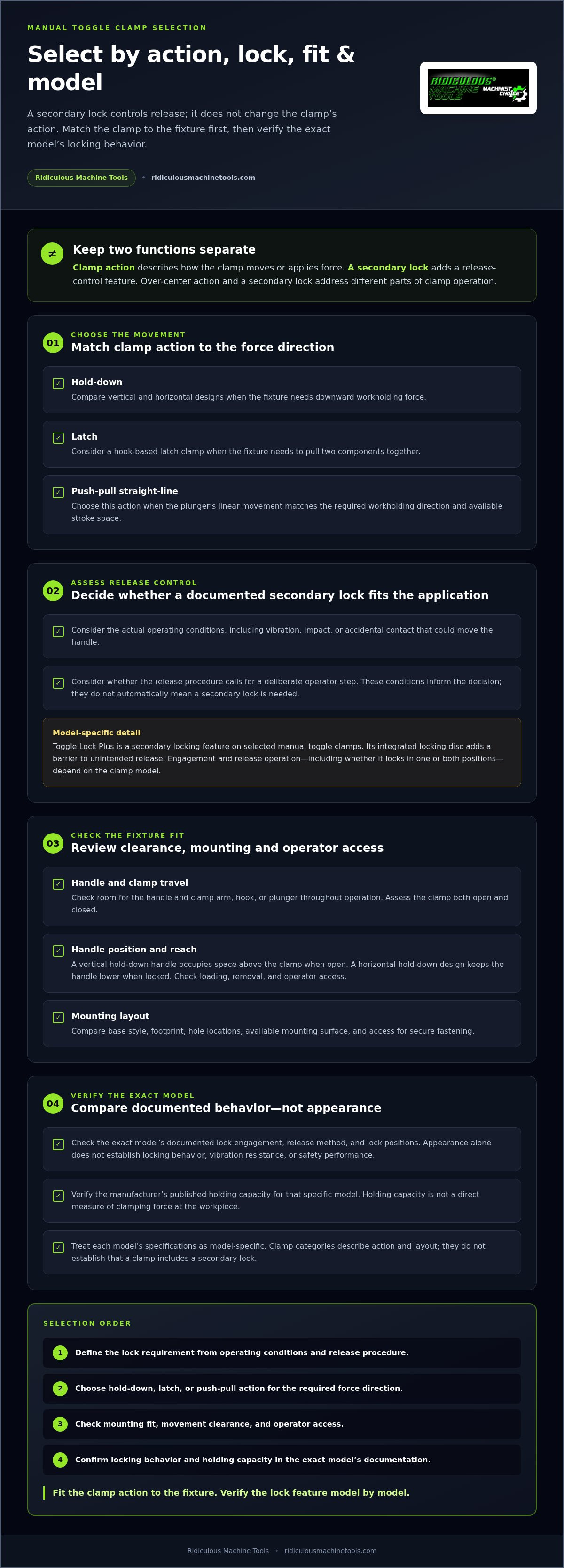
Use this sequence to narrow the options:
- Define the lock requirement. Decide whether the application calls for a documented secondary lock, based on operating conditions and the release procedure.
- Choose the clamp action. Select hold-down, latch, or push-pull straight-line action to match the required force direction and workpiece arrangement.
- Check the fit. Review the base and mounting layout, handle travel, clearance, and operator access with the clamp both open and closed.
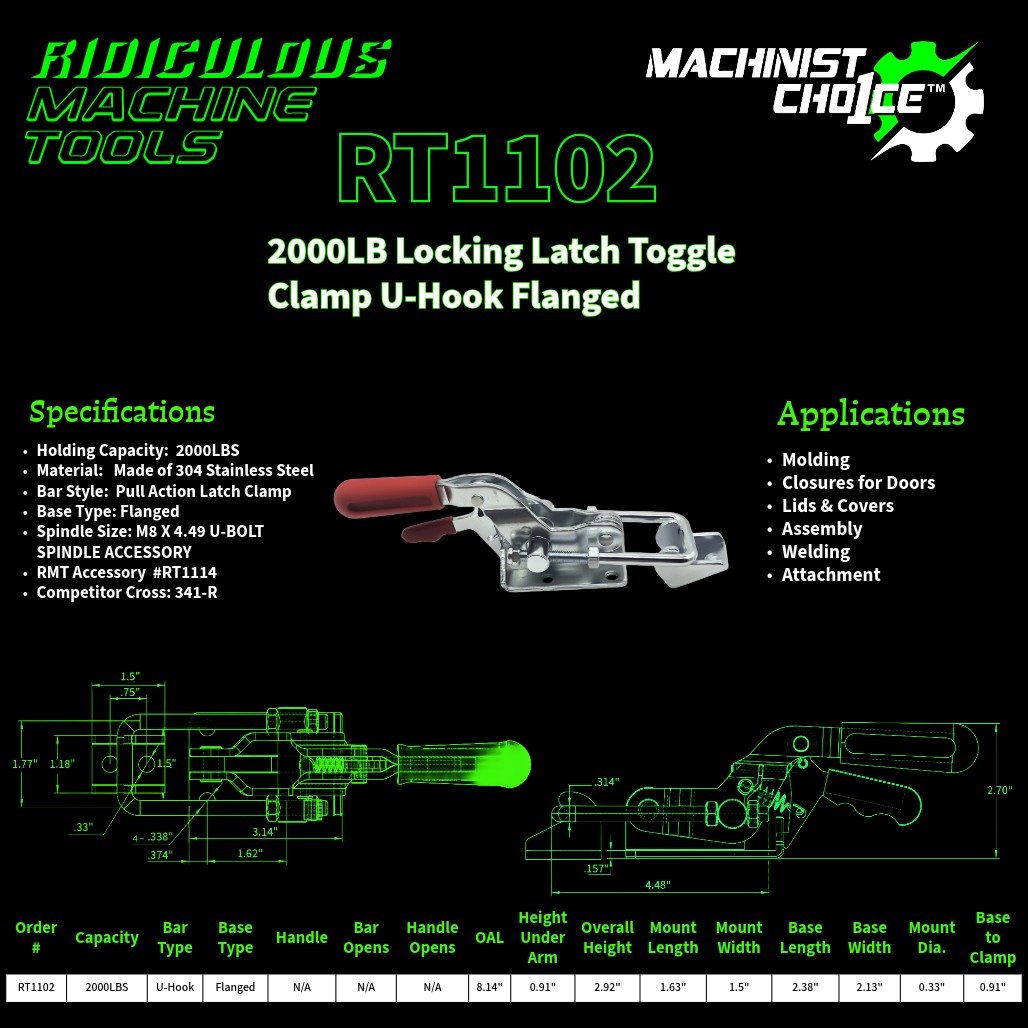
- Verify the exact model. Review its documentation for locking behavior, holding capacity, material, spindle, base style, and mounting details.
Separate requirements from preferences. If the application requires a secondary lock, handle orientation or convenient access does not replace that requirement. If it does not, workflow preferences can help distinguish otherwise suitable clamp geometries. The destaco toggle lock plus vs secondary lock toggle clamp alternatives decision depends on verified locking behavior and fixture fit, not the clamp category name alone.
Ridiculous Machine Tools offers manual toggle clamps in vertical hold-down, horizontal hold-down, latch, and push-pull straight-line configurations. These categories help match clamp action to fixture layout; they do not establish that a model has a secondary lock. Review the individual clamp’s documentation for its features and specifications before selecting it.
Browse manual toggle clamp options by action and configuration, then compare the model details with your application.
Choose the Clamp by Function, Fit, and Verified Features
A sound destaco toggle lock plus vs secondary lock toggle clamp alternatives decision starts by separating the locking feature from the clamp’s action. Decide whether the fixture calls for a documented secondary lock, then select the force direction and geometry. Handle orientation and quick access affect workflow, but do not establish locking capability.
Ridiculous Machine Tools offers horizontal hold-down, vertical hold-down, latch, and push-pull manual toggle-clamp categories for different fixture layouts. Treat these as action and geometry options, not evidence of an equivalent secondary lock. Review the exact model’s documentation for holding capacity, material, spindle, base style, and mounting requirements. Confirm that the clamp clears the workpiece and suits the operator’s loading and release sequence.
Once the lock requirement and fixture fit are defined, compare models using their documented features rather than brand names or appearance. Start with RMT’s manual clamp options:
Choose a configuration that fits the fixture and supports its workholding sequence.
Frequently Asked Questions
What does Toggle Lock Plus do on a manual toggle clamp?
Toggle Lock Plus is DESTACO’s named secondary locking feature on selected manual toggle clamps. DESTACO describes an integrated locking disc that adds resistance to unintended release beyond the clamp’s over-center action. In a destaco toggle lock plus vs secondary lock toggle clamp alternatives comparison, use the exact model’s documentation to determine how the lock engages and releases, and whether it locks in the open position, closed position, or both.
Is over-center locking the same as a secondary lock?
No. Over-center locking refers to the linkage moving past center to resist reversing while engaged. A secondary lock is an additional mechanism intended to help prevent unintended release. They describe different functions. A clamp’s action or over-center linkage alone does not establish that it has a secondary lock. Use the model’s documentation to understand its locking behavior rather than judging by appearance.
Can a horizontal or latch toggle clamp replace a secondary-lock clamp?
It depends on the fixture’s requirements. A horizontal hold-down or latch clamp describes geometry and force application, not lock equivalence. A latch clamp may pull components together; a horizontal hold-down applies downward workholding force with a low-profile handle position. Confirm the exact model’s specifications and locking documentation before treating it as a substitute for a clamp with a secondary lock.
How do I choose a toggle clamp alternative for a fixture?
Start with the application’s locking requirement, then choose the clamp action that matches the force direction. Check the mounting footprint, handle travel, workpiece access, and operator engagement and release sequence. Finally, review the exact model’s holding capacity, material, spindle, base style, and mounting details. Ridiculous Machine Tools offers horizontal, vertical, latch, and push-pull manual toggle-clamp categories for fixture comparisons.
Article by
Ridiculous Machine Tools Technical Team
The Ridiculous Machine Tools Technical Team provides practical information about precision machine tooling, CNC tooling, workholding, and related manufacturing applications. RMT focuses on helping machinists, manufacturers, fabricators, and other customers understand tooling specifications, compatibility, selection, and proper application. Our technical content draws on product specifications, industry knowledge, and RMT's quality-control experience to provide clear, useful information for selecting and using machine tooling and workholding products.
Ridiculous Machine Tools — Machinist's Choice™