
Maximum Stability: The Professional Guide to Horizontal Toggle Clamps (2026)
Posted by RMT on Sep 17th 2026
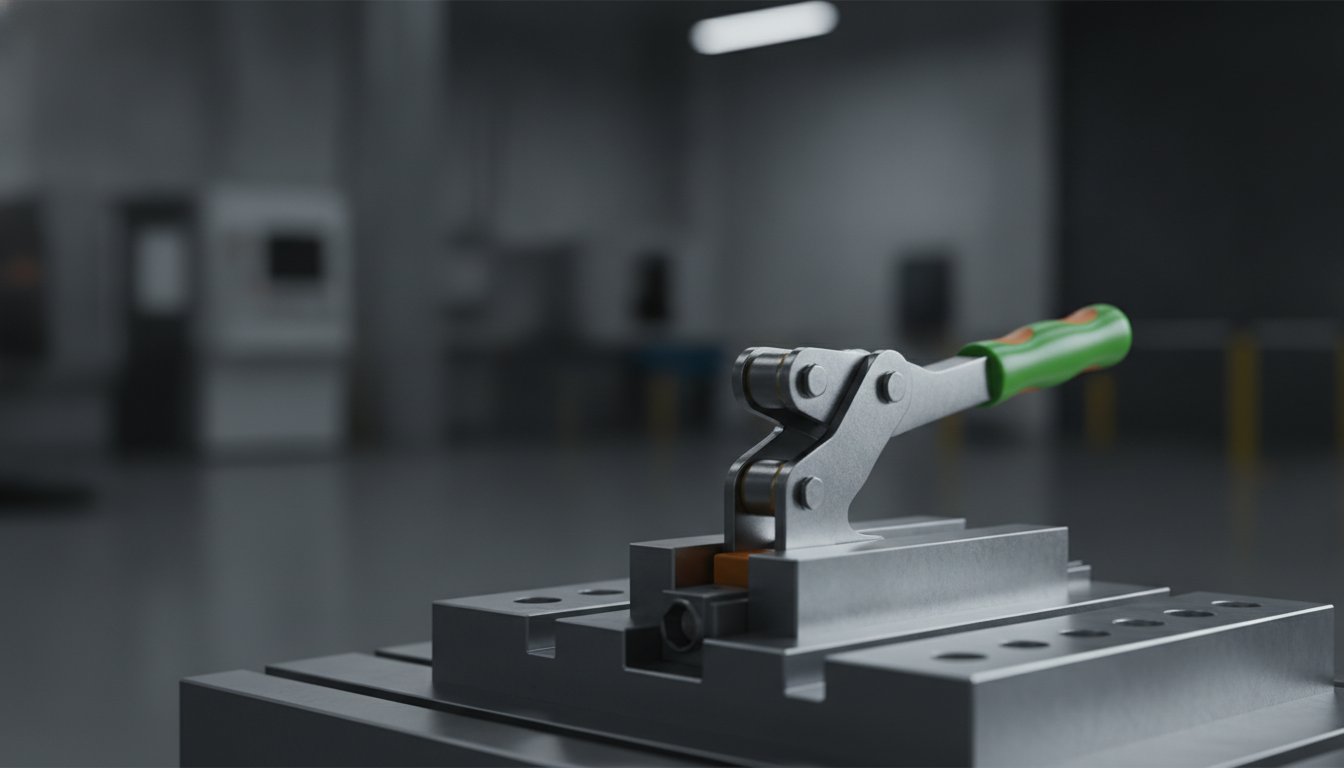
A single collision between a spindle and a vertical clamp handle can scrap a $5,000 workpiece and take a CNC machine offline for days. In high-precision milling, every millimeter of clearance is a tactical advantage. You've likely dealt with the frustration of inconsistent holding force or pivot points that develop slop after just a few thousand cycles. These aren't just minor inconveniences; they're production killers that lead to scrapped parts and wasted uptime. Strategic use of horizontal toggle clamps solves the clearance crisis by locking parallel to the fixture plate, keeping your tool paths clear and your workholding rigid.
You understand that a fixture is only as reliable as its weakest component. This guide moves past basic definitions to help you master the technical selection and industrial application of horizontal clamping systems. We'll break down the 2026 standards for mechanical advantage ratios and explain why your actual clamping force is often only a fraction of the rated holding capacity. You'll learn to optimize spindle positioning for low-profile machining and select hardware that survives high-volume production environments without losing precision. Let's get to work.
Key Takeaways
- Master the over-center locking principle to prevent accidental release and ensure fixture stability during high-resonance machining operations.
- Differentiate between static holding capacity and actual applied force to select the right horizontal toggle clamps for your specific load requirements.
- Optimize CNC tool-path efficiency by utilizing low-profile handle designs that provide maximum spindle and enclosure clearance.
- Apply professional mounting and calibration techniques to maintain rigid fixturing and prevent premature wear on linkage pivot points.
- Integrate high-durability workholding components with precision tool holders to minimize setup times and maximize production uptime.
Understanding Horizontal Toggle Clamp Mechanics and Over-Center Locking
Horizontal toggle clamps are precision-engineered linkage mechanisms built for low-profile workholding. Unlike vertical alternatives, these clamps feature a handle that locks in a position parallel to the mounting base. This specific orientation is a strategic choice for machinists who need to maximize overhead clearance. It's the standard solution for fixtures where tool paths must pass directly over the clamping point without interference.
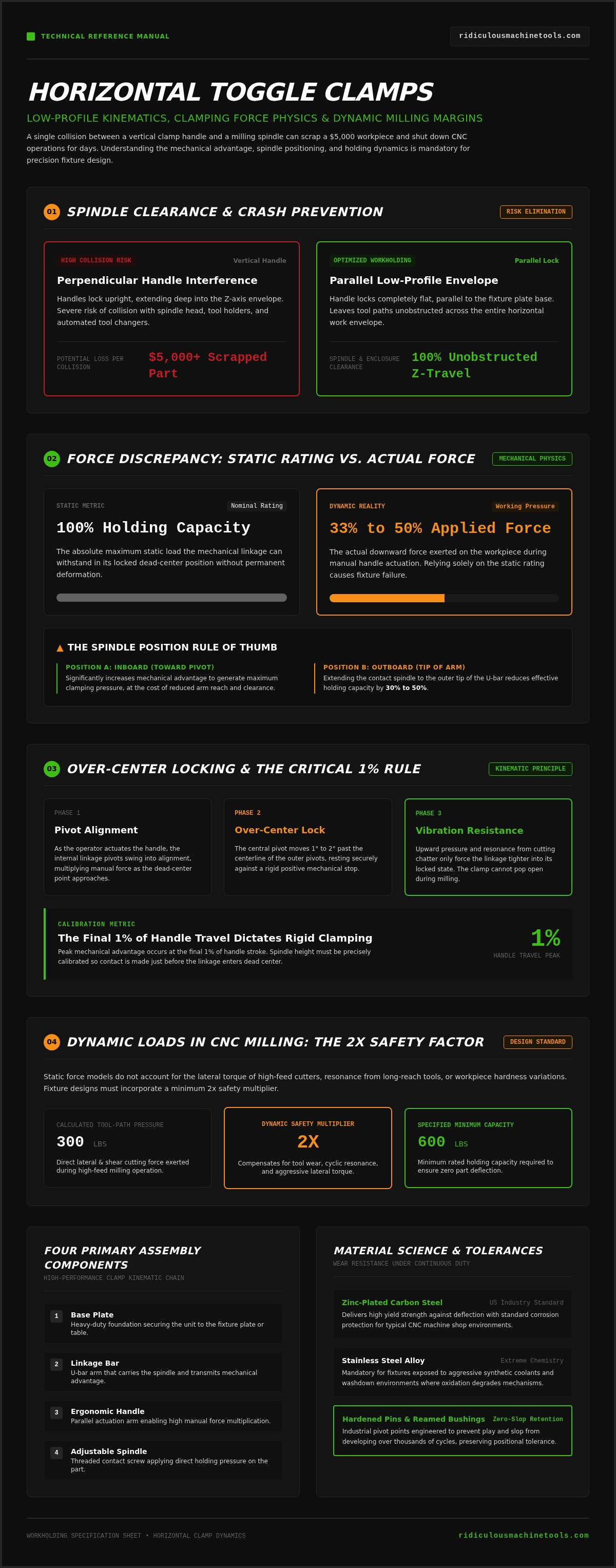
The core of this tool's reliability is the over-center locking principle. As you actuate the handle, the internal linkage pivots align. When the central pivot moves slightly past the centerline of the outer pivots, the clamp reaches its dead-center position. Moving just a degree or two beyond this point locks the mechanism against a positive mechanical stop. This kinematic design ensures that vibration or chatter from the cutting tool won't cause the clamp to pop open. In fact, upward pressure from the workpiece only forces the linkage deeper into its locked state.
A high-performance clamp consists of four primary components:
- Base Plate: The heavy-duty foundation that mounts to your fixture or workbench.
- Linkage Bar: The arm that carries the spindle and transmits the mechanical advantage.
- Handle: The ergonomic grip used to actuate the toggle.
- Spindle: The adjustable contact screw that applies direct pressure to the workpiece.
The Geometry of Low-Profile Workholding
Handle orientation dictates the vertical footprint of your entire setup. By keeping the handle horizontal, you provide the spindle head and tool changer with a clear path. This geometry is critical for modern CNC enclosures where every inch of Z-axis travel matters. Toggle action refers to the rapid multiplication of manual force as the linkage pivots reach their alignment point. This allows an operator to generate hundreds of pounds of downward force with minimal effort.
Material Science: Why Steel Grade Matters
Production environments demand materials that resist deformation. Zinc-plated carbon steel remains the industry standard in US machine shops because it offers high yield strength and reliable corrosion resistance. For operations involving aggressive chemical coolants, stainless steel options provide the necessary longevity. Rigidity depends on the quality of the pivot points. Industrial-grade horizontal toggle clamps feature hardened pins and reamed bushings. These components prevent the linkage from developing slop after thousands of cycles, ensuring your fixture remains repeatable and your parts stay within tolerance.
Calculating Holding Capacity and Clamping Force for Precision Fixtures
Static ratings often mislead inexperienced machinists. It is critical to distinguish between holding capacity and applied clamping force. Holding capacity is the maximum static load the linkage can resist in its locked state without mechanical deformation. Clamping force is the actual pressure the spindle exerts on the workpiece during actuation. In a standard setup, the applied force is typically only 33% to 50% of the rated holding capacity. Relying on the higher static number to secure a part under heavy milling loads is a recipe for fixture failure.
The Spindle Position Rule of Thumb
Spindle placement on the U-bar is your primary variable for force adjustment. Moving the spindle toward the pivot increases the mechanical advantage. This generates higher clamping force but reduces the total stroke and clearance. Moving the spindle to the outer tip of the arm can reduce the effective holding capacity by 30% to 50%. The physics of the final 1% of handle travel dictates your success. This is where the linkage reaches its peak mechanical advantage. You must adjust the spindle height so that it contacts the workpiece just before the linkage reaches the dead-center position.
Dynamic Loads in CNC Milling
Static calculations don't account for the lateral torque of a high-feed mill or the resonant vibration of a long-reach tool. CNC milling introduces dynamic forces that can overcome the friction holding your part. We recommend a 2x safety factor for all precision fixtures. If your tool-path analysis suggests 300 lbs of force is required to resist cutting pressure, specify horizontal toggle clamps rated for at least 600 lbs of holding capacity. This margin handles tool wear and material hardness variations common in 2026 production cycles.
Material selection also dictates your force requirements. Soft aluminum workpieces require neoprene-tipped spindles to prevent marring, but these tips compress and can allow slight part movement. Hardened steel parts demand rigid steel spindles and higher clamping pressures to ensure zero-slip performance. Always match the clamp's output to the yield strength of the workpiece. Over-clamping thin-walled sections can cause elastic deformation, leading to dimensional errors once the part is released from the fixture.
Strategic Selection: Horizontal vs. Vertical and Push-Pull Clamps
Selecting the right workholding tool isn't just about raw force. It's about spatial geometry and tool-path safety. Horizontal toggle clamps are mandatory when working in low-ceiling CNC enclosures or on fixtures where the spindle must travel directly over the clamping points. Vertical toggle clamps provide a tall handle that offers superior manual leverage, but they create a massive "no-fly zone" for your cutting tools. In a high-speed machining environment, a single vertical handle left in the upright position can result in a catastrophic spindle collision.
Setup speeds also vary between these orientations. Horizontal handles allow the operator's hand to remain closer to the fixture plate, which often results in faster part changeovers during high-volume production. However, if your application requires pulling two components together for high-pressure sealing or assembly, latch toggle clamps are the correct choice. These utilize a hook-and-latch system to generate significant tension that a standard hold-down clamp cannot replicate. For lateral pressure requirements, such as pushing a workpiece against a locating fence, push-pull straight line toggle clamps provide a linear stroke that ensures precision alignment without the arc of a traditional toggle arm.
Clearance vs. Leverage: The Trade-off
Horizontal handles excel in vertical clearance but demand more "swing room" on the fixture plate. You must map out the handle travel arc during the design phase to avoid dead zones where handles might collide with adjacent clamps or the workpiece itself. While vertical handles offer better ergonomics for high-repetition manual tasks, the safety of the tool path usually dictates the switch to a horizontal orientation in automated environments. You're trading a small amount of manual leverage for the ability to run more aggressive, low-profile tool paths without the risk of hardware interference.
Application Matching for Modern Shops
Modern shops must match the clamping mechanism to the specific machining task to maintain uptime and part quality. Horizontal clamps are the industry standard for CNC milling, inspection tables, and woodworking jigs where a low vertical profile is non-negotiable. If you need to secure tool holders for maintenance or assembly, integrating these clamps with a universal CNC tightening fixture streamlines the process and ensures repeatable results.
Consider these primary applications when choosing your hardware:
- CNC Milling: Horizontal clamps provide the necessary clearance for 3-axis and 5-axis tool paths.
- Precision Alignment: Push-pull straight line toggle clamps are superior for pushing workpieces into fixed locators.
- Assembly Fixtures: Latch-style clamps provide the tension needed for high-pressure sealing and component joining.
- Inspection and Gauging: Low-profile horizontal designs keep the workpiece accessible for probes and scanning equipment.
Best Practices for Installation and Shop Floor Maintenance
Precision fixturing fails when the foundation is compromised. Rigid mounting is the absolute baseline for maintaining the tight tolerances required in modern production. If the base plate flexes or shifts, your calculated clamping force becomes irrelevant. You must verify that the mounting surface is flat and free of debris before securing any hardware to the fixture plate.
Mounting and Alignment Optimization
Modular fixture plates and T-slot nuts provide the most flexibility for high-mix environments. You must ensure the clamp base sits perfectly parallel to the work surface to avoid side-loading the linkage. Side-loading leads to premature pin elongation and slop in the mechanism, which eventually scraps parts. Industrial fasteners should be torqued to approximately 80% of their yield strength to prevent fixture migration during high-frequency vibration cycles.
Calibrating spindle pressure is a methodical process that requires a feeler gauge or a dedicated force sensor. You want the spindle to contact the part just before the handle reaches its final mechanical stop. Over-tightening leads to workpiece marring or linkage fatigue, while under-tightening allows for part movement under cutting loads. Match your spindle tip to the job. Use neoprene for delicate surfaces and hardened steel for heavy-duty milling where grip is more important than aesthetics.
Routine Maintenance and Safety Protocols
High-cycle industrial environments demand a strict lubrication schedule to prevent pivot point wear. Apply a light coat of molybdenum-based grease to the pivot pins every 50,000 cycles to maintain smooth actuation. Weekly inspections should include a check for loose fasteners and a physical test for linkage play. If the arm can be wiggled more than 0.005 inches when locked, the pivot pins have likely reached their fatigue threshold and the clamp requires replacement.
Ergonomics and Operator Safety
Operator fatigue is a hidden cost in high-volume production. Proper handle positioning reduces the risk of repetitive strain injuries by keeping the actuation force within the operator's natural range of motion. Cushioned, oil-resistant vinyl grips improve tactile feedback and prevent slipping in coolant-heavy environments. Visual cues are equally important. The handle's horizontal position must clearly indicate the locked state so that a supervisor can verify fixture status from a distance. Secure your fixtures with heavy-duty horizontal toggle clamps built for long-term production reliability.
Industrial-Grade Workholding from Ridiculous Machine Tools
Ridiculous Machine Tools serves as the strategic partner for shops that prioritize rigidity and cost-effectiveness. Our inventory of horizontal toggle clamps is engineered for high-cycle fatigue thresholds, using hardened pivot pins and zinc-treated carbon steel. We don't sell marketing narratives; we sell industrial-grade components that keep your machines running. By removing the traditional distributor markup, we provide high-end hardware at prices that respect your bottom line.
The Full Precision Ecosystem
Workholding doesn't exist in a vacuum. A stable fixture requires a synergy between the clamp and the spindle. Our horizontal toggle clamps pair perfectly with our high-precision ER spring collets and ER collet chucks to ensure total system accuracy. If your setup requires modular flexibility, our Morse & Jacobs taper adapters and universal CNC tightening fixtures allow for rapid tool changes and repeatable clamping pressure. This integrated approach minimizes the variables that lead to scrapped parts.
Our components are built for the aggressive production schedules of 2026. We focus on the utility of the offering, providing specialized hardware like steel sealed ER spring collets and tap collets to round out your tooling inventory. This breadth of scale allows you to source your entire workholding and tool-holding package from a single, reliable supplier. You get the performance of premium brands without the inflated overhead.
Order with Confidence
Efficiency in procurement is just as important as efficiency on the shop floor. We provide direct-to-customer shipping across the United States to ensure your production lines stay active. Our team understands the practical needs of a workshop and provides direct technical support for your most demanding fixturing challenges. We act as a disruptive supplier for those who value performance over pretense.
Your 2026 shop upgrades require hardware that survives the rigors of high-volume machining. Browse our full range of Horizontal Toggle Clamps to find the exact holding capacity and profile your next project demands. Secure your work, protect your tools, and maximize your uptime with components built for the trade.
Optimize Your Workholding for 2026 Production
Mastering the physics of over-center locking and the geometry of low-profile setups isn't just an engineering exercise. It's a requirement for shops that demand zero-slip performance and maximum tool clearance. Technical expertise in calculating dynamic clamping force ensures your fixtures withstand the rigors of high-speed milling. By prioritizing low-profile mechanisms, you eliminate the risk of spindle collisions and maximize your machine's Z-axis envelope. Consistent maintenance and precise spindle calibration are the final steps in protecting your workpiece and your equipment.
Rigidity is the foundation of every successful setup. Ridiculous Machine Tools provides the heavy-duty hardware you need to maintain that foundation. Our inventory features professional-grade holding capacities up to 1,200 lbs and durable zinc-plated carbon steel construction. We focus on the utility of the equipment and the speed of your procurement. With fast national shipping across the US, we ensure your shop stays equipped for high-volume production cycles. Don't let inferior hardware compromise your precision or your uptime. Secure your setup with Ridiculous Machine Tools Horizontal Toggle Clamps and drive your production efficiency forward.
Frequently Asked Questions
How do I calculate the holding capacity needed for my fixture?
Calculate your forces first by using a safety factor of at least 2x the anticipated cutting load. Holding capacity refers to the static limit, but your applied force is typically only 33% to 50% of that rating. Consider the lateral torque of your end mills and the resonant vibration of the setup. It's better to over-specify than to risk a part shifting during a high-feed operation.
What is the difference between a U-bar and a solid bar horizontal clamp?
U-bars feature a slotted arm that allows the spindle to slide for adjustable positioning. This versatility makes them the standard for general-purpose fixtures. Solid bars offer superior structural rigidity for heavy-duty milling but require a fixed spindle location. Most horizontal toggle clamps in precision shops use the U-bar design to accommodate varying workpiece dimensions without rebuilding the entire fixture plate.
Can horizontal toggle clamps be used for welding applications?
They're highly effective for welding when equipped with spatter-resistant finishes. The low-profile handle stays out of the way of the welding torch and provides clear sightlines for the operator. You must ensure the pivot points remain clean and lubricated. Use models with oil-resistant grips to prevent handle degradation if the clamp is exposed to welding fumes or heat-sink compounds.
How do I adjust the clamping pressure on a horizontal toggle clamp?
You adjust pressure by turning the hex nuts on the threaded spindle rod. Lowering the spindle toward the workpiece increases the compression force when the handle is actuated. The goal is to have the spindle contact the part just before the linkage hits the mechanical stop. This timing utilizes the peak mechanical advantage of the toggle action for maximum rigidity and stability.
What are the advantages of stainless steel clamps over zinc-plated steel?
Stainless steel provides the best corrosion resistance for shops using aggressive water-based coolants or operating in high-humidity zones. Zinc-plated carbon steel is the standard for most US machine shops because it offers exceptional yield strength at a lower cost. Choose stainless for food-grade environments or surgical component manufacturing where rust is a non-negotiable failure point in the production process.
How often should I lubricate my toggle clamps in a production environment?
Lubricate all pivot pins every 50,000 cycles using a high-quality molybdenum grease. In a high-speed production cell, this might require a weekly maintenance interval. Proper lubrication reduces friction and prevents the pivot holes from elongating over time. If you ignore this schedule, the mechanism will develop slop, which compromises the repeatability of your fixture and leads to scrapped parts.
What happens if a toggle clamp is overloaded beyond its capacity?
Overloading leads to permanent deformation of the linkage bars or the pivot pins. This damage manifests as slop in the mechanism, meaning the clamp no longer holds the part securely in the locked position. Once the linkage is bent or the pins are elongated, the clamp's holding capacity is compromised. You must replace the unit immediately to avoid fixture failure and potential spindle damage.
Are there automatic or pneumatic versions of horizontal toggle clamps?
Pneumatic versions are the standard for automated production lines and high-volume CNC cells. These units use air cylinders to actuate the linkage, allowing for PLC-controlled clamping sequences. They provide consistent, repeatable pressure that manual handles can't always match. While manual horizontal toggle clamps are better for low-volume setups, pneumatic models are the preferred choice for maximizing uptime in automated environments.