
Carter vs. Destaco Toggle Clamps for Wood Jigs
Posted by RMT on Oct 10th 2026
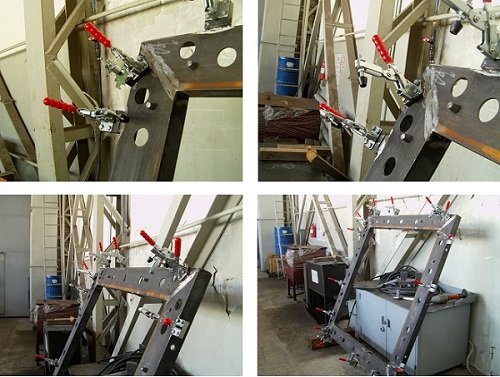
Brand names don't establish fixture fit. Start with an accurate comparison: Carter Products does not manufacture manual toggle clamps, while DESTACO does. The selection criteria remain the same: match a specific clamp model to the fixture and operation.
A published holding capacity is not the same as clamping force, and neither figure alone confirms whether the clamp’s linkage, handle position, base footprint, and mounting arrangement suit the setup. Those details affect workpiece access, tool-path clearance, and loading.
This article explains how to compare verified model specifications with fixture demands instead of relying on brand reputation. It also covers clamp geometry and points to RMT’s horizontal, vertical, latch, and push-pull manual toggle clamp categories for further evaluation.
Key Takeaways
- Correct the brand comparison first: Carter Products does not make manual toggle clamps, so compare verified DESTACO models with relevant alternatives.
- For good hand toggle clamps vs destaco for machining fixtures, judge each model by its published specifications and fit, not its brand name alone.
- Match clamp motion and mounting orientation to the workpiece, then check handle and clamp clearance against tool paths.
- Separate stated holding capacity from clamping force, and compare equivalent clamp styles before choosing a model.
What makes a hand toggle clamp a good fit for a machining fixture?
A manual toggle clamp uses a hand-operated lever and linked arms to move a contact pad, hook, or plunger into position and hold a workpiece or fixture component. Its geometry and mounting matter as much as its stated capacity. A toggle clamp can speed repeat loading, but a machining fixture must also locate the part and manage cutting loads through suitable supports and contact points.
A woodworking jig or assembly setup may face different forces and access constraints than a machining fixture. Cutting forces, tool approach, chip flow, and coolant can affect whether a clamp’s position is workable. For good hand toggle clamps vs destaco for machining fixtures, compare actual models and current manufacturer documentation, not labels or brand reputation. Carter Products does not make manual toggle clamps, so a direct Carter-versus-DESTACO model comparison is not available.
What the clamp must do in the fixture
Start with the workpiece contact point, the direction the clamp must move, and the space available for its base and handle. Identify where the part is located and supported; the clamp should secure it without blocking the cutter, loading surface, or chip evacuation path. Repeatable loading also depends on a consistent locating scheme, not clamp pressure alone.
Keep holding capacity distinct from clamping force. Capacity is the manufacturer’s stated maximum holding figure; clamping force is the force applied to the workpiece. Neither number alone establishes suitability for machining loads. A woodworking jig and a machining fixture have different operating demands, so assess the complete setup and load path.
How toggle linkage affects operation
In an over-center linkage, the mechanism passes center at the locked position, helping resist unintended release when properly engaged. The linkage also provides mechanical advantage, translating handle input into clamp motion and force. The amount depends on the model and setup, so use published model data rather than assuming a value.
Check handle travel in both open and locked positions. A handle that clears the operator’s hand may still obstruct the tool path, workpiece loading, or nearby fixture hardware. Compare mounting geometry and contact hardware in the applicable documentation. RMT’s manual toggle clamp categories include different styles for evaluating against fixture layout.
Carter Products vs. DESTACO toggle clamps: compare models, not labels
A model-by-model comparison starts with a correction: Carter Products does not manufacture or sell manual toggle clamps, so there are no Carter clamp models to compare with industry alternatives. The available examples below show why style and published capacity must be recorded alongside mounting and contact details. Treat those final fit checks as unresolved until you review the current manufacturer drawing.
| Manufacturer and model | Clamp style | Stated holding capacity | Mounting pattern | Contact hardware |
|---|---|---|---|---|
| Carter Products | No manual toggle clamp line | Not applicable | Not applicable | Not applicable |
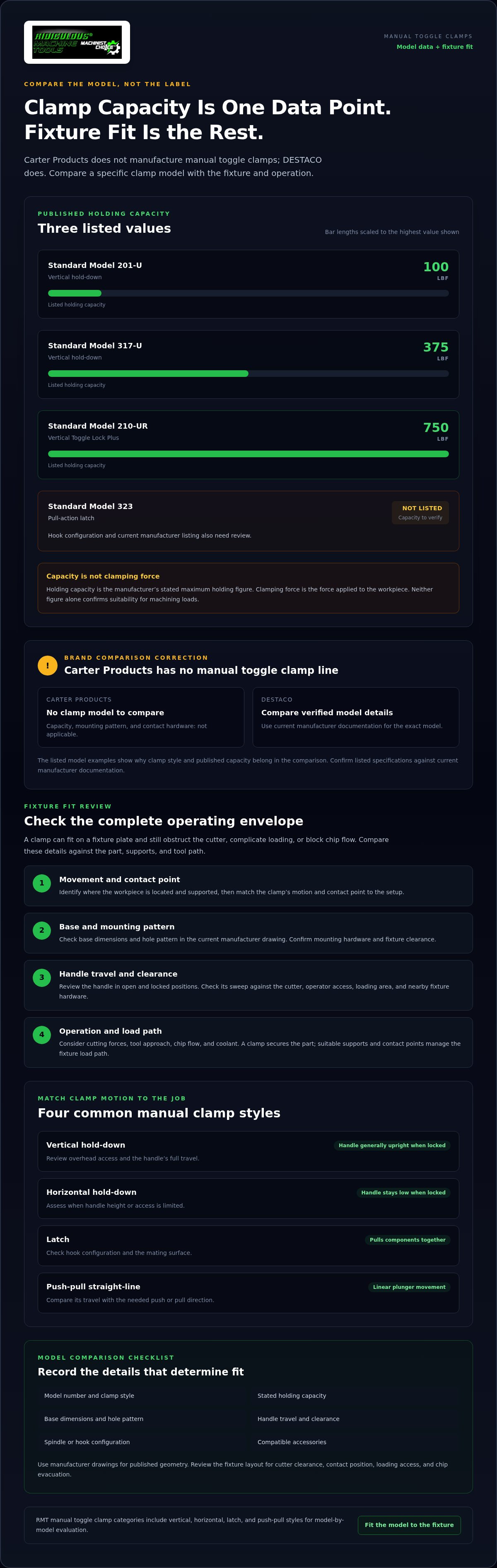
| Standard Model 201-U | Vertical hold-down | 100 lbf | Verify current manufacturer drawing | Verify model configuration |
| Standard Model 317-U | Vertical hold-down | 375 lbf | Verify current manufacturer drawing | Verify model configuration |
| Standard Model 210-UR | Vertical Toggle Lock Plus | 750 lbf | Verify current manufacturer drawing | Verify model configuration |
| Standard Model 323 | Pull-action latch | Verify current listing | Verify current manufacturer drawing | Verify hook configuration |
Capacities shown are from the available product listings; confirm them against current manufacturer documentation before selection. Holding capacity is not clamping force. The latch and vertical hold-down models also apply force through different motions, so their figures do not make them direct substitutes.
Which model details belong in the comparison?
Record the model number, clamp style, stated holding capacity, base dimensions and hole pattern, handle travel, spindle or hook configuration, and compatible accessories. Separate published data from layout observations: a drawing establishes geometry, while a fixture review determines whether the handle clears the cutter, the contact point suits the part, and chips can escape. Types of toggle clamps illustrate how linkage styles differ.
Do brand names settle the choice?
No. For good hand toggle clamps vs destaco for machining fixtures, compare equivalent motions and configurations against the actual fixture. Ridiculous Machine Tools' manual toggle clamp options provide another category to assess by model specifications and mounting fit, not brand claims.
Match clamp style, capacity, and mounting to the fixture
Work through selection in order: define the operation, choose the clamp motion, check the full operating envelope, then verify the exact model specifications. A clamp that fits on the fixture plate can still block a cutter, complicate loading, or leave fasteners inaccessible.
Choose clamp motion for the setup
Vertical hold-down clamps place the handle generally upright when locked; horizontal hold-down clamps keep it low and generally horizontal. If overhead clearance or operator access is tight, compare the locked handle position and full handle sweep. RMT’s horizontal manual toggle clamps are one category to assess when a low-profile handle position matters.
A latch clamp pulls two components together, which can suit a fixture component that closes against a mating surface. A push-pull straight-line clamp moves a plunger linearly for applications requiring direct pushing or pulling. Match the action to the required movement, then check that mounting hardware, contact points, and clamp travel fit the fixture layout.
Verify capacity and fixture integration
Compare the manufacturer’s stated holding capacity for the exact model and configuration. Don’t treat that value as clamping force: holding capacity is a published maximum holding figure, while clamping force is what the clamp applies to the workpiece. Neither figure alone confirms machining suitability.
Review the mounting footprint, hole pattern, fastener access, contact point, and any spindle, hook, or pad configuration. Then consider how the fixture locates and supports the workpiece and resists expected operation forces. Select a clamp by model data and setup fit, and assess the complete fixture using sound engineering judgment.
Compare manual toggle clamp styles
Choose a manual toggle clamp category for your fixture
Choose by required clamp motion, mounting arrangement, available clearance, and the exact model’s documented holding capacity. A vertical hold-down may fit a fixture with room for an upright locked handle; a horizontal hold-down may suit a layout with limited overhead clearance. Check the model drawing and specifications against the fixture before selecting.
Find the clamp style that matches the movement
Compare RMT’s manual vertical toggle clamps when vertical hold-down geometry suits the setup. If handle position drives the decision, review the horizontal category. A latch clamp may suit a component that closes against a mating surface, while a push-pull straight-line clamp provides linear plunger movement. Confirm the exact model configuration and fit for your application.
Move from comparison to a model decision
Use current manufacturer information to compare clamp style, holding capacity, mounting pattern, dimensions, contact hardware, and handle travel. Then check the selected configuration against fixture supports and the operation. RMT offers horizontal, vertical, latch, and push-pull manual toggle clamps; specifications vary by model, so evaluate the product details against your setup rather than relying on a category label alone.
Review RMT manual toggle clamps
Choose by fixture fit, then compare the model
A useful comparison starts with the right candidates: Carter Products does not sell manual toggle clamps, so there are no Carter clamp models to match against DESTACO. For good hand toggle clamps vs destaco for machining fixtures, focus on equivalent clamp motions, mounting geometry, clearance, and current model specifications. Treat published holding capacity as one comparison point, not proof that a clamp suits a machining load or replaces sound fixture design.
RMT offers horizontal, vertical, latch, and push-pull manual toggle clamp categories. Specifications vary by model, so compare the applicable product information against your fixture’s contact point, motion, mounting space, and operation. That keeps the decision tied to setup requirements rather than brand reputation.
With the fixture demands clearly defined, you can narrow the options and make a more informed clamp selection.
Frequently Asked Questions
Are DESTACO toggle clamps better than Carter Products clamps?
There are no Carter Products manual toggle clamp models to compare because Carter Products does not manufacture or sell this product line. So a direct brand ranking, including for good hand toggle clamps vs destaco for machining fixtures, isn't supported. Compare actual models from manufacturers that sell toggle clamps, matching clamp style and reviewing current specifications for capacity, mounting dimensions, contact hardware, and handle clearance.
Can a hand toggle clamp hold a workpiece during machining?
A manual toggle clamp can be part of a machining fixture, but the complete setup must suit the operation. Review the exact model’s stated holding capacity, then assess how the fixture locates and supports the workpiece and resists expected machining forces. A capacity label alone doesn’t establish suitability. Consider the clamp’s contact point, mounting, and position relative to the tool path.
What is the difference between holding capacity and clamping force?
Holding capacity is the manufacturer’s stated maximum holding force or capacity for a clamp. Clamping force is the force the clamp applies to the workpiece during clamping. The terms are related, but they don’t automatically describe the same measurement. Use the definitions and test conditions in each model’s documentation, and avoid comparing figures unless they refer to equivalent measurements.
How do I choose between horizontal and vertical hold-down toggle clamps?
Choose based on available space, handle position, workpiece access, and loading direction. A horizontal hold-down clamp keeps its handle generally low-profile when locked; a vertical hold-down clamp has a generally vertical handle in the locked position. Check the specific model’s dimensions, mounting arrangement, handle travel, and published holding capacity against the fixture layout before selecting a clamp.
Article by
Ridiculous Machine Tools Technical Team
The Ridiculous Machine Tools Technical Team provides practical information about precision machine tooling, CNC tooling, workholding, and related manufacturing applications. RMT focuses on helping machinists, manufacturers, fabricators, and other customers understand tooling specifications, compatibility, selection, and proper application. Our technical content draws on product specifications, industry knowledge, and RMT's quality-control experience to provide clear, useful information for selecting and using machine tooling and workholding products.
Ridiculous Machine Tools — Machinist's Choice™