Carr Lane vs. Destaco 331 Latch Clamps Compared
Posted by RMT on Oct 13th 2026
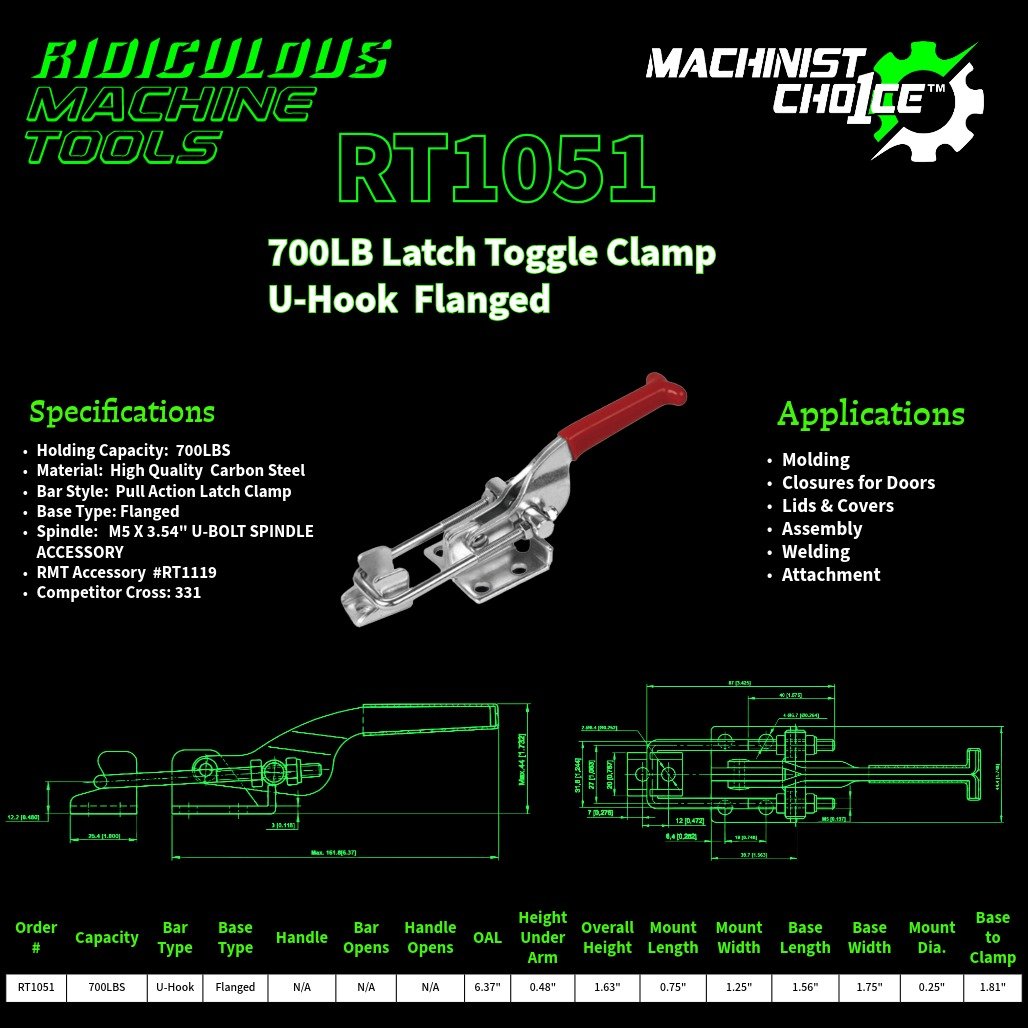
A clamp with the same published holding capacity can still be the wrong replacement. Hook reach, latch engagement, and mounting geometry determine whether it fits and closes correctly.
Comparing manual pull-action clamps with standard 331 series pull-action clamps means looking beyond brand names and matching ratings. Similar industrial models are both listed at 700 lbf holding capacity, but that alone doesn’t establish equivalent geometry or interchangeability.
This comparison examines pull action, hook adjustment, drawing movement, mounting, and clearance. It also explains how higher-capacity options differ from a direct capacity match, and what to check against your fixture before selecting a latch clamp.
Key Takeaways
- In carr lane latch clamps vs destaco 331 series pull action clamps, compare exact models and manufacturer drawings rather than assuming similarly named clamps are interchangeable.
- Match the hook’s engagement and reach to the fixture, then check mounting pattern, closed position, and handle clearance.
- Distinguish published holding capacity from clamping force, and compare ratings only in the context of each model’s specifications.
- Use the fixture’s operating requirements to narrow the choice; Ridiculous Machine Tools offers latch toggle clamps in multiple configurations.
Carr Lane Latch Clamps vs. DESTACO 331: What Is Being Compared?
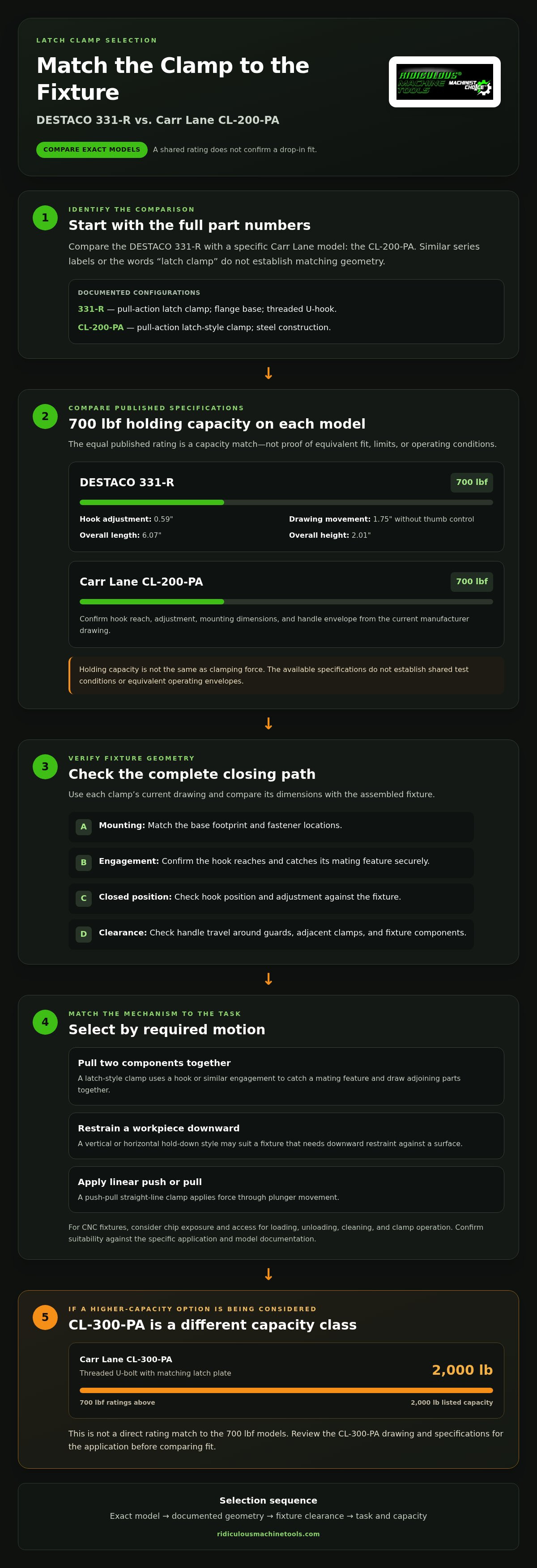
The useful comparison is between the DESTACO 331-R and a specific Carr Lane model, not between brand names or loosely matched series labels. Based on published holding capacity, Carr Lane’s CL-200-PA is a relevant comparator: both models are listed at 700 lbf. That shared rating does not establish that the clamps have the same geometry or can replace one another in a fixture.
Latch action and pull-action terminology
A latch toggle clamp uses a linkage and an engaging component, such as a hook, to pull two parts together and hold them closed. “Pull-action” describes the force direction or operating function; it doesn’t mean two manufacturers use identical linkages. DESTACO identifies the 331-R as a pull-action latch clamp with a threaded U-hook. Carr Lane identifies the CL-200-PA as a pull-action latch-style clamp. Don’t assume the Carr Lane model has the same hook arrangement based on that description alone. For a general overview of the tool category, see this Toggle clamp reference.
Identify exact models before comparing
Record the full part number and configuration, then use the current manufacturer drawing and specification sheet. The “331” designation here refers to DESTACO’s 331-R model; avoid calling it part of a “300 Series” unless DESTACO’s current documentation explicitly establishes that grouping. Carr Lane’s CL-200-PA is a model designation, not a Carr Lane “331” series. Similar numbers or the phrase “latch clamp” aren’t evidence of a series relationship.
Keep the comparison tied to documented features: the 331-R’s threaded U-hook, the CL-200-PA’s stated pull-action latch style, and each model’s published capacity. For other Carr Lane configurations, such as the CL-300-PA, compare that exact model separately. Ridiculous Machine Tools also offers manual latch toggle clamps in multiple configurations, with specifications that vary by model.
Compare Clamp Geometry, Mounting, and Verified Specifications
For carr lane latch clamps vs destaco 331 series pull action clamps, published ratings are only one part of the comparison. The specifications below identify what can be compared directly and what needs to be checked on each manufacturer’s current drawing.
| Model | Operating type and configuration | Published holding capacity | Verified geometry details |
|---|---|---|---|
| DESTACO 331-R | Pull-action latch clamp; flange base; threaded U-hook | 700 lbf | Hook adjustment: 0.59"; drawing movement: 1.75" without thumb control; overall length: 6.07"; overall height: 2.01" |
| Carr Lane CL-200-PA | Pull-action latch style; steel construction | 700 lbf | Hook reach, adjustment, mounting dimensions, and handle envelope require confirmation from its current drawing |
Fixture fit and operating clearance
Equal published holding capacity does not establish a drop-in fit. Compare base footprint and fastener locations, then check hook engagement and closed position against the fixture drawing. The 331-R’s listed hook adjustment and drawing movement are useful dimensions, but they don’t establish the CL-200-PA’s corresponding reach. Confirm handle travel and clearance from guards, adjacent clamps, and fixture components before substitution.
Capacity, materials, and operating limits
Both listed models have a 700 lbf holding capacity, and the CL-200-PA is specified as steel; DESTACO lists the 331-R as steel. Treat these as model-specific published ratings, not as clamping-force values or proof of identical limits. The available specifications here don’t establish shared test conditions, mounting patterns, or equivalent operating envelopes.
For a higher-capacity Carr Lane comparison, the CL-300-PA is listed at 2,000 lb, with a threaded U-bolt and matching latch plate. It is a different capacity class, not a direct rating match. Review the applicable drawing and specifications, or compare available latch toggle clamps by their model-specific fit and capacity.
Select for the Workholding Task, Not the Brand Label
Choose a clamp in sequence: define the motion the fixture needs, check the clamp’s geometry against the assembly, then verify the model’s published specifications. That process keeps carr lane latch clamps vs destaco 331 series pull action clamps focused on application fit rather than treating a familiar brand or capacity rating as a complete selection decision.
- Define the task: Must the clamp pull two components together, hold a lid or cover shut, or press a workpiece down against a fixture?
- Check geometry: Confirm the hook or contact point reaches and engages correctly through the full operating stroke.
- Verify conditions: Review capacity, adjustment, mounting, cycle frequency, and clearance for the actual setup.
When a latch-style clamp fits the fixture
A latch clamp suits an arrangement where a hook or similar engagement catches a mating plate or feature and draws adjoining components together. The fixture must give the hook a clear path and a secure engagement point. Check latch-plate position, hook reach, closed position, and adjustment against the assembled parts, not just the clamp’s catalog dimensions.
For CNC fixtures, also consider chip exposure and access for loading, unloading, cleaning, and clamp operation. These factors help identify possible interference or maintenance issues; they don’t establish suitability without checking the specific application and model documentation.
When a different toggle-clamp style may fit better
If the job needs downward restraint against a fixture surface, a vertical or horizontal hold-down style may align better with the required force direction. A push-pull straight-line clamp applies force through plunger movement, which may fit a linear pushing or pulling task. Handle position, operator access, and cycle frequency can help distinguish between these mechanisms.
For a broader look at low-profile handle arrangements and related designs, see the horizontal toggle-clamp guide.
Compare manual latch toggle clamp configurations
Choose a Verified Model and Find a Relevant Latch-Clamp Option
A useful carr lane latch clamps vs destaco 331 series pull action clamps comparison ends with a fixture-fit decision, not a brand ranking. Before ordering or replacing a clamp, record the full part number and configuration, then check the current manufacturer drawing and specification sheet. If documents use different terms or show conflicting details, compare the current model-specific sources rather than assuming the specifications are equivalent.
A final model-selection checklist
- Exact model: Confirm the complete part number and configuration, including any hook or safety-lock variant.
- Drawing: Check the clamp and mating latch plate dimensions in their intended positions.
- Mounting: Match the base footprint and fastener locations to the fixture.
- Engagement: Verify that the hook reaches and seats correctly through the operating stroke.
- Capacity: Record the manufacturer’s holding-capacity rating and its stated conditions. Don’t treat it as clamping force.
- Clearance: Confirm handle travel and access around nearby fixture components.
Mark any unavailable specification as unknown. Don’t substitute a typical value or infer a dimension from a similar model. For broader context on manual clamp types and fixture selection, review Ridiculous Machine Tools’ manual toggle clamp options.
Ridiculous Machine Tools offers manual latch toggle clamps in multiple configurations. Model specifications vary, so use the applicable product details to compare fit and requirements for your fixture.
Explore manual latch toggle clamps
Make the Clamp Choice Fit the Fixture
The practical takeaway from carr lane latch clamps vs destaco 331 series pull action clamps is to compare exact models, drawings, engagement geometry, mounting, operating clearance, and published capacity. Similar holding-capacity ratings can help identify a comparison point, but they don’t prove that clamps share a mounting pattern, hook reach, or replacement fit.
Start with the fixture’s job. A latch clamp must engage its mating feature and close with adequate clearance. Then verify the model-specific manufacturer documentation, keeping unknown dimensions or test conditions distinct instead of filling gaps with assumptions.
Ridiculous Machine Tools offers manual latch toggle clamps in multiple configurations. Product specifications and Ridiculous Machine Tools' USA-based quality control and inspection are tied to each product’s stated requirements, so compare the applicable product details with your fixture needs before selecting a model.
Review Ridiculous Machine Tools latch toggle clamps
With the model and geometry verified, you can move forward with a clearer basis for selecting a clamp that fits the workholding task.
Frequently Asked Questions
Are Carr Lane latch clamps and DESTACO 331 pull-action clamps interchangeable?
Not based on similar operating type or matching published capacity alone. Interchangeability depends on the exact models and whether base mounting, hook reach, engagement, closed position, latch plate, and handle clearance suit the fixture. For carr lane latch clamps vs destaco 331 series pull action clamps, compare current manufacturer drawings before treating one as a replacement. A clamp may mount in place but still miss its latch plate or interfere with nearby hardware.
What should I compare between a Carr Lane latch clamp and a DESTACO 331?
Compare complete part numbers, operating type, base dimensions and hole locations, hook configuration and adjustment, drawing movement, closed position, and handle travel. Then review each model’s published holding capacity, material, safety features, and any stated rating conditions. Similar terminology can describe related functions without confirming identical geometry. Keep unlisted or non-equivalent details marked as unknown rather than filling gaps with specifications from another model.
Does holding capacity mean the same thing as clamping force?
No. Holding capacity is the manufacturer’s stated maximum holding force or capacity for a clamp. Clamping force is the force applied to the workpiece during clamping. Don’t treat these terms as interchangeable or assume a capacity rating tells you the force acting on a particular part in a specific setup. Use each term as the manufacturer defines it, and consider the application and stated conditions.
How do I know whether a latch clamp fits my fixture?
Check the clamp against the fixture drawing and mating parts. Confirm that the base and fastener locations fit, the hook reaches and engages the latch plate, and the clamp closes in the intended position. Check the full operating path for handle clearance, including adjacent clamps, guards, and workpiece access. On CNC fixtures, also consider chip exposure and access for loading, cleaning, and operation.
What latch-clamp options does Ridiculous Machine Tools offer?
Ridiculous Machine Tools offers manual latch toggle clamps in multiple configurations. Specifications vary by model, so compare the applicable product details for configuration, mounting, engagement, and holding capacity against your fixture requirements. RMT’s USA-based quality control and inspection are conducted according to each product’s stated specifications. That quality control does not, by itself, establish where a product was manufactured.
Article by
Ridiculous Machine Tools Technical Team
The Ridiculous Machine Tools Technical Team provides practical information about precision machine tooling, CNC tooling, workholding, and related manufacturing applications. RMT focuses on helping machinists, manufacturers, fabricators, and other customers understand tooling specifications, compatibility, selection, and proper application. Our technical content draws on product specifications, industry knowledge, and RMT's quality-control experience to provide clear, useful information for selecting and using machine tooling and workholding products.
Ridiculous Machine Tools — Machinist's Choice™