
Lever Clamps: When to Use Them vs Toggle Clamps
Posted by RMT on Sep 29th 2026
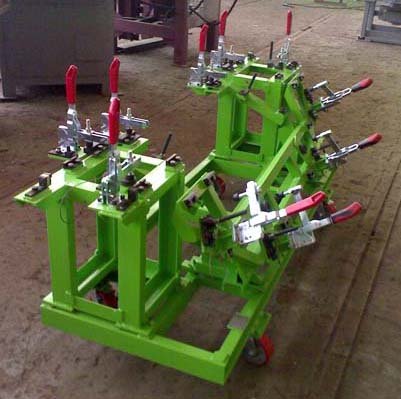
The label “lever clamp” doesn’t tell you enough to choose the right workholding hardware. Product listings may use it broadly, while a toggle clamp is one specific lever-operated mechanism. That distinction matters: a basic lever or strap clamp applies force through its lever geometry, while a toggle clamp uses linked pivots that pass over center to stay locked without continuous pressure on the handle. The movement, locking action, and fixture layout determine which design fits.
This comparison explains how the terms relate, what vertical and horizontal hold-down, latch, and push-pull toggle clamps do, and when another lever-operated clamp may be more appropriate. It also covers how to assess the workpiece, mounting clearance, force direction, and operating cycle. Because capacity and other specifications depend on the model, check the product information for the specific clamp instead of relying on a broad category label.
Key Takeaways
- Interpret “lever clamp” in context. The label alone may not identify how the clamp locks or restrains a workpiece.
- Check whether the clamp uses direct lever action or a toggle linkage that locks over center.
- Match clamp motion and force direction to fixture clearance, mounting pattern, and operator access.
- Compare manual toggle clamp types, then verify the model’s holding capacity and mounting details on its product page.
What Does “Lever Clamp” Mean in Workholding?
“Lever clamp” is a broad label, not a reliable description of one specific mechanism. Suppliers may use it for different devices that use a handle or lever to apply force. A clamp is generally a fastening device that holds or secures a workpiece, but the lever alone doesn’t explain how the clamp moves, locks, or contacts the part.
Look at the clamp’s working elements: the handle provides operator input, the linkage transfers that motion, the contact point applies force to the workpiece, and the base mounts the assembly to a fixture or surface. A lever may move a strap, drive a plunger, or operate a toggle linkage. These arrangements differ in movement and locking action, even when listings use similar names.
For selection, compare the mechanism and model specifications rather than relying on the label. Check the direction of restraint, mounting pattern, available clearance, contact arrangement, and manufacturer-stated holding capacity. Together, these details show whether the clamp fits the fixture and task. Ridiculous Machine Tools lists several manual toggle clamp types, with specifications varying by model.
Is a lever clamp the same as a toggle clamp?
Sometimes the terms overlap. A toggle clamp is operated by a lever, but its linkage passes over center to resist unintended release when properly engaged. Other lever-operated clamps may not use that linkage or lock in the same way. “Toggle clamp” identifies a mechanism more specifically, while “lever clamp” may describe only the operator input.
Don’t assume two listings describe identical designs because both mention a lever. Look for a clear mechanism description, then verify the mounting, contact, and capacity details for the specific model.
How Lever-Operated and Toggle Clamps Differ in Use
A lever supplies the operator’s input; the linkage determines how that motion reaches the workpiece. Depending on the design, the contact point may press down, move in a straight line, or pull two parts together. A lever clamp may lock through friction, a screw, a cam, or another arrangement. A toggle clamp uses linked pivots, and some designs pass over center to resist release.
Compare the working details, not just the handle shape:
| Feature | Lever-operated clamp | Toggle clamp |
|---|---|---|
| Mechanism | Varies by design; lever moves a contact element directly or through a mechanism. | Linked arms and pivots transfer handle movement to the clamping element. |
| Typical motion | May press, pull, or turn a screw. | May hold down, latch, or move a plunger in a straight line. |
| Fixture fit | Depends on contact direction, handle travel, and mounting arrangement. | Depends on locked handle position, linkage clearance, and force direction. |
| Verify | Locking method, mounting details, and stated capacity. | Model specifications, including holding capacity and mounting requirements. |
What over-center locking changes
In an over-center linkage, the pivots move past a center position as the clamp closes. When properly engaged, this arrangement can resist unintended release without the operator maintaining pressure on the handle. It describes a linkage condition, not every lever-operated clamp. Check the product description to confirm the mechanism.
Where the comparison matters on a fixture
Check handle sweep and access before mounting. A handle that hits a guard or adjacent fixture, or blocks the operator’s hand, can make loading and removal difficult. Then check where the contact element applies force. Downward restraint suits a different layout from a latch that pulls two components together or a plunger that moves in a straight line.
Ridiculous Machine Tools groups its manual toggle clamps by design. Compare the published holding capacity for each model with the application. Holding capacity is not automatically the same as the clamping force applied to the workpiece.
How to Select a Lever Clamp for Your Fixture
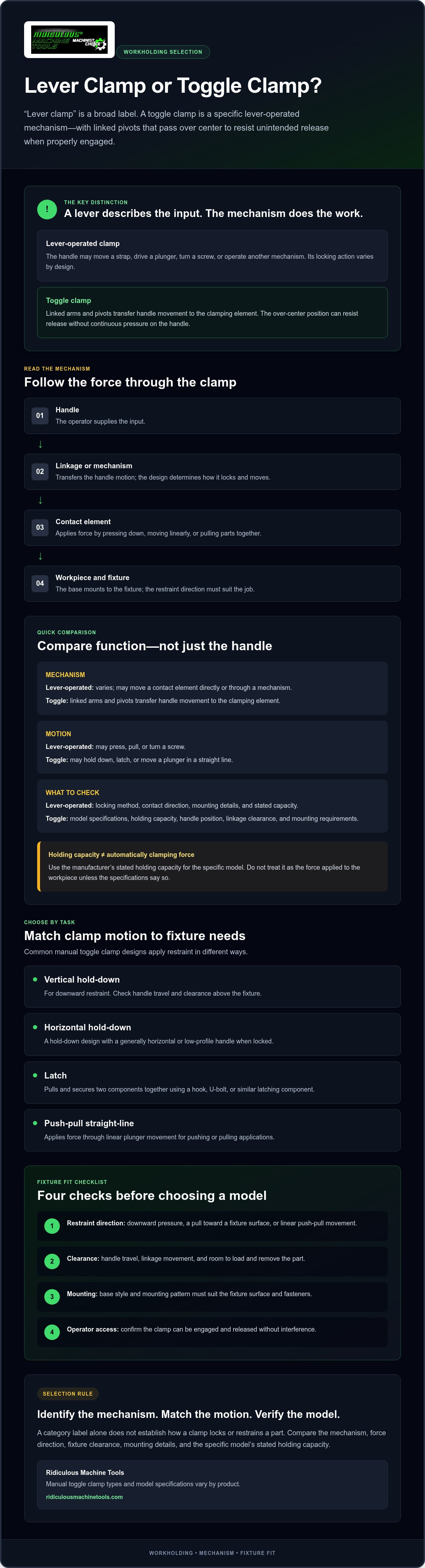
Start with the restraint the fixture needs, then check that the clamp fits the available space and mounting points. Use this sequence:
- Identify restraint direction. Decide whether the workpiece needs downward pressure, a pull toward a fixture surface, or linear push-pull movement.
- Check clearance. Account for handle travel, linkage movement, and access for loading and removing the part.
- Confirm mounting. Compare the clamp’s base style and mounting pattern with the fixture’s available surface and fasteners.
- Assess operating access. Make sure the operator can engage and release the clamp without interference from the workpiece or nearby equipment.
Choose a clamp style that suits the task before comparing individual models. For downward restraint, a vertical or horizontal hold-down design may fit, depending on handle position and clearance. A latch design may suit a setup that pulls two components together. A push-pull straight-line clamp may work where the required movement follows the plunger’s axis. Confirm the actual motion and configuration in the product description.
Check model specifications before purchase
Compare the listed holding capacity with the demands of the application, but don’t treat that figure as clamping force unless the manufacturer explicitly equates them. Also check the model’s material, spindle, base style, and mounting requirements. These details vary between models and affect fit and use.
Workpiece stability and safe operation depend on the specific setup. Follow the product documentation and established shop practices, and verify that the workpiece is properly supported and restrained for the operation. Review manual toggle clamp options by type, then confirm the specifications for the model under consideration.
Choose the Right Manual Toggle Clamp for the Job
Choose by mechanism, fixture geometry, required motion, and the verified specifications for the model. RMT offers manual toggle clamp styles rather than a separately identified generic “lever clamp” category. Narrow your choice to the clamp type that restrains the workpiece as needed, then confirm that its base, contact arrangement, and handle travel fit the fixture.
When a manual toggle clamp is the relevant category
For downward restraint, compare vertical and horizontal hold-down designs. A vertical hold-down clamp’s handle is generally vertical when locked; a horizontal hold-down clamp keeps the handle generally horizontal or low-profile. If the fixture needs to pull two components together, assess a latch design. If the required movement is linear, a push-pull straight-line clamp may fit. Its plunger moves along a line, so check its direction and mounting arrangement against the fixture.
Handle orientation and clamp motion affect access. For example, a low-profile handle may suit a fixture with limited space above the clamp, while a plunger-style unit needs clearance along its travel path. Review the product configuration rather than relying on the category name alone.
A practical final check
Before purchase, confirm the mounting pattern, contact-point configuration, handle and linkage clearance, and listed holding capacity for the specific model. Check the material, spindle, and base style as well. Holding capacity is not automatically the same as clamping force, and capacity figures should not be compared without understanding what each listing specifies.
For a low-profile handle layout, compare the available horizontal hold-down toggle clamps. If linear plunger travel is the deciding factor, review the applicable push-pull model details. Choose a category only after confirming fixture fit and model specifications.
Make the Clamp Choice Fit the Fixture
The label lever clamp alone doesn’t confirm how a clamp moves or locks. Choose by restraint direction, linkage, fixture geometry, and operator clearance. Then verify the specific model’s holding capacity, material, mounting details, and contact configuration before purchase.
Ridiculous Machine Tools offers horizontal and vertical hold-down, latch, and push-pull manual toggle clamp categories. Their motion and handle position suit different fixture layouts. Check the product information for the model’s specifications and compare them with the workpiece and operation rather than assuming a category name tells the whole story.
Once you’ve identified the clamp style and confirmed it fits, compare RMT manual toggle clamp options and review the specifications for the model you’re considering.
Frequently Asked Questions
What is a lever clamp?
A lever clamp is a broad name for a manually operated clamp that uses a lever to apply or release restraint. The term doesn’t identify one universal linkage or locking method. Before choosing a model, check its product description, movement, mounting arrangement, and stated capacity. These details help show whether the mechanism and configuration fit the fixture.
How do I choose between a horizontal and vertical hold-down toggle clamp?
Start with handle clearance, access around the workpiece, mounting position, and the direction of restraint the fixture needs. Then verify the specific model’s holding capacity, base style, spindle, and mounting requirements. A horizontal or vertical handle position may affect fixture clearance, but orientation alone doesn’t establish suitability. Check the product information for the clamp you’re considering rather than transferring specifications between models.
Can a toggle clamp be used for machining?
A toggle clamp may suit a machining fixture if its mechanism, mounting, restraint direction, and documented capacity fit the operation. Confirm that the workpiece remains stable under the actual process conditions, and follow applicable shop safety practices. Don’t infer suitability from a general category name or capacity figure alone. Verify the individual clamp specifications and assess the complete fixture setup before use.
Article by
Ridiculous Machine Tools Technical Team
The Ridiculous Machine Tools Technical Team provides practical information about precision machine tooling, CNC tooling, workholding, and related manufacturing applications. RMT focuses on helping machinists, manufacturers, fabricators, and other customers understand tooling specifications, compatibility, selection, and proper application. Our technical content draws on product specifications, industry knowledge, and RMT's quality-control experience to provide clear, useful information for selecting and using machine tooling and workholding products.
Ridiculous Machine Tools — Machinist's Choice™