
How to Integrate Push-Pull Straight Line Toggle Clamps into Your Workflow (2026)
Posted by RMT on Sep 21st 2026
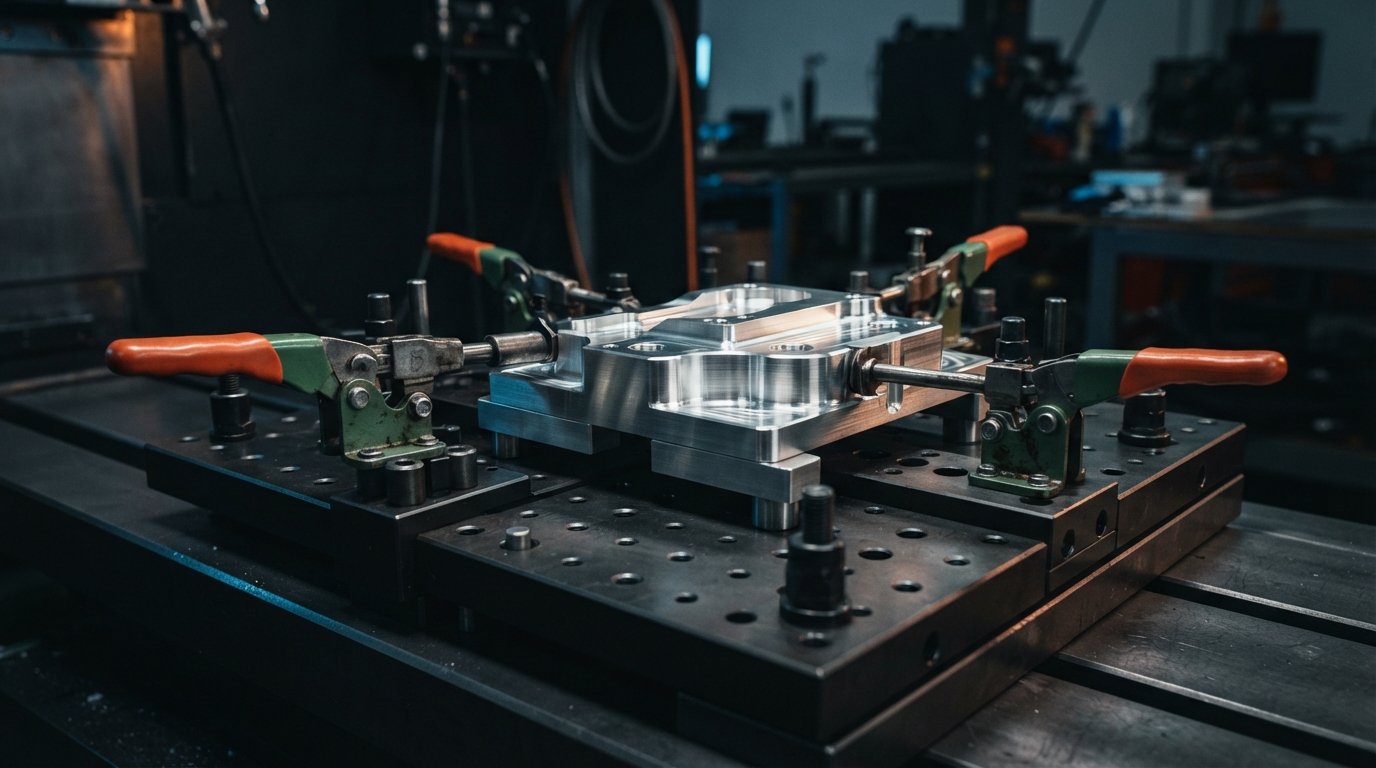
A single millimeter of lateral play can turn a high-tolerance CNC machine fixture into a scrap metal generator. You've likely dealt with the frustration of lateral movement ruining tolerances or insufficient clamping force during high-vibration machining. Integrating push-pull straight line toggle clamps into your setup is the most direct way to solve these issues. These components provide the mechanical advantage needed for secure fastening without the risk of angular displacement.
Mastering the selection and application of these clamps allows you to achieve zero-play workholding and faster setup times. It's about understanding the relationship between stroke length and handle travel to ensure a reliable over-center locking condition every time. This article breaks down the technical details of holding capacity and material selection, covering everything from 304 stainless steel options to components hardened to 58-62HRC. You'll learn how to configure your shop for repeatable precision and maximum efficiency using industrial-grade hardware built for the most demanding production environments.
Key Takeaways
- Learn how to integrate push-pull straight line toggle clamps into your workflow to eliminate lateral shift and maintain tight tolerances.
- Understand the critical distinction between holding capacity and clamping force to ensure your setup withstands high-vibration machining without failure.
- Master the installation process by aligning the plunger perpendicular to the workpiece for a perfect over-center locking condition.
- Identify the right material specifications, including 304 stainless steel for corrosion resistance and components hardened to 58-62HRC for industrial durability.
- Streamline your CNC machine fixture setups using modular designs that support both push-action compression and pull-action tensioning.
Mechanics of Straight-Line Clamping and Over-Center Locking
Straight-line clamps are specialized instruments built to apply direct linear force along a specific axis. They function differently than standard hold-down tools. Instead of an arm swinging down to apply pressure, a plunger extends or retracts to secure the workpiece. This linear movement is the foundation of high-precision workholding in industrial environments. These tools are often categorized within industrial clamp mechanisms as plunger-style devices because they convert handle rotation into axial motion. This conversion allows for high clamping force without the risk of the workpiece shifting during the engagement cycle.
Linear Force vs. Lateral Movement
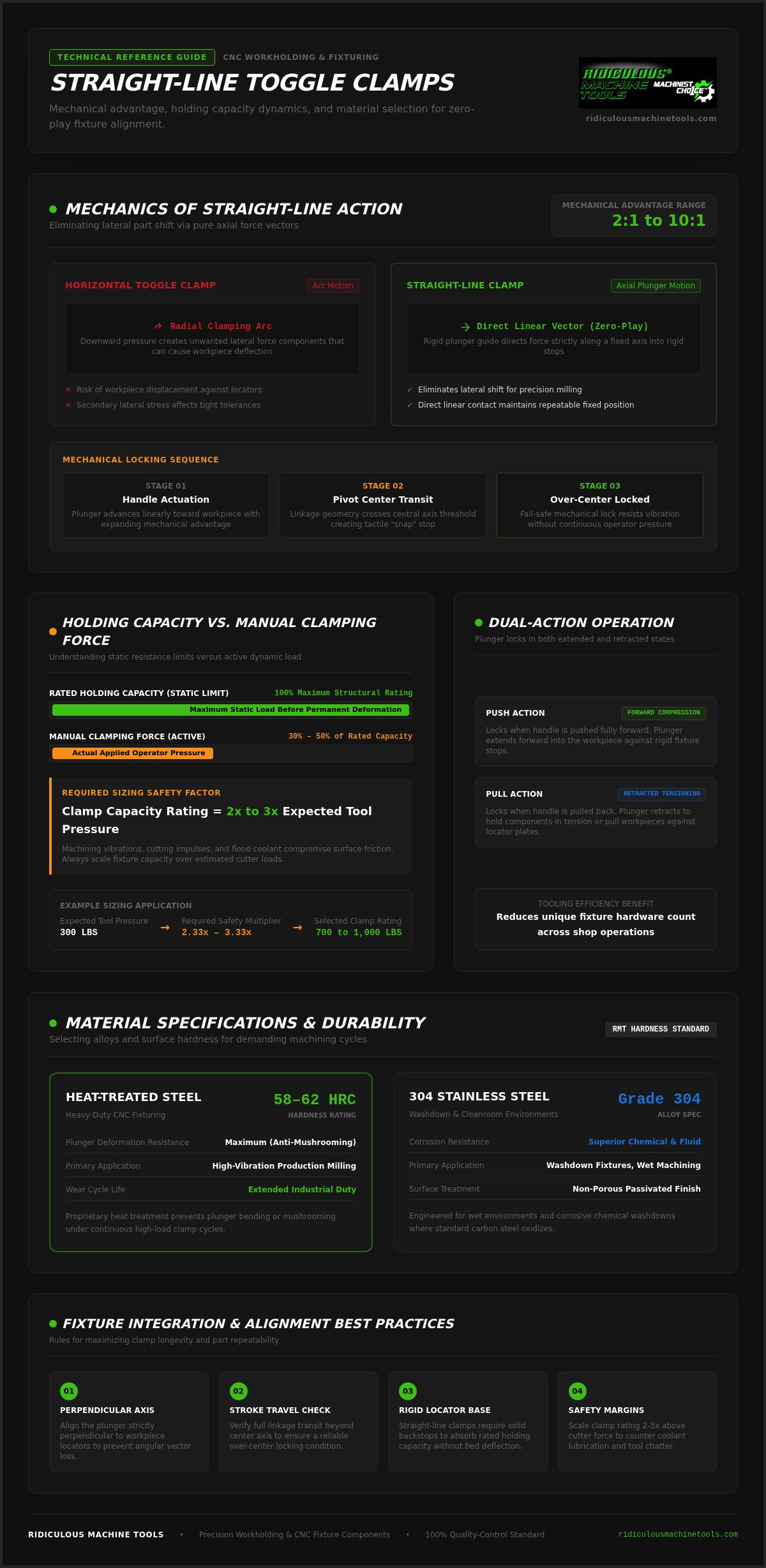
The plunger guide acts as a rigid housing that prevents the workpiece from deflecting during the clamping cycle. While a horizontal toggle clamp applies pressure in an arc-like motion that can pull or push material sideways, push-pull straight line toggle clamps deliver force strictly along a fixed axis. This direct pressure is critical for maintaining tolerances in precision milling. If a clamp introduces lateral stress, the part may lift or slide, resulting in a scrapped component. Linear force ensures the workpiece stays registered against locators or pins, providing a stable base for high-speed machining operations.
The Engineering Behind Over-Center Locking
The security of a straight-line clamp comes from its specific linkage geometry. As the operator moves the handle, the internal pivot points align until they pass a central axis, creating an over-center locking condition. This mechanical state ensures the clamp remains engaged even under heavy vibration or extreme tool pressure. The toggle mechanism produces a significant mechanical advantage, typically ranging from 2:1 to 10:1 throughout the stroke.
Operators don't have to guess if the tool is secure. They feel a distinct "snap" or positive stop when the linkage crosses the center point. This physical feedback confirms the tool is in a fixed position and ready for the cycle. Because the locking action is mechanical, it doesn't rely on constant manual pressure. Once the handle is in the locked position, the plunger stays extended, maintaining a constant holding capacity. This fail-safe design is why professional shops rely on these clamps for high-stakes fabrication and CNC work.
Plunger Action and Durability
The plunger itself is often the most stressed part of the assembly. RMT designs these components using materials hardened to 58-62HRC to withstand repetitive industrial use. The plunger can lock in both the extended (push) and retracted (pull) positions, which adds versatility to your setup. You can use the same tool for forward compression or tension-based holding. This dual-action capability simplifies fixture design and reduces the number of unique tools needed in your inventory.
Evaluating Technical Specs: Holding Capacity and Stroke
Holding capacity isn't a suggestion; it's the absolute limit of the tool's mechanical integrity. This specification represents the maximum static load the clamp handles in a fixed position before permanent deformation occurs. In high-stakes production, you must differentiate between static holding and the actual clamping force applied by the operator. Manual force is typically only 30% to 50% of the rated holding capacity. Failure to account for this gap leads to part shift or tool breakage. Adhering to OSHA machine guarding standards requires workholding that safely resists the specific dynamic forces of your machining cycle.
Calculating Necessary Clamping Force
Don't select a clamp based on the exact force of your tool path. You should choose a model with a capacity rating 2-3x higher than the expected tool pressure. High-vibration machining and flood coolant can compromise surface friction, making a significant safety margin essential for secure fastening. If your operation exerts 300 lbs of pressure, a clamp with a 700-lb or 1,000-lb rating is the professional choice. This overhead ensures the part remains stationary even when the cutter enters a heavy roughing pass.
Material Selection: Steel vs. Stainless Steel
The choice between carbon steel and 304 stainless steel depends on your specific shop environment. Carbon steel offers the highest hardness levels for heavy-duty use. RMT components undergo a specific heat treatment process to reach 58-62HRC, which prevents the plunger from bending or mushrooming under extreme load. For washdown applications or setups using synthetic coolants, 304 stainless steel is the better option. It provides the corrosion resistance needed to prevent pivot point degradation and joint galling. While zinc plating on steel models offers basic protection, stainless steel ensures long-term reliability in chemically aggressive environments.
Stroke and Plunger Versatility
Stroke length defines the total linear distance the plunger travels from the open to the closed position. Standard industrial models typically offer strokes ranging from 0.75 inches to 3.0 inches. You should also verify the plunger thread size, such as 5/16-18 or metric equivalents, to ensure compatibility with your CNC machine fixture. This thread allows you to swap spindles or add custom tips for non-porous surfaces or delicate materials. If you need a reliable solution for your next project, examine the push-pull straight line toggle clamps engineered for industrial precision.
Strategic Applications in CNC Fixturing and Fabrication
Modern CNC machine fixture design relies on modularity and rapid changeovers. While many shops default to standard vises, push-pull straight line toggle clamps offer a low-profile alternative for securing complex geometries. These tools are particularly effective when you need to apply force in tight spaces where a standard swing-arm would interfere with the tool path. By integrating these into a modular grid plate, you achieve multi-axis security. For instance, combining a linear plunger with a vertical toggle clamp allows you to lock a part from both the top and the side simultaneously. This setup ensures the workpiece doesn't lift or slide during aggressive side-milling operations.
Push vs. Pull Action Scenarios
The versatility of these clamps stems from their dual-action capabilities. In a 'push' scenario, the plunger extends to press a workpiece firmly against a fixed stop or locator pin. This is the standard configuration for most machining operations where forward compression is required. Conversely, 'pull' action is used for tensioning applications. You'll find this useful for securing mold halves together or latching a fixture lid. Professional-grade models lock in both the fully extended and fully retracted positions. This feature allows you to use the same hardware for different fixture types, maximizing your inventory utility without sacrificing holding capacity.
High-Vibration Welding and Metalworking
Welding jigs present a unique challenge due to heat and high vibration. During heavy grinding or intense welding cycles, standard clamps can vibrate loose if they don't have a reliable over-center lock. The mechanical design of a straight-line clamp ensures it stays engaged regardless of the external frequency. In these environments, vertical space is often limited by the reach of a welding torch or robotic arm. The low profile of the plunger mechanism keeps the work area clear and accessible.
Durability is non-negotiable when dealing with thermal expansion and weld spatter. RMT's use of materials hardened to 58-62HRC ensures the internal linkage doesn't warp under high-heat conditions. For environments with excessive spatter, using copper-plated spindles or protective sleeves prevents the plunger from seizing. These technical choices separate industrial workholding from hobbyist tools. When your shop's throughput depends on zero-play stability, the precision of a heat-treated linear bearing becomes your primary competitive advantage.
Step-by-Step Installation for Secure Fastening
Installation precision is the difference between a secure setup and a failed part. Even the best push-pull straight line toggle clamps will underperform if the mounting geometry is flawed. You must start with a rigid mounting surface. Any flex in the base plate or fixture body will absorb the clamping force and compromise the over-center locking mechanism. Use ground steel or cast-iron plates to ensure a stable foundation for your workholding. If the base moves, your tolerances won't hold.
Mounting and Alignment Procedures
- Step 1: Mark the base holes ensuring the plunger center-line aligns with the workpiece target. Any angular deviation creates lateral stress that can mar the part or bend the plunger. Alignment is critical for applying direct linear force without introducing unwanted torque.
- Step 2: Secure the flanged base using high-grade fasteners to prevent base-flex. Standard bolts often stretch or loosen under vibration. Use Grade 8 hardware or better to maintain a fixed position throughout the production cycle.
- Step 3: Verify that the handle travel does not interfere with other fixture components. Ensure the operator has enough clearance and that the handle doesn't strike other parts of the CNC machine fixture when fully engaged. Clearance prevents pinch points and ensures the clamp can reach its full locking potential.
Adjusting the Plunger for Precision
Proper engagement requires fine-tuning the spindle depth. Thread the spindle into the plunger until it makes contact with the workpiece while the handle is in the open position. Gradually adjust the depth so the handle requires a firm but smooth force to snap into the locked position. This "snap" indicates you've achieved the over-center locking condition. If you need hardware that maintains these tight tolerances, shop the professional inventory at RMT for clamps built to industrial specifications.
Use jam nuts to maintain the fixed position during production runs. This prevents the spindle from rotating or backing out during high-vibration machining. Before you hit the cycle start button, check for plunger runout to ensure even pressure distribution across the workpiece. A misaligned tip will cause uneven clamping force and may lead to workpiece deflection.
Testing for Zero-Play Engagement
Before starting a production run, perform a physical pull-test on the workpiece. With the clamp engaged, there should be zero perceptible movement. If the part can be shifted by hand, your clamping force is insufficient. Re-adjust the spindle depth in small increments. Repeat this process until the part is immovable. This methodical approach ensures your setup can handle the dynamic forces of the machining path without shifting or losing registration. Don't settle for "tight enough" when your tolerances are on the line.
Precision Workholding Solutions from Ridiculous Machine Tools
Success in high-stakes machining depends on the reliability of your hardware. Ridiculous Machine Tools (RMT) positions itself as a straight-shooter supplier for shops that cannot afford unexpected downtime. Our 100% USA quality-control certification isn't a marketing label; it's a technical guarantee that every component meets industrial standards before it reaches your floor. These push-pull straight line toggle clamps are part of a broader ecosystem of tool holding solutions designed to provide zero-play workholding and repeatable precision in the most demanding environments.
Why RMT Precision Matters for Machinists
Durability is the primary focus of our engineering process. RMT components, including the internal linkages and plungers of our clamps, undergo a specific heat treatment process to reach 58-62HRC. This level of hardness prevents mechanical deformation even during high-vibration machining cycles. We've spent over three decades gathering real-world experience to refine our inventory for professional machinists and fabricators. By using a direct-to-shop model, we ensure you receive high-end equipment without the middleman fluff that drives up complexity and lead times. You get the technical performance you need to maintain tight tolerances and secure fastening across every production run.
Building a Reliable Tooling Inventory
A professional shop is only as efficient as its backup inventory. We encourage machinists to look beyond individual clamps and consider their entire setup. RMT offers a complete range of ER collet chucks and tool holders that maintain certified G2.5 balancing at 30,000 RPM. Integrating these high-precision components alongside your clamping hardware creates a unified system of stability. You should also consider the following to reduce setup downtime:
- Maintain a stock of standard push-pull straight line toggle clamps in both carbon steel and 304 stainless steel.
- Employ various Morse and Jacobs taper adapters to ensure compatibility across different machine spindles.
- Keep a range of high-precision ER spring collets on hand to match specific tool diameters with minimal runout.
Our CAT40 and CAT50 tool holders provide 0.0001 to 0.0002 inch TIR accuracy, matching the precision of our workholding hardware. When you upgrade your shop with professional-grade tools from RMT, you're investing in a system built for industrial durability. We sell our complete offering directly to machine shops, welders, and manufacturing facilities across the United States. Don't let inferior workholding be the weak link in your production chain. Upgrade to the precision and reliability of RMT today to ensure your shop operates at peak performance.
Mastering Repeatable Precision in Your Shop
High-stakes production demands workholding that doesn't compromise on stability or speed. By prioritizing perpendicular alignment and calculating holding capacity with a proper safety margin, you eliminate the risk of part shift during aggressive machining path cycles. Integrating professional-grade push-pull straight line toggle clamps into your workflow ensures that every setup remains secure under the dynamic forces of high-vibration manufacturing. RMT's hardware provides the linear force necessary for zero-play engagement, backed by over three decades of real-world application experience in the aerospace and automotive sectors.
Every component is 100% USA Quality-Control Certified and hardened to 58-62HRC to ensure long-term industrial durability. As a direct-to-shop precision tooling specialist, RMT streamlines your procurement process while delivering the high-end hardware your facility requires to maintain tight tolerances. Shop Industrial-Grade Straight-Line Toggle Clamps at Ridiculous Machine Tools to upgrade your fixtures and achieve repeatable precision across every cycle. Take control of your tolerances and build a more efficient shop today.
Frequently Asked Questions
What is the difference between a push-pull clamp and a horizontal toggle clamp?
Push-pull clamps apply linear force along a plunger axis, while horizontal clamps apply downward pressure through an arc. Push-pull models are better for eliminating lateral shift during heavy machining. Horizontal clamps are typically used for hold-down applications on flat surfaces. push-pull straight line toggle clamps are the preferred choice when vertical clearance is limited or when force must be applied through a hole or against a vertical face.
How do I calculate the holding capacity needed for my machining operation?
You should select a clamp with a holding capacity 2 to 3 times higher than the expected tool pressure. This margin accounts for the difference between static holding capacity and the dynamic forces generated during machining. Factors like vibration, surface friction, and coolant lubrication reduce effective grip. If your milling path exerts 500 lbs of force, use a clamp rated for at least 1,000 to 1,500 lbs to ensure secure fastening.
Can straight-line clamps be used for pulling applications?
Yes, these tools are engineered for both push and pull actions. Most industrial models feature a plunger that locks in both the fully extended and fully retracted positions. This dual-action capability allows you to use the same tool for forward compression or tension-based latching. It's a versatile solution for securing mold halves or pulling a workpiece against a secondary locating pin in a complex CNC machine fixture.
Why is over-center locking important for CNC machine fixtures?
Over-center locking prevents the clamp from releasing under the high vibrations of CNC machining. The mechanical linkage passes a central pivot point, creating a self-locking state that remains engaged without manual pressure. This is a critical safety feature that ensures the plunger stays in a fixed position. It protects the operator and the machinery from part ejection if the cutter hits a hard spot or experiences chatter during the cycle.
What materials are best for toggle clamps in high-moisture environments?
AISI 304 stainless steel is the best material for high-moisture or washdown environments. It provides superior corrosion resistance compared to standard zinc-plated carbon steel. In shops using synthetic coolants or water-soluble oils, stainless steel prevents pivot point galling and surface oxidation. This choice ensures the internal linear bearing and linkage stay functional over thousands of cycles without seizing or losing precision in your specific workholding setup.
How do I adjust the stroke length on a straight-line clamp?
You don't adjust the physical stroke length of the mechanism, as it's determined by the linkage geometry. Instead, you adjust the spindle depth to control where the plunger makes contact within that stroke. By threading the spindle in or out, you set the exact point where the over-center locking condition occurs relative to your workpiece. This allows you to accommodate part variances while maintaining consistent clamping force every time.
Are there stainless steel versions of push-pull toggle clamps for medical or food-grade use?
RMT provides 304 stainless steel push-pull straight line toggle clamps specifically for environments requiring high hygiene or chemical resistance. These models are ideal for medical device manufacturing and food-grade fabrication where non-porous surfaces are required. Stainless steel construction resists the harsh cleaning agents used in these industries. They maintain the same durability as our carbon steel models while providing the necessary protection against joint degradation and contamination.
What maintenance is required to prevent plunger wear in a production environment?
Maintenance involves regular inspection of the plunger and pivot points for wear or debris buildup. You should apply a light industrial lubricant to the moving parts to ensure smooth handle travel and positive engagement. Check the jam nuts frequently to confirm the spindle hasn't moved from its fixed position. In high-production environments, monitor the plunger for mushrooming, though RMT's heat-treated components are designed to resist these issues over time.