
Vertical Toggle Clamps: The Machinist’s Guide to High-Pressure Workholding
Posted by RMT on Sep 18th 2026
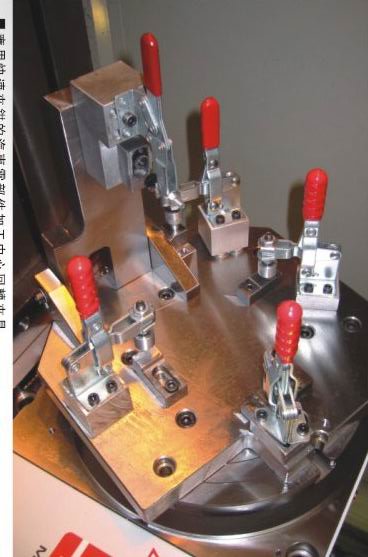
A precision fixture is useless if the workpiece moves mid-cut. Your high-speed milling operation is only as reliable as the downward force holding the part to the subplate. If you're struggling with scrapped parts due to harmonic vibration or handle interference in tight spaces, your workholding strategy needs an upgrade. A heavy-duty vertical toggle clamp provides the rigid, over-center locking force required for high-stakes machining. These tools leverage a planar four-bar linkage to multiply operator input into massive holding power.
We understand that shop floor efficiency depends on secure, repeatable setups and clear tool paths. This guide will help you master the mechanics of vertical workholding to maximize downward pressure and eliminate setup downtime. You'll learn the critical distinction between static holding capacity and dynamic clamping force. We also preview the selection criteria for solid-bar versus U-bar configurations and the role of secondary safety interlocks in high-vibration environments. Stop settling for mediocre fixtures and start building for maximum stability.
Key Takeaways
- Understand how the over-center linkage mechanism generates maximum downward pressure to resist harmonic vibrations during high-speed milling.
- Distinguish between rated holding capacity and actual dynamic clamping force to ensure your workpiece remains secure under heavy cutting loads.
- Determine when the compact footprint of a vertical toggle clamp is superior to horizontal models for tight tool path clearance.
- Compare flanged and straight base configurations to optimize mounting rigidity and repeatability on modular CNC subplates.
- Reduce setup downtime by matching clamp ergonomics and arm articulation angles to your specific production cycle requirements.
Understanding Vertical Toggle Clamps in Precision Fixturing
A vertical toggle clamp is a workholding device where the handle travels through a vertical arc to engage the clamping arm. When the mechanism is fully locked, the handle stands perpendicular to the mounting base. This specific orientation is engineered for applications requiring maximum downward pressure. It is a fundamental tool for milling fixtures, welding jigs, and heavy-duty assembly stations where part movement isn't an option.
The Over-Center Toggle Principle
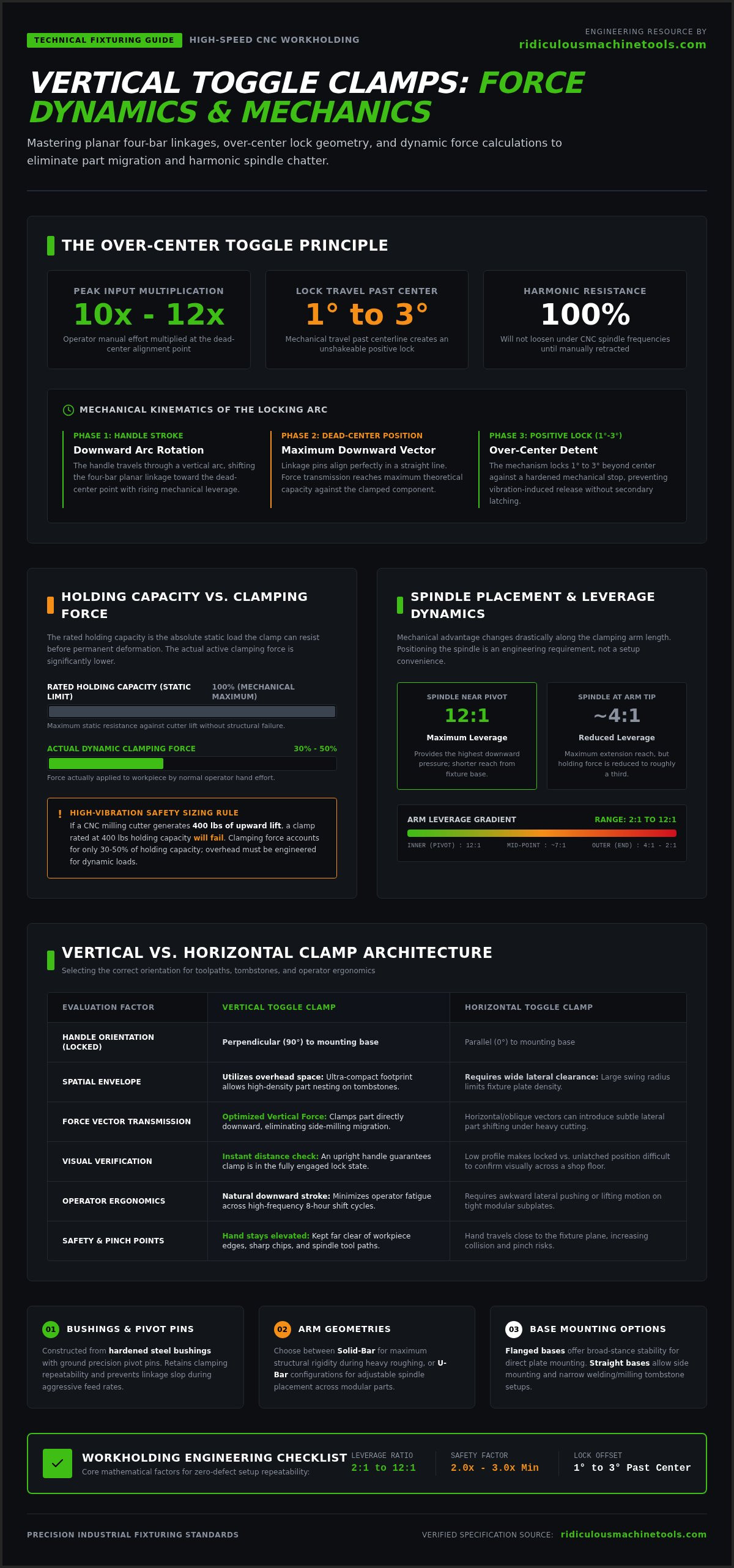
The strength of this tool lies in its planar four-bar linkage. As you move the handle, the internal links align toward a dead-center position. Mechanical advantage peaks at this point, often multiplying operator input by a factor of 10 or 12. Engineering standards dictate that the mechanism travels 1° to 3° past this center point to create a positive mechanical lock.
This over-center design is critical for high-vibration environments. Standard friction-based clamps can loosen under the harmonic frequencies of a CNC spindle. A toggle clamp stays locked until the operator manually pulls the handle back through the center point. Hardened steel bushings and precision pivot pins ensure this pressure remains consistent throughout the production cycle. This mechanical certainty is what allows for aggressive feed rates without the risk of part slippage.
Vertical vs. Horizontal Handle Orientation
Spatial requirements dictate the choice between handle styles. While a horizontal clamp offers a low profile, it demands a wide horizontal swing area to operate. In contrast, the vertical toggle clamp utilizes overhead space. This allows for tighter spacing on modular subplates and tombstones. If your fixture requires multiple parts clamped in close proximity, the vertical handle is the logical choice to minimize the footprint of the workholding setup.
Ergonomics and safety also play a role in precision fixturing. The vertical orientation provides several advantages for the operator:
- Visual Confirmation: You can verify the locked status of every clamp on a fixture from a distance. An upright handle means the part is secure.
- Natural Motion: The downward locking stroke is often more ergonomic for operators during high-frequency cycles, reducing fatigue over an eight-hour shift.
- Hand Clearance: The upright handle stays clear of the workpiece and the tool path, reducing the risk of pinch points or tool collisions during setup.
Integrating these clamps into your setup isn't just about holding a part. It's about building a repeatable, safe, and efficient system. When you combine industrial-grade clamps with precision tool holding, you eliminate the variables that lead to scrapped parts and broken end mills. Professional machinists don't just clamp parts; they engineer setups for total stability.
Mechanical Advantage and Clamping Force Dynamics
The vertical toggle clamp excels because its linkage geometry is optimized for vertical force transmission. Unlike horizontal models, the vertical handle allows for a greater range of motion and longer leverage arms relative to the base footprint. This mechanical advantage typically ranges from 2:1 to 12:1 depending on the spindle position. When you mount the spindle closest to the pivot, you maximize the force. Moving it to the end of the arm reduces that leverage to roughly 4:1. This is why spindle placement is a critical engineering decision, not just a setup convenience.
Holding Capacity Explained
Holding capacity is the maximum amount of static force a clamp can resist in its locked position without undergoing permanent mechanical failure or deformation. It is essential to distinguish this from clamping force. Clamping force is the pressure actually applied to the workpiece by the operator's hand effort. In most professional shop environments, the actual clamping force is only 30% to 50% of the rated holding capacity.
Machinists must account for this discrepancy when designing fixtures for high-vibration milling. If a cutter generates 400 lbs of upward lift, a clamp with a 400 lb holding capacity will likely fail. You need a substantial safety factor to prevent part migration. Selecting a clamp from our industrial vertical toggle clamp inventory ensures you have the overhead required to handle these dynamic loads without slippage or linkage wear.
Force Distribution on the Fixture Plate
Vertical force vectors are the primary advantage of this orientation. Because the pressure is applied directly downward, lateral part movement is minimized. This is vital for maintaining tight tolerances during aggressive side-milling or pocketing operations. While a horizontal clamp can sometimes introduce a slight forward vector that pushes the part against a stop, the vertical clamp pins it directly to the subplate. This direct path of force reduces the reliance on side-stops for part location.
Rigidity is the final piece of the force equation. High-tensile toggle linkages can generate over 1,200 lbs of force. If the base mounting isn't rigid, that force is wasted on fixture flex. Using flanged bases and high-grade fasteners ensures every pound of pressure is transferred to the workpiece. This stability is what separates a professional setup from a temporary jig. It ensures that your tool paths remain precise and your surface finishes stay clean throughout long production runs.
Vertical vs. Horizontal Toggle Clamps: When Clearance Matters
Selecting between handle orientations is a calculation of spatial envelopes. While previous sections detailed force vectors and mechanical ratios, those metrics are secondary if the spindle crashes into a handle. A vertical toggle clamp requires significant overhead clearance but occupies a minimal horizontal footprint. Conversely, horizontal models stay low to the fixture plate but demand a wide swing arc for the handle. Choosing the wrong one leads to tool collisions or restricted access to the workpiece.
Tool Path and Spindle Clearance
In 3-axis milling, the primary concern is the Z-axis envelope. If your CNC has limited vertical travel or a low-hanging gantry, a horizontal clamp is often the safer choice. However, if you are performing side-milling or pocketing on 5-axis machines, a vertical toggle clamp is superior. The upright handle keeps the operator's hands and the linkage away from the tool's lateral path. This provides unobstructed access to the sides of the part, allowing for complex tool paths that would otherwise be blocked by a horizontal handle's side-swing.
Spindle clearance also involves the approach and retract movements. A vertical handle stands tall, making it a clear landmark for programmers to avoid. Horizontal handles can be deceptive; they may clear the tool during a cut but interfere with the spindle housing during a rapid move. Using vertical orientation simplifies the "safe zone" calculation in your CAM software, ensuring that the tool path remains efficient without risking a catastrophic collision.
Fixture Density and Modular Setups
Production efficiency often depends on how many parts you can pack onto a single subplate or tombstone. Horizontal toggle clamps require "swing room" on either side of the base to allow the handle to move into the unlocked position. This dead space limits fixture density and forces parts further apart. Vertical designs eliminate this requirement. Because the handle moves in a vertical plane, you can mount these clamps in tight clusters. This is especially effective when integrated with a Universal CNC Tightening Fixture to streamline the setup process across multiple workpieces.
Longevity in coolant-heavy environments also favors the vertical design. Chips and swarf are less likely to accumulate in the vertical linkage compared to horizontal pivot points that sit closer to the table surface. Gravity helps clear debris from the vertical mechanism, reducing the risk of jam-ups. Regular maintenance involves a quick visual inspection for pin slop, which takes about five minutes per clamp. Efficiency isn't just about clamping force; it's about keeping the spindle moving without interference or unnecessary downtime.
Selection Criteria for Industrial-Grade Toggle Clamps
Choosing a vertical toggle clamp is an engineering decision based on load requirements and spatial constraints. It is not enough to select a clamp that fits the mounting holes. You must match the tool mechanical limits to the specific forces generated by your machining operations. Industrial-duty models typically offer holding capacities ranging from 100 lbs to 1,200 lbs. If you are milling tough alloys with aggressive feed rates, aim for the higher end of that spectrum to account for the 50% discrepancy between static holding capacity and dynamic clamping force.
Material selection impacts long-term reliability. High-grade carbon steel is the industry standard for general shop environments. It provides the necessary tensile strength for heavy-duty linkages. However, if your setup involves constant exposure to corrosive coolants or wash-down cycles, stainless steel variants are mandatory. These prevent pivot-pin seizure and maintain the smooth over-center action required for rapid part changes. Look for red ergonomic handles that provide a secure grip, especially when operators are working with oily or coolant-slicked hands.
Mounting and Base Configuration
Base geometry determines how the clamp integrates with your fixture plate. Flanged bases are the most common choice for horizontal surfaces. They feature wide mounting feet that provide maximum lateral stability, preventing the clamp from twisting under load. This is vital for maintaining part position during side-milling. Straight bases are designed for side-mounting or integration into custom weldments where vertical space is at a premium. Most industrial clamps utilize standard hole patterns, making them compatible with modular fixture plates and tombstones without custom drilling.
Adjustability and Customization
Precision workholding requires fine-tuning. Spindle height adjustment allows you to compensate for variations in part thickness or casting irregularities. A threaded spindle with jam nuts provides a reliable way to set the exact over-center pressure needed. For delicate surfaces or finished parts, swivel shoes or neoprene-tipped spindles prevent marring. If you are dealing with aggressive material removal, hardened cone-point grippers provide a mechanical bite into the workpiece. You can browse our full range of vertical toggle clamps to find the exact configuration for your next high-pressure fixture.
Customization often extends to the arm itself. U-bar configurations allow you to slide the spindle along the length of the arm for flexible positioning. Solid-bar arms are preferred for high-torque applications where torsional stiffness is the priority. These can be cross-drilled or modified to accept custom clamping pads. Every selection variable should lead back to one goal: creating a secure, repeatable setup that allows the machine to run at peak capacity.
Optimizing Shop Productivity with Ridiculous Machine Tools
Professional machinists prioritize results over marketing fluff. At Ridiculous Machine Tools, we provide the hardware that keeps your spindles turning. Our inventory is built for shops that demand reliability and aggressive pricing without sacrificing technical quality. Every vertical toggle clamp we stock undergoes 100% US quality inspection. This ensures that the over-center lock you rely on at the start of a shift remains just as secure 10,000 cycles later. We don't just sell parts; we supply the components that stabilize your entire production process. Our technical authority is rooted in shop floor experience. We know that a failed pivot pin can stall a five-axis mill for hours. That is why we prioritize high-grade carbon steel and hardened bushings across our entire range.
The Synergy of Quality Workholding and Tool Holding
High-pressure workholding is only one half of the precision equation. Your fixture can be rock-solid, but if your tool holding is subpar, you'll still face runout and scrapped parts. We emphasize the synergy between our industrial-duty clamps and our high-precision ER spring collets. A rigid setup requires total stability from the table to the spindle. By combining 1,200 lb holding capacity clamps with ultra-precision collets, you eliminate the micro-vibrations that destroy tool life. This integrated approach creates a machining ecosystem where every component is engineered for maximum rigidity. When the part doesn't move and the tool doesn't deflect, your surface finishes and tolerances improve immediately. Stable part positioning and stable tool positioning are the two pillars of high-speed machining.
Streamlined Procurement for Modern Shops
Modern shops don't have time for slow procurement or vague technical data. We provide direct access to the specs you need to design your next fixture. Our catalog includes CAD-ready dimensions and clear load ratings to simplify your engineering process. We stock vertical toggle clamps in bulk 5-packs and 10-packs to support high-density tombstone setups and modular subplates. Rapid shipping ensures that your production line doesn't wait on a simple clamp. We cut out the corporate overhead to deliver high-end equipment at prices that respect your bottom line. Our goal is to be your savvy, disruptive supplier. Stop overpaying for legacy brands and start investing in hardware that works as hard as you do. Upgrade your fixtures with our vertical toggle clamps today and experience the difference of no-nonsense precision.
Secure Your Setups with Industrial-Duty Workholding
Precision machining requires more than just a fast spindle. It demands a workholding strategy that resists harmonic vibrations and ensures total part stability. By mastering the mechanics of the vertical toggle clamp, you eliminate the variables that lead to scrapped work and broken tooling. You now understand how to balance mechanical advantage with spindle clearance and why high-tensile linkages are non-negotiable for professional machine shops. This technical foundation allows you to build fixtures that withstand aggressive feed rates and maintain tight tolerances.
Ridiculous Machine Tools provides the high-performance hardware needed to optimize your production floor. Our inventory focuses on durability and technical utility, offering aggressive pricing on components designed for the high-stakes environment of a precision workshop. Don't let poor fixture ergonomics or part slippage stall your progress. It's time to streamline your procurement and upgrade your shop with hardware that delivers consistent results under pressure. High-tensile industrial components are the backbone of any reliable setup.
Take the next step in refining your fixturing system. Browse Industrial-Grade Vertical Toggle Clamps and secure your setup for the long run. Start building more efficient fixtures today.
Frequently Asked Questions
What is the main difference between a vertical and horizontal toggle clamp?
The primary difference is the position of the handle when the clamp is in the locked state. A vertical toggle clamp handle stands perpendicular to the base, while a horizontal clamp handle sits parallel. This orientation determines your clearance envelope. Vertical models are ideal for tight horizontal footprints where you have ample overhead room. They allow for closer fixture spacing on modular subplates compared to the wide swing arc required by horizontal handles.
How do I calculate the holding capacity needed for my milling fixture?
You should follow the 50% rule to ensure fixture stability. Rated holding capacity is a static measurement, but milling forces are dynamic and unpredictable. Actual clamping force exerted by an operator is typically only 30% to 50% of the rated capacity. If your machining operation generates 300 lbs of lift, you need a clamp rated for at least 600 lbs to account for harmonic vibrations and safety factors.
Can vertical toggle clamps be used for heavy-duty CNC machining?
Yes, vertical toggle clamp models are suitable for heavy-duty CNC machining when correctly specified. You must select industrial-grade tools with high-tensile linkages and hardened bushings to withstand continuous cycles. For high-vibration setups, choose models with secondary safety interlocks. These mechanical catches prevent the linkage from backing out of the over-center position during aggressive material removal. Secure workholding is the foundation of precision tool performance.
What maintenance do toggle clamps require in a machine shop?
Maintenance in a professional shop involves regular visual inspections and debris removal. Spend five to ten minutes per clamp checking for pin slop or mechanical wear in the linkages. Clear away accumulated swarf and coolant residue that can jam the pivot points. Periodically lubricate the pivot pins with a light machine oil to maintain a smooth over-center action. Consistent maintenance prevents unexpected failure during long production runs.
How do I prevent part marring when using high-pressure vertical clamps?
Use articulated swivel pads or neoprene-tipped spindles to protect finished surfaces. High-pressure clamping can easily deform soft materials like aluminum or leave indentations on ground steel. Swivel shoes allow the clamping pressure to distribute evenly across irregular surfaces. For non-marring applications, urethane pads provide a secure grip without the risk of surface damage. Proper spindle selection is as important as the clamp's holding capacity.
Are stainless steel toggle clamps worth the extra cost?
Stainless steel models are necessary if your fixtures face constant exposure to corrosive coolants or wash-down cycles. While carbon steel is the standard for dry environments, it can rust and seize at the pivot points when wet. Stainless steel 304 or 316 variants maintain their mechanical integrity and smooth operation over thousands of cycles in harsh conditions. The investment prevents downtime caused by frozen linkages or snapped handles.
What is the advantage of a flanged base on a vertical toggle clamp?
A flanged base provides maximum lateral stability for the clamp assembly. The wide mounting feet allow for secure fastening to subplates using standard hole patterns. This prevents the clamp from twisting or shifting when subjected to side-loading forces during milling. Straight bases are useful for side-mounted applications, but the flanged version is the industry standard for securing parts directly to a horizontal fixture table or tombstone.
How does handle length affect the clamping force of a toggle clamp?
Handle length directly dictates the mechanical advantage and operator effort required. A longer handle provides more leverage, allowing the operator to generate higher clamping forces with less physical exertion. Most industrial toggle linkages offer ratios between 2:1 and 12:1. If you need to maximize downward pressure in a compact space, ensure the spindle is positioned as close to the pivot point as possible to utilize the maximum leverage of the handle.