
Top Destaco Push-Pull Clamp Alternatives for Fixtures
Posted by RMT on Oct 5th 2026
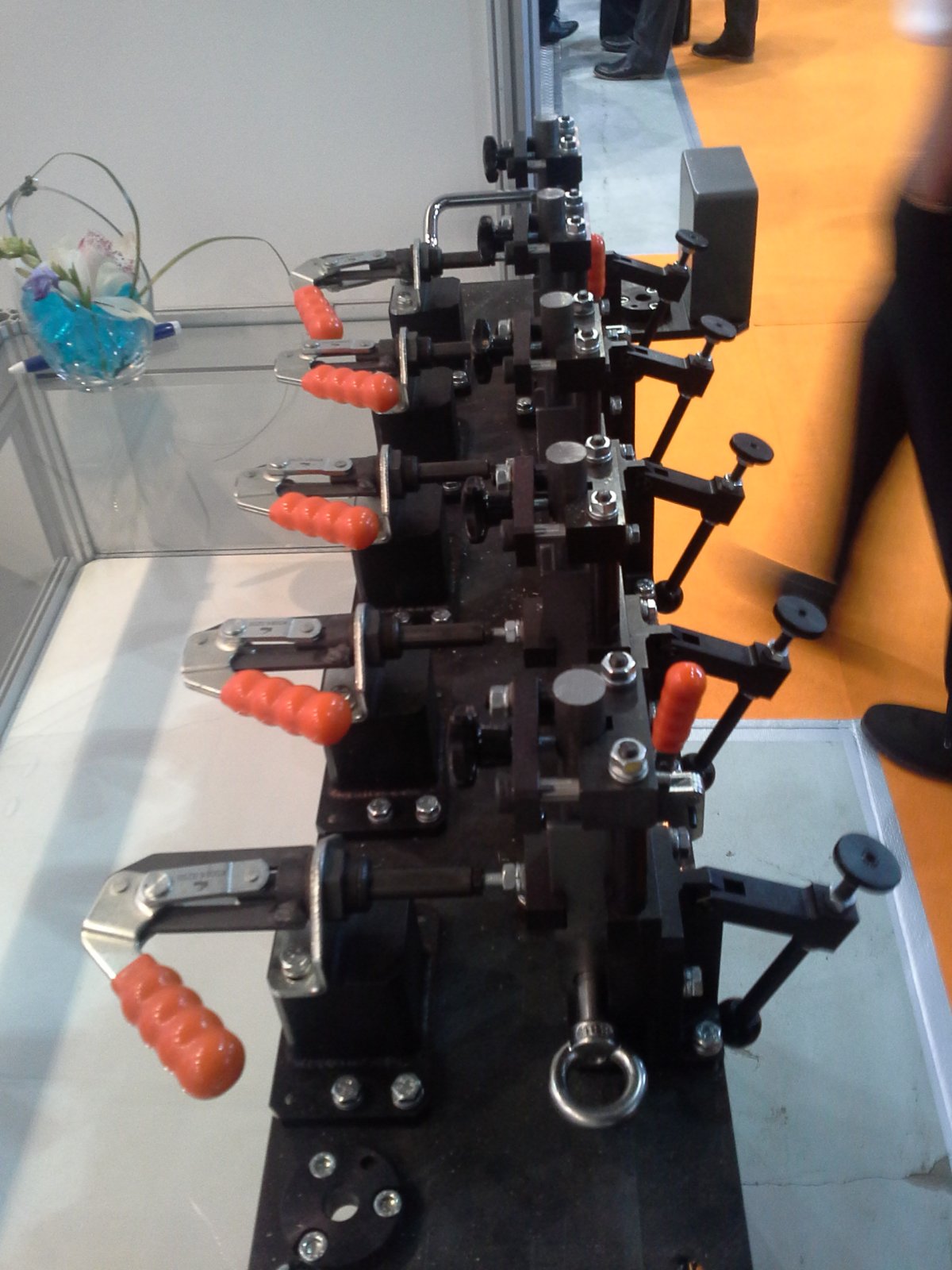
When evaluating push pull toggle clamp alternatives for inspection fixtures, a similar holding-capacity rating does not guarantee a suitable replacement. Check the mounting pattern, plunger travel, and handle position. A clamp that blocks a probe or indicator can limit measurement access.
Choose a replacement by checking how its motion suits the fixture, whether the workpiece locates consistently, and whether datums and inspection points remain accessible. This comparison covers straight-line push-pull action, mounting and travel, and the difference between published holding capacity and force applied to the workpiece. It also considers Ridiculous Machine Tools' push-pull straight-line clamp category as an option to assess against verified model details before ordering.
Key Takeaways
- Compare destaco push pull toggle clamp alternatives for inspection fixtures by mounting pattern, plunger travel, thread, body envelope, and handle clearance, not by category name alone.
- Map the clamp’s force direction against fixture datums and inspection points to help protect workpiece positioning and measurement access.
- Check the exact model’s published holding capacity, and distinguish that rating from the clamping force applied to the workpiece.
- Evaluate RMT’s push-pull straight-line clamp category, then verify model details against the fixture drawing before ordering.
What Makes a Push-Pull Clamp a Suitable Destaco Alternative for Inspection Fixtures?
A push-pull straight-line toggle clamp uses a linkage to move a plunger linearly. Depending on its setup, the plunger pushes against a workpiece or pulls it toward a fixture stop. This action can suit inspection fixtures when the required restraint acts along the plunger axis rather than downward or across a joint. A toggle clamp is one of several clamp types, so a brand or product label alone does not establish a fit.
For destaco push pull toggle clamp alternatives for inspection fixtures, assess the application first: force direction, mounting pattern, travel, body envelope, handle clearance, and verified capacity. A substitute may require a different mounting location, hardware, or fixture modification. Similar appearance or a cross-reference does not prove that a clamp will install or function as a direct replacement. RMT offers a push-pull straight-line clamp category to evaluate against the fixture’s requirements. Check each model’s details individually.
How push-pull motion differs from hold-down and latch action
Use linear pushing or pulling when the fixture needs the workpiece driven toward a locator, restrained against a stop, or held along the plunger’s line of travel. A vertical or horizontal hold-down clamp applies force through a pivoting arm, typically toward the fixture surface. A latch clamp pulls two components together using a hook or similar engagement. Each motion suits different geometry and loading needs; none is universally preferable.
Why inspection fixtures impose different clearance demands
Inspection access is part of fit. Check the clamp in both open and locked positions against the operator’s hand, indicator stem, probe path, and target features. A body beside a datum or a handle crossing a measurement path can obstruct access. Contact on a thin section may also affect how consistently the part seats. Confirm that the workpiece remains located and accessible during loading, clamping, and measurement.
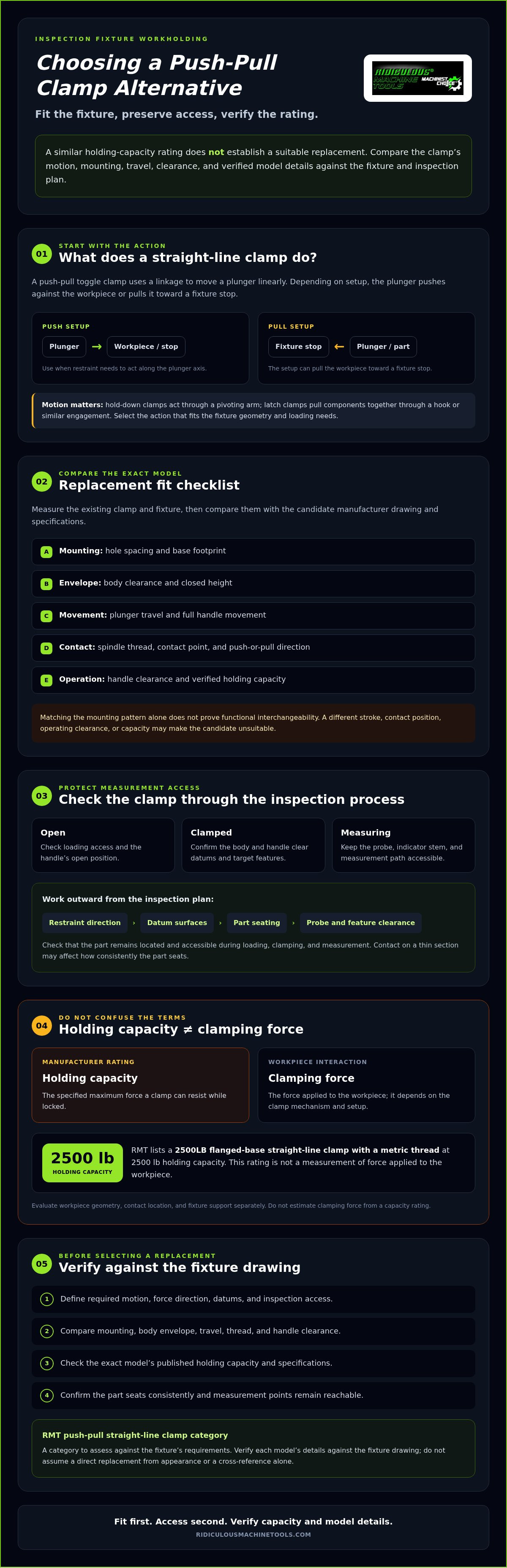
Holding capacity is the manufacturer’s specified maximum force a clamp can resist while locked. Clamping force is the force applied to the workpiece and depends on the clamp’s mechanism and setup. These ratings are not interchangeable.
Compare Push-Pull Clamp Alternatives by Fit, Travel, and Verified Capacity
Compare candidate clamps using manufacturer drawings and specifications for each exact model. Record mounting-hole spacing, base footprint, closed height, body envelope, plunger travel, spindle thread, handle clearance, and whether the setup pushes or pulls. Matching mounting geometry alone does not establish functional interchangeability. Differences in stroke, contact position, operating clearance, or rated capacity can prevent a clamp from working with the fixture and inspection process.
Which dimensions should you confirm before replacing a clamp?
Measure the existing clamp and fixture, then compare them with the candidate’s drawing. Check hole spacing and base footprint, along with clearance through the full handle movement and plunger stroke. Confirm that the spindle thread and contact point suit the workpiece, and that the plunger acts in the required direction. The workholding principles Purdue University discusses reinforce the need to secure the part without compromising its location or measurement access.
How should you interpret capacity claims?
Use the manufacturer’s holding-capacity rating for the exact model and configuration. For example, RMT lists its 2500LB flanged-base straight-line clamp with a metric thread at 2500 lb holding capacity. That figure is not a measurement of force applied to the workpiece. Evaluate workpiece geometry, contact location, and fixture support separately. Do not estimate clamping force from a capacity rating.
Over-center locking and mechanical advantage can affect operation, but compare these features only when the relevant manufacturer documentation describes them for the models under review. For destaco push pull toggle clamp alternatives for inspection fixtures, RMT’s push-pull straight-line clamp category is a starting point. Confirm each candidate’s specifications against the fixture drawing before selecting it.
Choose a Clamp Around Inspection Access and Workpiece Repeatability
Choose the clamp by working outward from the inspection plan. First, identify the direction in which the workpiece must be restrained. Next, define the datum surfaces and how the part seats against them. Then check whether the clamp body, handle, and contact point clear the measured features and planned probe or indicator paths.
Check contact placement against the inspection plan
Position the clamp contact so its force supports the locating scheme rather than pushing the workpiece away from a datum. Contact on a thin wall or unsupported area could deflect the part. Contact on a measured feature could obstruct the instrument or affect how the part sits. Review the full loading, clamping, and measurement sequence, not just the clamp’s locked position.
Repeatability depends on the fixture system: datums, supports, contact locations, and consistent clamping. A clamp helps hold the workpiece, but it does not establish measurement accuracy on its own. For linear push or pull action, compare the fixture requirements with RMT’s push-pull straight-line clamp category, then verify the specific model details.
When another clamp style may fit better
If the fixture needs downward restraint and a low handle position would preserve access, consider a horizontal hold-down clamp. Its pivoting arm applies force differently from a straight-line plunger, so it is suitable only when that action works with the part’s locating scheme and support. Review the horizontal toggle clamp category as a separate mechanism, not an automatic substitute.
When comparing destaco push pull toggle clamp alternatives for inspection fixtures, prioritize the intended force path and an unobstructed measurement approach over visual similarity to the existing clamp.
Compare RMT push-pull straight-line clamps
Verify the Replacement Before Ordering an RMT Push-Pull Clamp
Use the fixture drawing alongside the exact clamp model’s product-page details. A category match or familiar appearance is not enough to confirm fit. For destaco push pull toggle clamp alternatives for inspection fixtures, verify the dimensions and functions that affect installation, workpiece contact, and access before ordering.
What to verify on the product page
- Dimensions: Compare body envelope, base footprint, mounting-hole spacing, and closed height.
- Travel and direction: Confirm plunger stroke and whether the setup needs pushing or pulling.
- Connection: Check spindle thread and the contact or mounting hardware required.
- Construction and rating: Verify material and holding capacity for the exact model and configuration.
Do not transfer a specification from another clamp family or model. If a compatibility detail is unclear, provide the supplier with the exact model number, fixture drawing, and required motion, then ask for clarification. Ridiculous Machine Tools offers several manual clamp types; its manual toggle clamp category is a starting point for reviewing the available configurations.
When to modify the fixture instead of forcing a match
Once you have established the fit, review RMT tooling options and compare the applicable product details before ordering.
Choose the Replacement That Fits the Fixture
A sound replacement decision starts with the fixture, not a cross-reference. Confirm the clamp’s mounting dimensions, plunger travel, thread, contact direction, and clearance around inspection points. Check the exact model’s published holding capacity, but do not treat that rating as the force applied to the workpiece. These checks help distinguish a suitable alternative from a clamp that only looks similar.
For destaco push pull toggle clamp alternatives for inspection fixtures, Ridiculous Machine Tools offers push-pull straight-line manual toggle clamps to assess against your fixture requirements. Model specifications vary, so check the product details against your fixture before ordering.
Frequently Asked Questions
Is an RMT push-pull clamp a drop-in replacement for a Destaco clamp?
Not by default. Treat an RMT push-pull clamp as a potential alternative until you check the exact model’s mounting pattern, body dimensions, plunger travel, thread, contact setup, and operating clearance against the existing clamp and fixture drawing. Compare manufacturer specifications for both models. Similar motion or capacity labels alone do not confirm compatibility or prove that the replacement will operate correctly in the fixture.
Can a push-pull toggle clamp be used on an inspection fixture?
Yes, if its linear plunger motion suits the required force direction and the installed clamp holds the part without blocking measurement access. Check clearance for the operator, probe, or indicator in both open and locked positions. Consider whether the contact point could shift or deflect the workpiece from its datums. The fixture’s locating surfaces and supports also contribute to repeatable inspection.
How is a clamp’s holding capacity different from clamping force?
Holding capacity is the manufacturer’s stated maximum force the clamp can resist while locked. Clamping force is the force the clamp applies to the workpiece during use. These are not interchangeable ratings. Applied force depends on the mechanism and setup, including operator input and contact position. Do not infer workpiece clamping force from a published holding-capacity figure.
What should I measure before choosing an inspection-fixture clamp alternative?
For destaco push pull toggle clamp alternatives for inspection fixtures, record mounting-hole spacing, base footprint, closed height, body envelope, plunger travel, spindle thread, and contact position. Check handle clearance through its operating path and confirm the required push or pull direction. Then compare the measurements with the exact replacement model’s product details and the fixture drawing. Verify material and holding capacity from that model’s published specifications.
Article by
Ridiculous Machine Tools Technical Team
The Ridiculous Machine Tools Technical Team provides practical information about precision machine tooling, CNC tooling, workholding, and related manufacturing applications. RMT focuses on helping machinists, manufacturers, fabricators, and other customers understand tooling specifications, compatibility, selection, and proper application. Our technical content draws on product specifications, industry knowledge, and RMT's quality-control experience to provide clear, useful information for selecting and using machine tooling and workholding products.
Ridiculous Machine Tools — Machinist's Choice™