

Collet Nut Overtightening Damage to Toolholder Taper: Causes and Fixes
Posted by RMT on Sep 23rd 2026
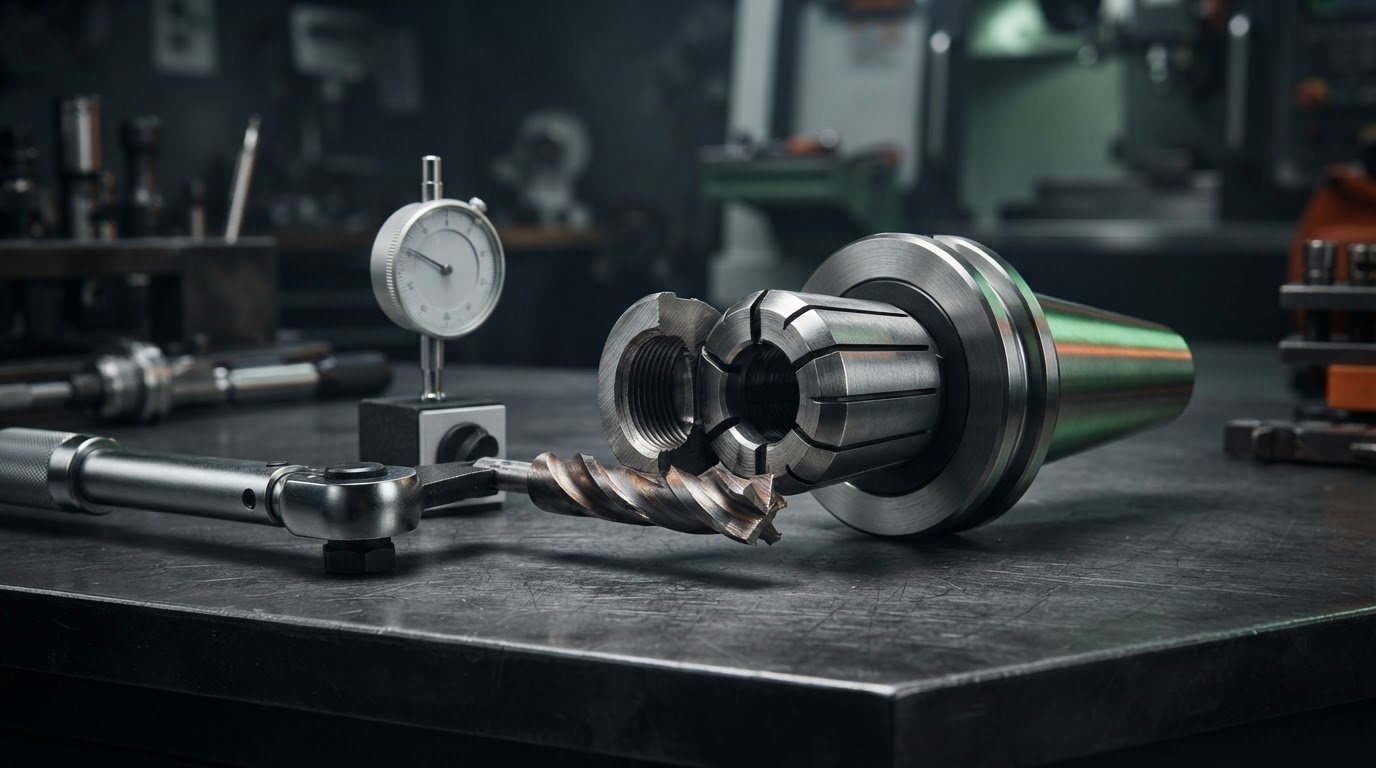
Machinists often assume stripped threads are the first warning of excessive clamping torque, but precision steel yields long before the threads shear off. When an operator leans on an open-ended spanner to stop end mill slip, collet nut overtightening damage to toolholder taper geometry happens immediately. You likely know the fallout on the shop floor: erratic runout that ruins surface finishes, carbide tools snapping mid-cycle, and collets that seize inside the chuck during tool changes.
Replacing broken end mills gets expensive fast, especially when you are unsure whether the toolholder itself is permanently ruined. You will learn how extreme hoop stress drives internal bell-mouthing, how to inspect your holders for taper deformation using straightforward shop-floor checks, and how to establish rigid torque protocols that preserve your certified TIR specs. The guide below details the mechanics of taper distortion, clear diagnostic steps, and the setup discipline needed to protect your tooling investments.
Key Takeaways
- Understand the mechanical threshold where collet nut overtightening damage to toolholder taper geometry causes irreversible hoop stress and nose expansion.
- Differentiate harmless surface galling from permanent bell-mouthing using reliable bench inspection checks.
- Protect carbide end mills from premature breakage by keeping assembly runout within certified 0.0001 to 0.0002 inch TIR tolerances.
- Match precise torque values to specific collet series from ER16 through ER40 to avoid exceeding the alloy's elastic limit.
- Prevent destructive spindle and holder side-loads by standardizing on calibrated torque wrenches and dedicated tightening fixtures.
Mechanics of Collet Nut Overtightening on Toolholder Tapers
Collet nut overtightening occurs when applied torque exceeds the manufacturer engineering threshold for a given toolholder assembly. In a high-precision tooling setup, applying extra torque does not yield extra security. Instead, excessive torque converts rotational thread energy into destructive physical forces. The primary culprit is the standard DIN 6499 design found across industrial CNC machining centers. Understanding how force transfers through this geometry reveals why collet nut overtightening damage to toolholder taper walls happens long before external threads strip.
The Angular Wedge Effect in ER Systems
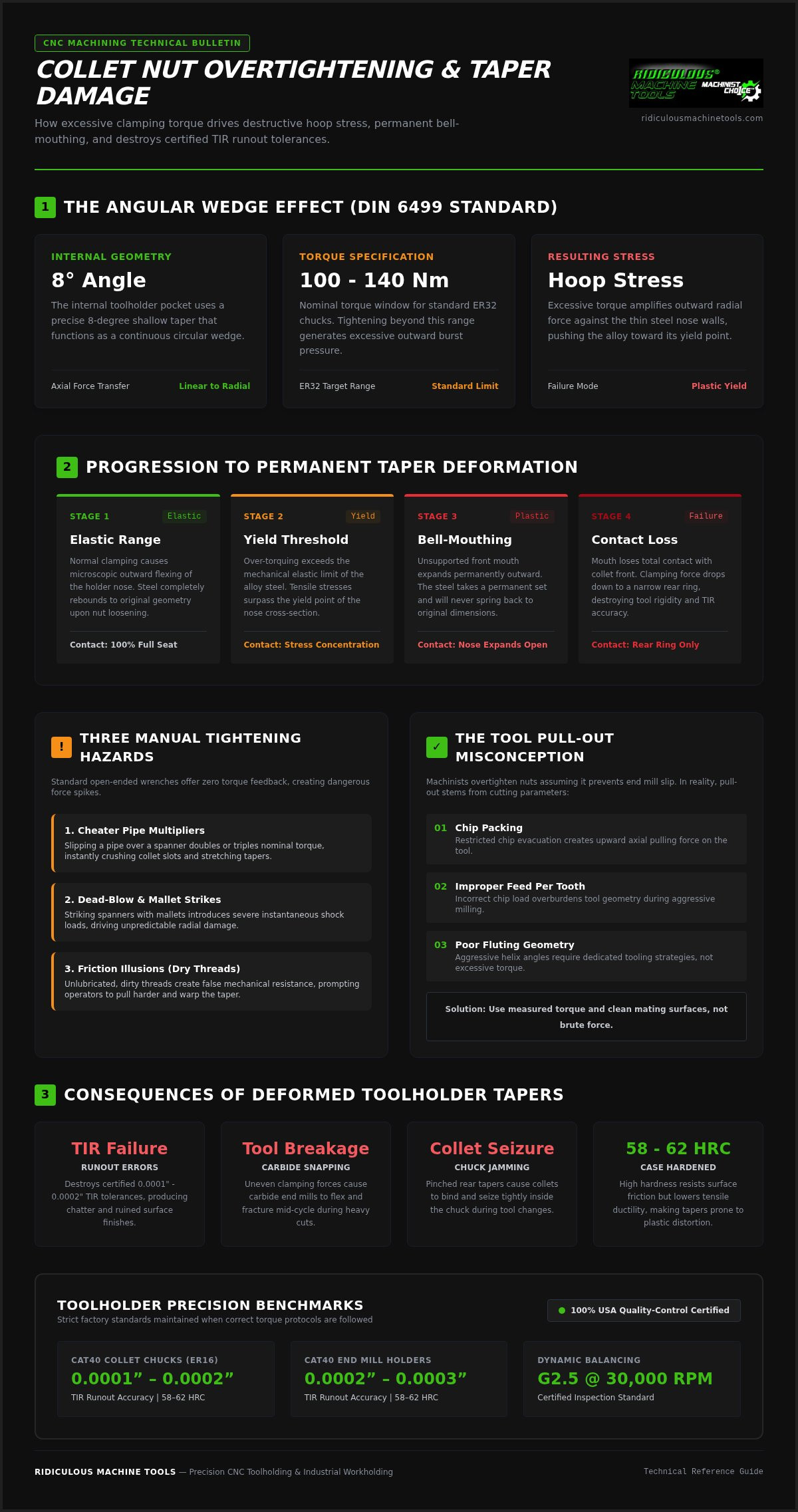
ER toolholder pockets utilize a precise 8-degree internal angle. Just as a conventional machine taper system locks tooling shanks into a spindle, this shallow internal angle functions as a continuous circular wedge. When you thread the nut down, it drives the collet deeper into the bore. The 8-degree incline amplifies the axial draw, converting linear thrust into severe radial expansion pressure against the toolholder nose.
Every foot-pound applied past nominal torque drives up outward radial stress. The thin steel walls surrounding the internal taper pocket absorb this load directly. In an ER32 chuck, tightening past the 100 to 140 Nm window generates immense outward forces that try to burst the toolholder nose from the inside out.
Common Operator Misconceptions About Clamping Force
Machinists often overtighten collet nuts under the mistaken assumption that higher torque stops end mill pull-out during aggressive milling cycles. In practice, tool pull-out stems from chip packing, improper feed per tooth, or poor fluting geometry, not insufficient nut torque. When tools slip, reaching for a longer wrench is the wrong move.
Standard open-ended hand wrenches provide zero torque feedback. Operators routinely exceed nominal limits through aggressive manual tightening:
- Leverage multipliers: Slipping a cheater pipe over a standard spanner instantly doubles or triples nominal torque, crushing collet slots.
- Impact tightening: Striking spanner wrenches with dead-blow mallets spikes instantaneous radial loads, triggering collet nut overtightening damage to toolholder taper pockets.
- Friction illusions: Dry, unlubricated threads create false resistance, prompting operators to pull harder and warp the underlying taper.
Applying unmeasured force quickly pushes toolholder steel past its yield point. Proper clamping force requires measured torque, clean mating surfaces, and calibrated tooling fixtures rather than brute physical leverage.
Hoop Stress and Permanent Plastic Deformation of the Taper
Toolholders are built to tight tolerances, but they do not have infinite mass. The nose section surrounding an ER collet cavity has a thin cross-sectional wall. When an operator cranks past specified torque limits, the outward wedge action generates intense circumferential tension known as hoop stress. High-grade alloy steel flexes elastically under normal loads. Exceed the yield point, however, and the steel transitions into plastic deformation. Once steel deforms plastically, it never springs back. This structural failure represents true collet nut overtightening damage to toolholder taper geometry, destroying concentricity permanently.
Bell-Mouthing at the Toolholder Nose
Plastic deformation concentrates at the unsupported front edge of the chuck. As excessive radial force pushes outward, the mouth expands wider than the internal taper base. This defect is called bell-mouthing. Instead of establishing full surface-to-surface engagement along the entire 8-degree slope, the expanded mouth makes zero contact with the front of the collet. The holder pinches only at the back, rocking under load, generating massive runout, and killing cutting tool rigidity.
The Mechanics of Taper Distortion:
- Elastic range: Normal clamping causes micro-flexing that rebounds entirely upon loosening.
- Yield threshold: Over-torquing forces the thin nose wall past its elastic limit.
- Plastic stretch: Circumferential expansion bells the outer socket opening.
- Contact loss: Clamping surface drops from near-100% full-body seating down to a narrow rear ring, slashing effective gripping force.
Case Hardening Limits and Micro-Cracking
Premium toolholders are case-hardened to 58-62 HRC. This heat treatment creates exceptional wear resistance and surface durability against friction, but high hardness reduces tensile ductility. Hardened steel behaves rigidly under outward hoop stress. While extreme torque can bow a softer shank, a case-hardened nose is prone to brittle micro-fissuring along the internal ground seat and external thread roots.
For assemblies to deliver factory accuracy, components must be properly torqued during every tool change. Continued over-tightening turns microscopic stress cracks into complete structural fatigue. Shops relying on high-feed milling must secure high-performance tooling with precision-matched components. Upgrading damaged tooling to certified ER collet chucks built with 58-62 HRC case hardening preserves factory concentricity, provided your operators respect strict torque limits.
Comparing Toolholder Taper Damage: Over-Torque vs. Normal Wear
Every toolholder undergoes wear during routine machining cycles, but wear patterns tell two entirely different mechanical stories. Normal operational degradation appears as an even, micro-polished contact band across the full length of the internal 8-degree pocket. This natural burnishing preserves coaxial alignment over thousands of production hours. In contrast, collet nut overtightening damage to toolholder taper walls alters the fundamental cross-sectional geometry of the holder nose, requiring immediate retirement of the tool.
- Normal Abrasive Wear: Uniform contact pattern spanning at least 80% of the internal taper depth, negligible increase in runout, and smooth collet release upon thread disengagement.
- Over-Torque Plastic Distortion: Isolated contact ring at the rear seat, flared entrance at the chuck mouth, and mechanical binding of the collet body.
- Surface Galling: Localized cosmetic scoring from micro-debris that can be cleaned, distinct from permanent taper bell-mouthing.
Symptoms of a Deformed Internal Taper
A bell-mouthed chuck produces unmistakable operational red flags on the machine floor. The most immediate sign occurs during setup: after backing off the collet nut past its extraction ring, the collet remains jammed inside the pocket. Operators must physically tap the chuck to free the assembly. This binding indicates the deformed mouth has pinched the collet or forced it off its center axis.
Machining symptoms escalate rapidly under cut. When internal runout exceeds certified 0.0001 to 0.0002 inch TIR thresholds, cutting forces concentrate on a single end mill flute. Solid carbide cutters experience catastrophic corner chipping, severe chatter marks destroy part finishes, and cycle times suffer. If brand-new carbide tooling snaps prematurely during baseline production runs, suspect internal taper distortion rather than incorrect cutting feeds.
Fretting Corrosion and Machine Spindle Damage
Operating a deformed collet chuck does not just ruin cutting tools; it jeopardizes the machine spindle. ER collet chucks balanced to certified G2.5 specifications at 30,000 RPM rely on symmetrical mass distribution. A bell-mouthed nose forces the cutter and collet into an eccentric seated position. At spindle speeds exceeding 10,000 RPM, this mechanical eccentricity creates severe dynamic unbalance.
The resulting harmonic vibration travels up through the holder shank into the spindle bearings. Micro-movements between the toolholder shank and the machine spindle bore scrub away protective surface layers. This friction produces brown iron oxide residue known as fretting corrosion across the mating surfaces. Left unchecked, collet nut overtightening damage to toolholder taper pockets transfers destructive wear directly into the primary spindle taper, turning an inexpensive toolholder replacement issue into an expensive machine teardown.
How to Inspect and Diagnose Internal Taper Distortion
Do not guess whether a suspect toolholder is salvageable. Running a damaged chuck risks expensive carbide and compromises parts. Instead, set up a dedicated quality bench to audit your toolholders before loading them into a machine carousel. Always degrease the internal cavity using a fast-evaporating, non-chlorinated solvent and wipe it with a lint-free industrial swab. Even microscopic oil films or fine swarf particles alter contact readings and mask true collet nut overtightening damage to toolholder taper surfaces.
High-Spot Bluing Inspection Method
A precision-ground ER master taper plug offers the fastest visual verification for taper distortion on the shop floor. Apply a micro-thin, uniform layer of non-drying layout bluing to the gauge plug. Slide the plug straight into the cleaned toolholder pocket without rocking it, apply light forward pressure, and rotate the gauge 90 degrees.
Extract the plug and evaluate the ink transfer across the internal mating walls:
- Conforming geometry: An unbroken ink pattern covering at least 80% of the internal seating depth confirms true taper alignment.
- Bell-mouthing: Clean steel at the front socket lip with heavy ink transfer at the back indicates severe hoop expansion. The mouth has flared open.
- Hourglass distortion: Ink transfer focused exclusively on the extreme top and bottom edges signals localized wall collapse from extreme over-torquing.
Measuring Total Indicated Runout (TIR)
Visual checks confirm surface geometry, but dial test indicators quantify physical runout. Mount the toolholder shank into a precision inspection block or master bench spindle. Place a 0.0001-inch resolution test indicator tip directly against the internal ground 8-degree angle, approximately halfway down the pocket depth.
Rotate the toolholder manually through 360 degrees while recording total needle deflection. Premium ER16 CAT40 toolholders carry certified runout tolerances between 0.0001 and 0.0002 inches TIR from the factory. If bare taper runout exceeds 0.0002 inches on the bench gauge, the internal seat is permanently warped. When collet nut overtightening damage to toolholder taper walls exceeds allowable limits, scrap the chuck immediately.
Quarantine damaged tooling to protect your shop floor from unexplained chatter and premature carbide breakage. Replace deformed units with factory-certified ER collet chucks to re-establish rigid 0.0001-inch baseline accuracy across every production setup.
Preventing Taper Damage: Proper Torque and Fixturing Protocols
Eliminating taper deformation starts by removing operator guesswork from assembly. Hand-tightening with standard spanners introduces wide torque variations, turning everyday setups into a liability. Preventing collet nut overtightening damage to toolholder taper geometry requires calibrated torque wrenches and dedicated bench assembly fixtures across the machine shop. A strict mechanical routine protects internal toolholder tapers and preserves factory runout specifications.
Standard Torque Specifications by Collet Size
Torque values scale directly with collet diameter. Clamping an ER16 nut with the leverage needed for an ER32 assembly will instantly yield the smaller taper nose. Keep every assembly dry; anti-seize or oil on threads alters friction coefficients, increasing axial clamping force by up to 40% at identical torque readings.
- ER16: 50 to 60 Nm (37 to 45 ft-lbs)
- ER20: 70 to 80 Nm (52 to 60 ft-lbs)
- ER25: 90 to 115 Nm (66 to 85 ft-lbs)
- ER32: 100 to 140 Nm (74 to 105 ft-lbs)
- ER40: 130 to 170 Nm (96 to 125 ft-lbs)
Nut styles also dictate torque limits. Slotted nuts generate higher friction, while ball-bearing friction nuts convert more rotational energy directly into axial clamping force. Match your torque wrench settings precisely to the nut design and collet size to avoid over-stressing the pocket.
Safe Tool Assembly with CNC Tightening Fixtures
How you hold the toolholder during assembly matters as much as the torque wrench itself. Machinists often clamp steep-taper shanks directly between bench vise jaws. This practice is destructive. Flat vise jaws exert point contact on ground shanks, scratching precision surfaces and applying asymmetric radial loads directly against the internal taper pocket.
Tightening tools inside the machine spindle is equally problematic. High torque loads transfer severe side-loads into spindle bearings, degrading machine alignment over time. The correct solution is a dedicated benchtop tightening block. A universal CNC machine fixture clamps securely around the toolholder drive flange, leaving the critical shank and nose completely free of side pressure.
This balanced radial clamping permits accurate, linear torque wrench engagement without slipping. Operators apply smooth rotational force directly into the nut threads, completely eliminating off-axis twisting. Investing in certified tool holding solutions and pairing them with rigid fixturing protocols protects ground tapers from plastic deformation, keeping runout within certified 0.0001-inch tolerances production run after production run.
Protect Your Taper Accuracy and Tooling Investments
Leaning on open-ended spanners or guessing thread tightness creates costly scrap parts. Preventing collet nut overtightening damage to toolholder taper walls comes down to consistent shop protocols. Standardizing on calibrated torque wrenches protects thin nose walls against permanent hoop expansion, while dedicated bench fixtures prevent destructive radial side-loads during assembly.
Precision machining demands dependable tooling that holds strict tolerances cut after cut. Premium alloy bodies case-hardened to 58-62 HRC resist premature deformation, while precision grinding holds concentricity within certified 0.0001 to 0.0002 inch TIR. Combined with factory balancing certified to G2.5 at 30,000 RPM, reliable toolholders provide smooth high-speed performance and extend cutter life across your production runs. Treat torque control as a non-negotiable process on your machine floor. Upgrade your shop with precision ER collet chucks and tooling fixtures to safeguard spindle health, maintain tight workpiece tolerances, and keep your CNC operations running profitably.
Frequently Asked Questions
Can you fix an ER collet chuck taper that has been bell-mouthed from overtightening?
No, you cannot safely repair a bell-mouthed toolholder taper. When steel yields past its elastic limit, the plastic deformation permanently stretches the socket mouth. Attempting to regrind the internal taper removes the hardened 58-62 HRC case depth and ruins factory balance. Once collet nut overtightening damage to toolholder taper geometry occurs, retire and replace the holder immediately to avoid scrapping workpieces or damaging your spindle.
How do I know if my collet nut is tightened too much?
Mechanical binding during tool changes is the quickest indicator. If you loosen the nut past its extraction ring but the collet stays jammed inside the socket, the taper is over-torqued. Other clear signs include severe assembly runout above 0.0002 inches TIR, sudden carbide cutting edge chipping, and visible rear contact rings during high-spot bluing tests on the bench.
Does overtightening an ER collet increase holding power on end mills?
No, it actually reduces effective grip. Over-torquing bells the toolholder nose outward, lifting the front taper seat away from the collet body. This shifts clamping pressure onto a narrow ring at the very back of the pocket. The cutter loses full-length cylindrical contact, which invites severe tool deflection, micro-slippage, and premature cutter breakage under heavy side loads.
What happens if you tighten a collet nut without a cutting tool installed?
Tightening an empty ER collet collapses the spring slots unevenly and crushes the internal segments. Without an arbor or tool shank resisting inward pressure, the collet segments twist off-axis and permanently deform. Forcing an empty collet deep into the socket also drives severe radial hoop stress into the chuck nose, creating collet nut overtightening damage to toolholder taper walls without cutting a single chip.
How does internal taper distortion damage the machine tool spindle?
A distorted internal taper pushes the tool off-center, generating severe runout. At spindle speeds above 10,000 RPM, this eccentricity creates violent harmonic vibration that degrades dynamic balance. That vibration transmits up the shank and causes fretting corrosion between the toolholder and the spindle bore, which wears out precision spindle bearings and ruins factory spindle runout tolerances.
Should I apply oil or grease to collet nut threads before tightening?
No, you should always keep the threads and taper surfaces completely clean and dry. Lubricating threads lowers the friction coefficient dramatically. When an operator applies standard torque to lubricated threads, the nut converts excess rotational energy into dangerous axial force. This unintended hydraulic effect over-drives the collet inward, generating extreme hoop tension that splits or bells the toolholder nose.