The Ultimate Guide to Destaco toggle clamps vs jw winco toggle clamps holding capacity
Posted by RMT on Oct 17th 2026
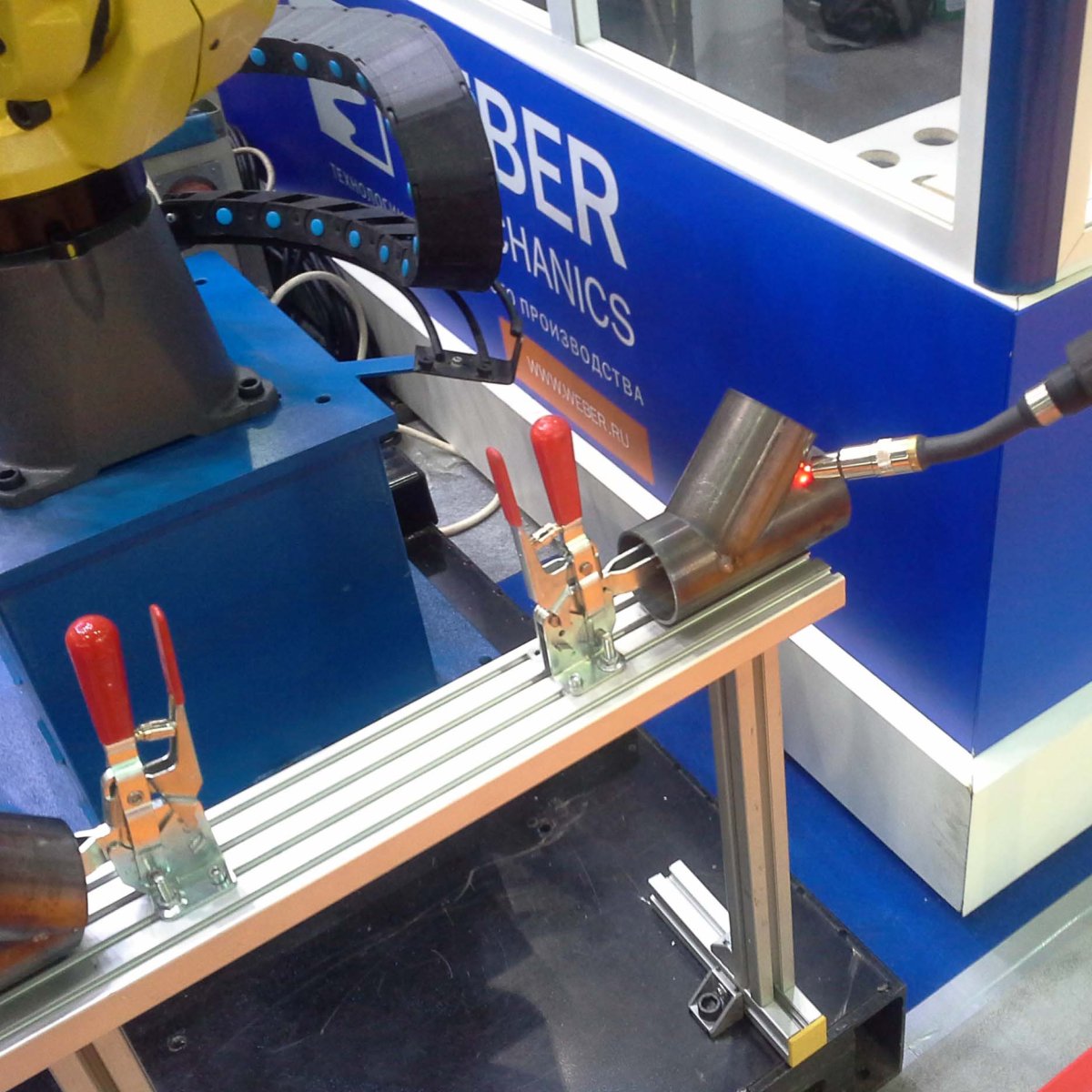
A higher published holding-capacity figure doesn’t, by itself, show which clamp suits a fixture. When evaluating toggle clamp holding capacity, compare exact models, rating definitions, and fixture requirements rather than judging by brand name alone.
This guide explains how to assess the published data, match clamp configurations, and connect a rating to the workholding task. The same model-by-model approach also helps you evaluate Ridiculous Machine Tools horizontal hold-down clamps.
Key Takeaways
- Compare exact DESTACO and JW Winco models using their published rating definitions, not brand names alone.
- Check clamp type, base style, contact arrangement, and load direction before judging whether capacity figures are comparable.
- Choose a clamp configuration that fits the fixture’s mounting space, workpiece contact point, and operating conditions.
- Consider RMT horizontal hold-down clamps as another category, and review each model’s specifications for application fit.
DESTACO vs. JW Winco Toggle Clamp Holding Capacity: What the Rating Tells You
Compare specific DESTACO and JW Winco models using each manufacturer’s published rating definition, not brand names alone. A capacity figure describes a manufacturer-defined limit under stated conditions. It does not tell you, on its own, how much force reaches the workpiece in a particular fixture.
What does a toggle-clamp holding-capacity rating mean?
Holding capacity is the manufacturer’s stated maximum holding force or capacity for a clamp under specified conditions. It is not a direct measure of the clamping force applied to a workpiece in every installation.
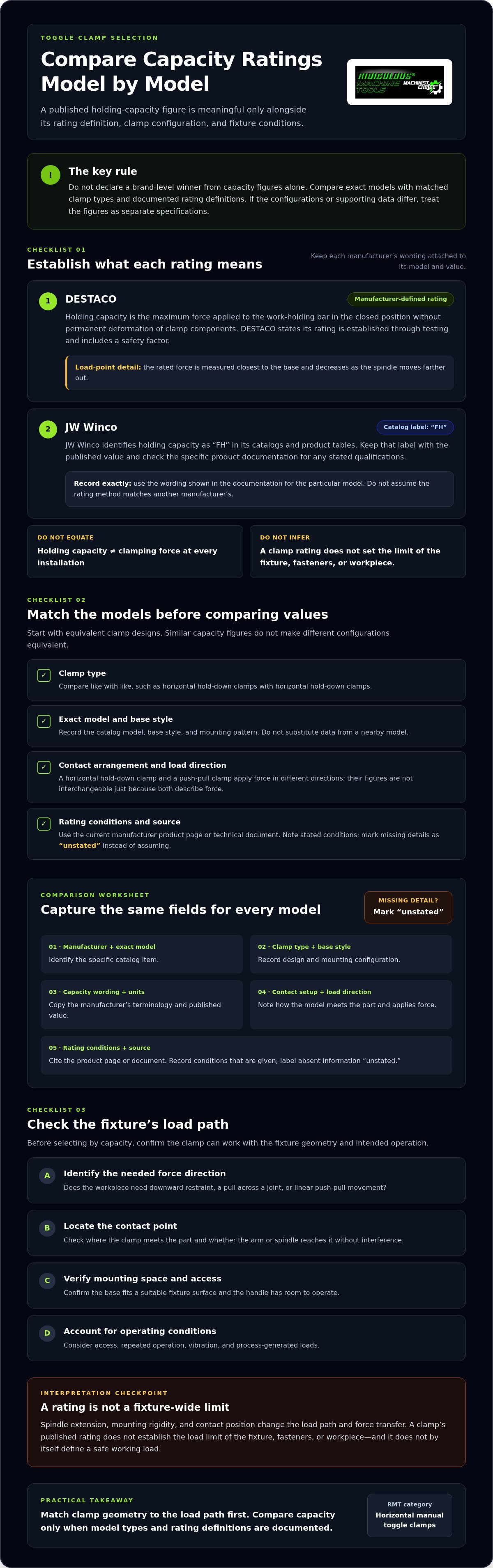
DESTACO defines holding capacity as the maximum force applied to the work-holding bar in the closed position without permanent deformation of clamp components. Its rating is established through testing and includes a safety factor. DESTACO also states that the rated force is measured closest to the base and decreases as the spindle moves farther out.
JW Winco identifies holding capacity as “FH” in its catalogs and product tables. Keep that label with the model’s published value, and review the specific documentation for any stated qualifications. Don’t describe a holding-capacity figure as clamping force unless the manufacturer explicitly defines it that way.
Why brand-level capacity comparisons can mislead
Similar ratings do not mean clamps share the same design or workholding role. A horizontal hold-down clamp and a push-pull clamp, for example, apply force in different directions. Their figures cannot be treated as equivalent just because both are expressed as force.
Fixture setup also affects how the clamp engages the workpiece. Spindle extension changes the load point, while mounting rigidity and contact position affect force transfer. The clamp’s published rating does not establish the load limit of the fixture, fasteners, or workpiece.
Compare models only after accounting for their design, rating language, and stated conditions. Without equivalent configurations and supporting source data, a brand-level winner cannot be established.
How to Compare DESTACO and JW Winco Capacity Ratings Model by Model
A defensible comparison starts with current manufacturer product pages or technical documents for the exact models under consideration. The phrase destaco toggle clamps vs jw winco toggle clamps holding capacity describes a meaningful comparison only when model types and rating definitions are documented. Don’t fill gaps with a nearby model’s data or a typical industry value.
Match clamp type and configuration before comparing figures
Start with equivalent designs, such as horizontal hold-down clamps compared with horizontal hold-down clamps. Then record the details that determine whether the models are genuinely comparable: clamp type, exact model number, base style and mounting pattern, contact arrangement, and intended load direction. Similar capacity figures cannot make different configurations equivalent. Engineering references such as IEEE’s Engineering Principles of Clamping also emphasize the role of force, part geometry, and material properties in clamping systems.
Read manufacturer capacity data without filling gaps
For each model, capture the manufacturer’s exact capacity wording and units, plus any stated test conditions or qualifications. JW Winco uses “FH” for holding capacity in its product tables, so preserve that label alongside the published figure. For DESTACO, copy the wording shown in the specific model documentation. If a condition or configuration detail is not stated, mark it “unstated” rather than assuming both manufacturers use the same method.
A comparison worksheet should include:
- Manufacturer and exact model: identify the specific catalog item.
- Clamp type and base style: record the design and mounting configuration.
- Capacity wording and units: copy the published terminology and value.
- Contact setup and load direction: note the relevant model details.
- Rating conditions and source: cite the product page or document; mark missing information “unstated.”
A valid capacity comparison requires matched clamp types and documented rating definitions. Otherwise, treat the figures as separate specifications, not a head-to-head result. Apply the same model-by-model method when reviewing horizontal manual toggle clamps.
Choose a Toggle Clamp by Load Direction, Fixture Geometry, and Use
Before comparing model ratings, work through these selection checks:
- Identify load direction. Determine whether the workpiece needs downward restraint, a pull across a joint, or linear push-pull movement.
- Locate the contact point. Check where the clamp will meet the part and whether the arm or spindle can reach it without interference.
- Check mounting space. Confirm the base can sit on a suitable fixture surface and the handle has room to operate.
- Review operating conditions. Account for access, repeated operation, vibration, and the loads generated by the process.
Match clamp geometry to the load path before comparing capacity figures. Fixture stiffness, secure mounting, and proper workpiece contact all matter, but they do not replace the manufacturer’s model-specific rating or establish a safe working load on their own.
When a horizontal hold-down clamp fits the fixture
A horizontal hold-down toggle clamp keeps its handle generally horizontal or low-profile in the locked position while the clamping arm presses downward on the workpiece. That orientation can suit fixtures with limited overhead clearance or where a raised handle would obstruct access. Check the arm’s travel and contact point against the part and surrounding tooling. RMT’s horizontal manual toggle clamps provide this clamp category for fixture selection.
Check mounting and contact conditions
Compare the individual model’s base style, mounting requirements, and spindle or contact arrangement with the fixture. A clamp mounted on a flexible plate or contacting the part far from its support creates a different load path from one suggested by the rating alone. Don’t assign a safe working load from the published capacity unless the manufacturer provides guidance for that application.
Latch toggle clamps pull components together, making them suited to securing mating parts or closures. Push-pull straight-line toggle clamps move a plunger to apply linear force. Choose among these and hold-down designs based on the direction and location of restraint the operation needs, then verify the selected model’s documentation.
Where RMT Horizontal Toggle Clamps Fit After the Comparison
The practical decision is model-specific: verify the published holding capacity, confirm the clamp configuration, and check that its mounting and load path suit the fixture. Use the same standard when comparing DESTACO, JW Winco, and RMT. A capacity number alone does not establish that different clamps are interchangeable or suitable for the same operation.
Compare RMT models using the same evidence standard
For an RMT model, review its product page for the listed capacity and configuration details, including material, spindle, base style, and mounting requirements where specified. Keep those figures distinct from DESTACO and JW Winco ratings. Don’t transfer a value or test condition between brands, models, or clamp types. Ridiculous Machine Tools subjects its products to USA-based quality control and inspection against specifications established for each product.
Move from comparison to product selection
RMT horizontal hold-down clamps are relevant when the fixture calls for downward restraint and a handle that remains generally low-profile when locked. Compare each candidate’s individual specifications with the available mounting surface, workpiece contact point, and operating conditions. That makes the destaco toggle clamps vs jw winco toggle clamps holding capacity comparison a starting point for selection, not a substitute for checking application fit.
For additional background, use a professional guide to horizontal toggle clamps alongside the model’s product information. Review the applicable capacity and configuration before selecting a clamp; specifications can vary across a product category.
Browse horizontal manual toggle clamps and review model specifications
Put Your Clamp Selection to Work
Use the destaco toggle clamps vs jw winco toggle clamps holding capacity comparison as a decision tool, not a substitute for reviewing the fixture. Once selected, keep the clamp’s model information with the fixture documentation. This gives operators a clear reference if the setup changes, a component is replaced, or the workholding arrangement moves to another operation.
For a horizontal hold-down application, compare the available configurations with your fixture layout and operating needs, then review the specifications for the exact model. A sound selection connects the manufacturer’s published data to how the clamp will be mounted and used.
Choose a clamp by matching its documented capacity and configuration to the fixture, not by relying on a brand-level comparison. Browse RMT horizontal manual toggle clamps and review the specifications for the model that fits your application.
Frequently Asked Questions
How do you compare DESTACO and JW Winco toggle-clamp holding capacity?
For a useful destaco toggle clamps vs jw winco toggle clamps holding capacity comparison, begin with exact model numbers and current manufacturer documents. Record each model’s clamp type, capacity wording, units, base style, contact hardware, and stated rating conditions. Keep the source with the comparison entry. If a document omits a detail, label it “unstated”; don’t use another model’s information to fill the gap.
Is toggle-clamp holding capacity the same as clamping force?
No. Holding capacity is the manufacturer’s stated maximum holding force or capacity for the clamp, while clamping force is the force applied to the workpiece. Check how the specific model’s documentation defines its figure before using it in calculations or fixture planning. A clamp’s published capacity does not, by itself, tell you the force acting at a particular contact point in your setup.
Can a toggle clamp’s published capacity be used as the fixture’s safe working load?
Not by itself. The clamp rating does not establish the allowable load for the complete fixture assembly. Review the fixture plate, mounting hardware, workpiece support, and how operating forces act on the setup. The clamp and surrounding structure may have different limits. Base the application decision on the manufacturer’s documentation and an evaluation of the actual fixture.
Why can two toggle clamps with similar capacity ratings behave differently in a fixture?
A similar rating does not mean the clamps apply force at the same point or fit the same fixture. A longer reach or different base layout, for example, can change clearance, mounting position, or workpiece contact. Process loads can also make installation conditions relevant. Compare each model’s geometry and setup details, then assess whether they suit the operation instead of relying on the rating alone.
Where can you find current holding-capacity specifications for a specific clamp?
Use the current product page or technical document for the exact model and configuration. Check that the model number matches, and note the document revision or access date in your purchasing or fixture records. Product-family summaries may not show every model qualification. If a document does not state a test condition or configuration detail, leave it unresolved rather than estimating from an older listing or a different clamp.
Article by
Ridiculous Machine Tools Technical Team
The Ridiculous Machine Tools Technical Team provides practical information about precision machine tooling, CNC tooling, workholding, and related manufacturing applications. RMT focuses on helping machinists, manufacturers, fabricators, and other customers understand tooling specifications, compatibility, selection, and proper application. Our technical content draws on product specifications, industry knowledge, and RMT's quality-control experience to provide clear, useful information for selecting and using machine tooling and workholding products.
Ridiculous Machine Tools — Machinist's Choice™