

Selecting BT30 Tool Holders for Drill Tap Centers
Posted by RMT on Nov 18th 2026
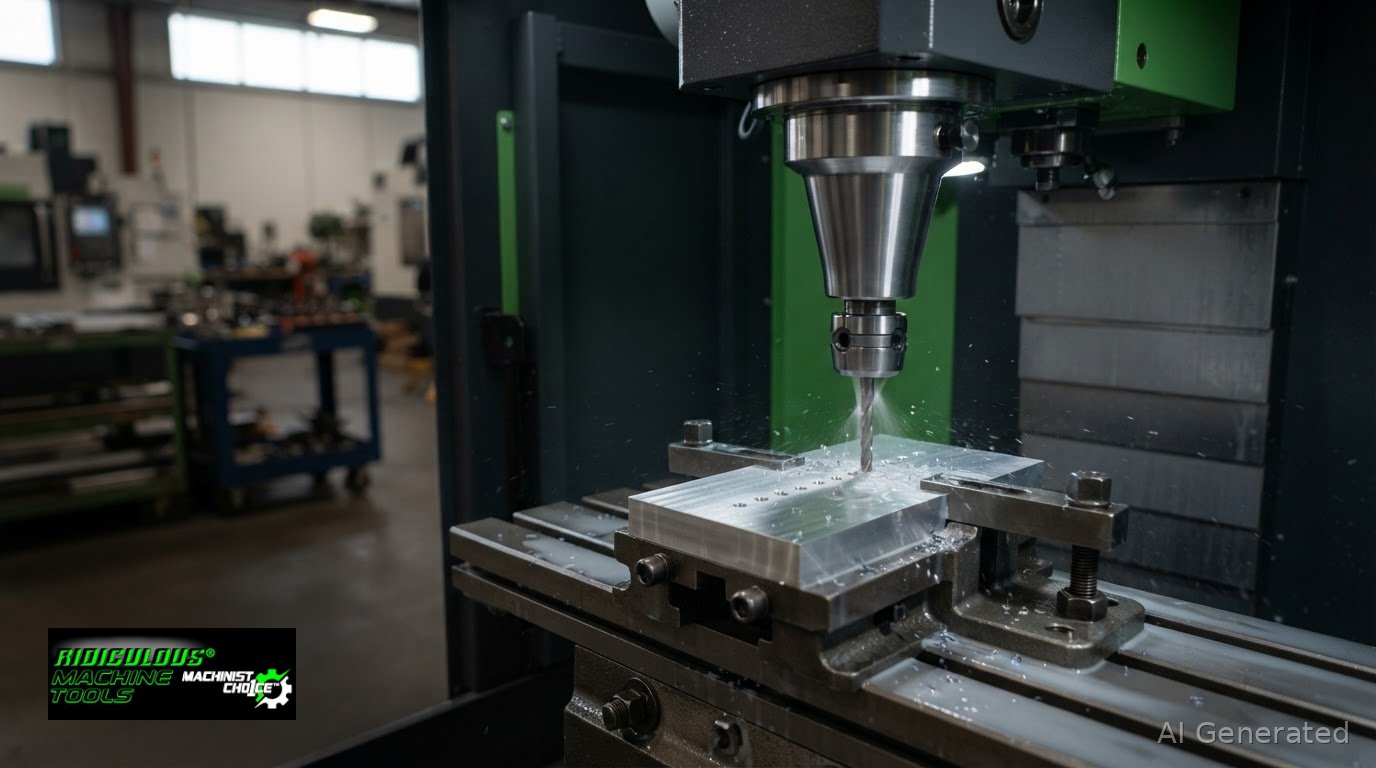
BT30 tool holder selection for high speed drill tap centers starts with the machine’s spindle interface, then turns on contact condition, rotational mass, material, and cutting application. A 15,000 RPM rating should not be assumed for standard BT30 tool holders; speed limits depend on the specific holder and configuration.
Compare those factors against your spindle speed, tool, workpiece material, and cut. This guide explains how each affects holder choice, from light, high-speed machining to applications that place greater demands on rigidity and stability.
Key Takeaways
- Do not assume a BT30 tool holder is rated for speeds up to 15,000 RPM; verify the holder’s rating and spindle compatibility for the application.
- Inspect holder contact surfaces for dirt, scratches, or rust; surface condition can affect contact stiffness and machining accuracy.
- BT30’s lightweight design supports faster spindle acceleration and deceleration, making rotational mass a practical selection factor.
- Match holder choice to the workpiece material and operation, then compare holder specifications for the specific application.
Which Tool Holder Should You Choose?
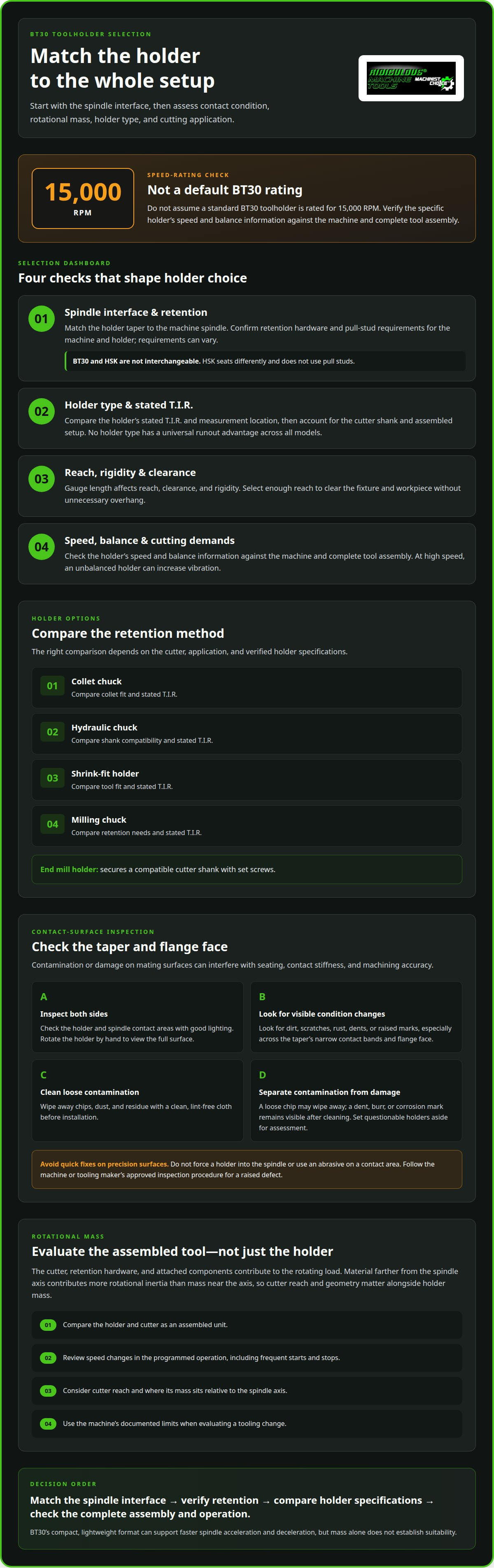
Choose a BT30 holder that matches the spindle interface, retention hardware, cutter, and operation. Compare the complete setup, not the taper label alone; spindle speed, holder design, and cutting demands all affect suitability.
BT30 and HSK Suitability
BT30 suits many high-speed, light-duty jobs and supports small precision work. HSK is another high-speed interface, but it seats differently and doesn’t use pull studs. Clamping force and radial stiffness vary with the interface design, holder, and machine setup, so compare verified specifications for the specific systems rather than assuming a fixed advantage. These systems aren’t interchangeable; the machine spindle determines the interface.
BT30 Holder Types and Runout
Collet chucks, hydraulic chucks, shrink-fit holders, and milling chucks retain cutters through different mechanisms. No type has a universal runout advantage across all models. Compare each holder’s stated T.I.R. and measurement location, then account for the cutter shank and assembly. An end mill holder secures a compatible cutter shank with set screws.
Machine Compatibility and Operating Costs
BT30 compatibility requires the holder taper to match the spindle and the tool interface to suit the cutter. Retention-knob thread types can vary, so confirm that the retention hardware is compatible with both the machine and holder. Pull-stud requirements vary by machine manufacturer. For operating costs, consider compatible tooling, maintenance, and the production needs the setup serves.
Holder Length, Rigidity, and High-Speed Risks
Gauge length affects reach, clearance, and rigidity. Choose a holder that clears the fixtures and workpiece without unnecessary overhang. At high speed, an unbalanced holder can increase vibration, while an incompatible interface can reduce accuracy and shorten tool life. Check the holder’s speed and balance information against the machine and complete tool assembly.
| Holder option | Compare |
|---|---|
| Collet chuck | Collet fit and stated T.I.R. |
| Hydraulic chuck | Shank compatibility and stated T.I.R. |
| Shrink-fit holder | Tool fit and stated T.I.R. |
| Milling chuck | Retention needs and stated T.I.R. |
First match the holder interface to the spindle, then compare retention, runout, reach, and operating demands.
Checking holder contact surfaces
Inspect the BT30 holder’s taper and flange face whenever you attach or remove a tool. Contamination on these surfaces can interfere with proper seating. Use good lighting and rotate the holder by hand to view the full contact area. Look for dirt, scratches, rust, dents, or raised marks.
Before installation, wipe loose contamination from the holder with a lint-free cloth. Check and clean the spindle’s matching surfaces as well. Pay particular attention to the taper’s narrow contact bands and the flange face: a scratch or rust spot across a seating area can affect contact stiffness and machining accuracy.
- Inspect the taper and flange face before each installation.
- Wipe away chips, dust, and residue with a clean cloth.
- Look for visible damage on both holder and spindle contact areas.
- Keep questionable holders separate until their condition is assessed.
Separate surface contamination from damage. A loose chip may wipe away; a dent, burr, or corrosion mark will remain visible after cleaning. Don’t force the holder into the spindle or use an abrasive as a quick fix on a precision surface. Altering a contact area can affect how the holder seats. For a raised defect, follow the machine or tooling maker’s approved inspection procedure.
For repeatable inspections, use the same lighting and viewing angle each time. Note where a mark appears and whether it is on a seating area. If seating or machining results change between setups, inspect the holder and spindle together before blaming the cutter. Clean contact surfaces make comparisons between tool setups more meaningful and help identify visible damage that needs attention.
Spindle acceleration and rotational mass
Rotational mass affects how much effort a spindle needs to change speed. BT30’s compact, lightweight format can support quicker acceleration and deceleration, but the holder is only part of the rotating load. The cutter, retention hardware, and any attached components also contribute. Compare complete tool assemblies when evaluating a drill-tap center’s programmed cycle.
Mass distribution matters as much as total weight. Material farther from the spindle axis contributes more rotational inertia than mass near the axis. A long-reach cutter can therefore affect the assembly differently from a short drill, even when their weights are similar. Consider tool geometry and reach, not just holder body mass.
- Compare the holder and cutter as an assembled unit.
- Review speed changes in the programmed operation, including frequent starts and stops.
- Consider cutter reach and where its mass sits relative to the spindle axis.
- Use the machine’s documented limits when evaluating a tooling change.
For a cycle that alternates drilling and tapping, consider how often the spindle changes speed or direction. A steady milling pass creates a different acceleration profile. Compare the actual tool sequence, not just a general label such as “high speed.” Don’t change holder mass without considering the cutter, retention components, and the machine’s programmed motion.
Keep records for each tooling assembly, noting the holder configuration, cutter type, and operation. If a new setup changes acceleration behavior, compare the complete assembly and programmed cycle before attributing the difference to one component. A lighter holder may be useful, but mass alone doesn’t establish suitability. The spindle, cutter, and operation must work as a system.
A tool holder connects a CNC machine spindle to the cutting tool and transmits rotational power from the spindle to the cutter. Machining-center spindle shapes are defined by ISO standards. Above 8,000 rpm, the spindle receiver expands faster than the shank. Choosing between BT30 and BT40 depends on material type, spindle speed requirements, cutting conditions, machine capability, and production objectives.
Material and application-based holder selection
A sound BT30 tool holder selection for high-speed drill-tap centers starts with the workpiece, cutter, and operation. BT30 is suited to machining aluminum, plastics, composites, and small precision components. Material alone doesn’t settle the choice; cutting load, tool reach, and required stability also shape the setup.
For steel or cast iron, assess the cut rather than choosing by material name alone. Deep cuts and roughing place different demands on a holder than light finishing passes. When an operation creates substantial cutting load, compare the setup’s rigidity with the machine’s capabilities before deciding.
For drilling and tapping, match the holder to the tool shank and the spindle interface. Drilling calls for secure shank retention and suitable runout. Tapping also depends on a compatible tool setup and machine cycle. Check shank geometry, required reach, and workpiece material together. That makes BT30 tool holder selection for high-speed drill-tap centers specific to the actual job, not just the tool category.
- For aluminum, plastics, and composites, weigh speed, reach, and finish needs.
- For drilling, match the retention method to the drill shank.
- For tapping, account for the tap setup and programmed machine cycle.
- For steel or cast iron, assess cutting load and required rigidity.
A short drill in aluminum differs from a long-reach tap in steel. Holder fit, cutter geometry, overhang, and cutting forces interact, so changing one part can affect the whole setup. A further BT30 tool holder selection for high-speed drill-tap centers should account for the tool assembly’s reach and the operation’s load, then confirm spindle and shank compatibility.
Start with the material and operation, then narrow the choice by interface, retention, runout, and reach. This keeps holder selection grounded in the machining task.
Ridiculous Machine Tools: End Mill Holders
Ridiculous Machine Tools offers end mill holders for operations that require a holder to secure a compatible cutter shank. For a drill-tap center, match the holder’s spindle interface to the machine, then confirm cutter shank fit and the holder’s listed specifications. BT30 compatibility depends on the specific holder configuration.
An end mill holder may suit cutters with a compatible shank, including Weldon-flat styles secured by set screws. Before choosing one, compare cutter geometry, required reach, and the operation. Specifications vary by model, so assess the details for the holder you’re considering rather than assuming they apply across models.
Browse end mill holders to compare options for your tooling setup.
Contact Ridiculous Machine Tools to discuss your holder selection.
Make Your Tooling Standard Repeatable
Turn BT30 tool holder selection for high-speed drill-tap centers into a repeatable shop standard. Record the machine interface, the cutter and operation each holder serves, and the conditions approved for that setup. A clear tool-library record helps programmers and operators keep decisions consistent as jobs and tooling requirements change.
Ridiculous Machine Tools offers End Mill Holders for compatible cutter shanks. Choose a holder according to the specific operation and fit, not the category name alone.
Base the selection process on documented machine and application requirements. This gives your team a practical standard for choosing tooling on future jobs.
Make your next tooling decision with a clear standard and a specific application in mind.
Frequently Asked Questions
What is BT30?
BT30 is a BT-family toolholder interface with a 30 taper size. The number identifies the taper class, not the cutter diameter or holder length. BT tooling is used on compatible CNC machine spindles, including drill-tap centers. In a tool library, distinguish BT30 from other taper sizes so the programmed holder configuration matches the spindle and the intended tool assembly.
What BT30 tool holder types are best for high-speed drill tap centers?
No single holder type suits every drill-tap operation. Choose according to the cutter shank, tool-change requirements, and cutting task. An ER collet chuck holds compatible shank sizes with a matching collet; an end mill holder suits a compatible cutter shank secured by set screws. For drilling or tapping, prioritize secure tool retention and a setup suited to the machine cycle.
What spindle speed and balance grade should BT30 holders support for high-speed machining?
Standard BT30 holders can reach speeds up to 15,000 RPM, while balanced BT holders can handle speeds up to 30,000 RPM. Match the holder’s stated speed and balance information to the machine’s programmed maximum and the complete tool assembly. A balance grade alone doesn’t establish suitability if its applicable RPM or the holder’s speed rating falls short.
How much do high-speed BT30 tool holders cost in the United States?
There isn’t one price for every high-speed BT30 holder. The holder type, retention design, balance specification, runout specification, and intended spindle speed affect the purchasing comparison. Compare complete, application-ready configurations rather than holder bodies alone, and account for compatible collets or other required components. Select by machine fit and documented specifications before comparing the purchase cost.
What BT30 pull stud and retention knob specifications does my machine require?
BT holders use metric retention-knob threads, and pull-stud requirements vary by machine manufacturer. Check the machine requirements to confirm the compatible pull stud and retention knob.
Article by
Ridiculous Machine Tools Technical Team
The Ridiculous Machine Tools Technical Team provides practical information about precision machine tooling, CNC tooling, workholding, and related manufacturing applications. RMT focuses on helping machinists, manufacturers, fabricators, and other customers understand tooling specifications, compatibility, selection, and proper application. Our technical content draws on product specifications, industry knowledge, and RMT's quality-control experience to provide clear, useful information for selecting and using machine tooling and workholding products.
Ridiculous Machine Tools — Machinist's Choice™