
R8 ER32 Collet Chuck Guide for Bridgeport Mills
Posted by RMT on Nov 16th 2026
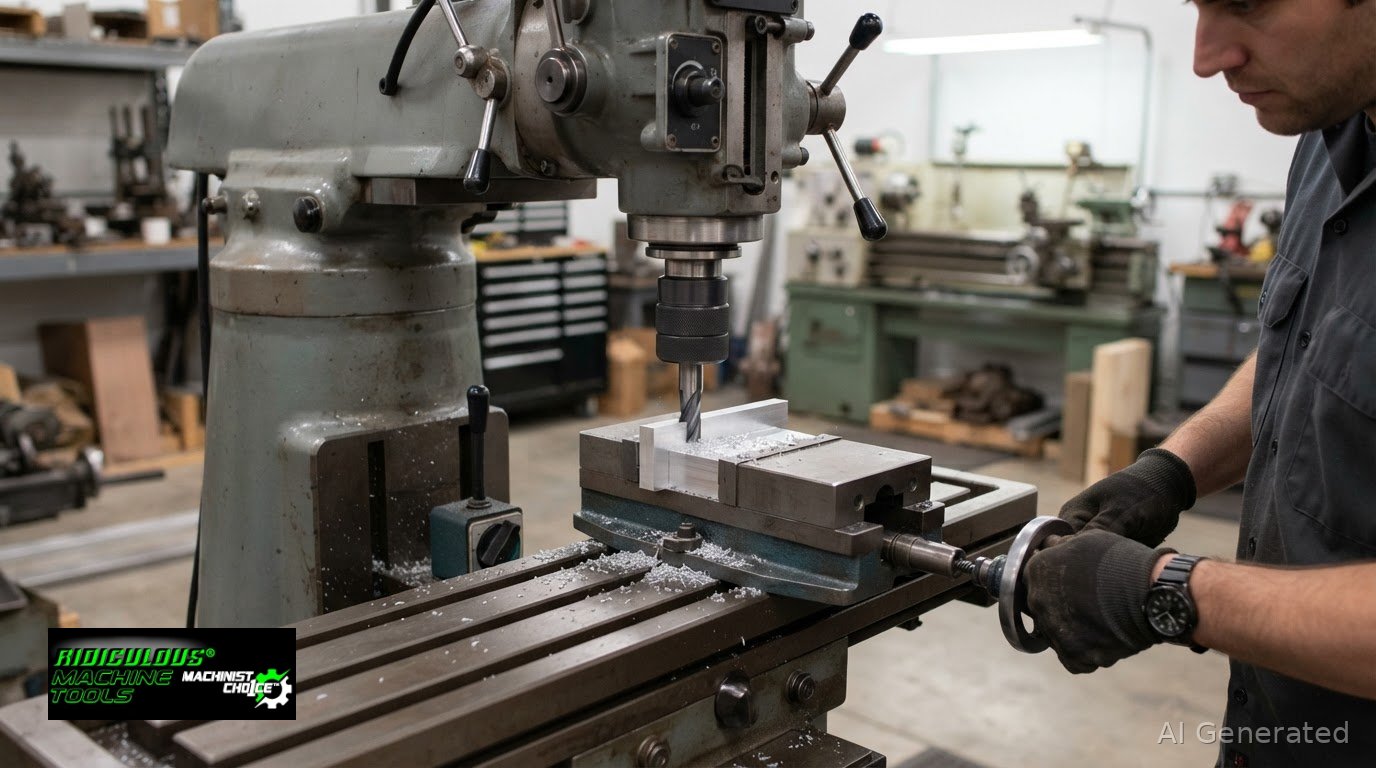
An R8 ER32 collet chuck system for a Bridgeport knee mill combines an R8 spindle connection with an ER32 toolholding interface. Selecting one means considering more than the collet label: the chuck, collet, tool shank, and mill must form a compatible assembly. This guide explains how to evaluate those interfaces and what to consider before choosing the setup for a particular milling task. You’ll learn how collet size relates to shank fit, how dimensions and collapse range affect selection, and why tool engagement and overextension matter during cutting. It also compares an ER collet chuck with R8 collets and end mill holders, outlines fit and specification checks, and explains when a different holder style may suit the cutter better. Use these points to assess compatibility, usable clearance, and the kind of toolholding your operation calls for before selecting equipment for a Bridgeport mill.
Key Takeaways
- Match the collet’s nominal size to the tool shank diameter, then confirm the collet’s specified collapse range.
- Use the chuck and collet dimensions to assess how the assembly fits the R8 spindle setup and available Z-space.
- Evaluate how much straight shank the collet grips; excessive tool extension can compromise secure engagement.
- Compare an ER collet chuck with an end mill holder based on the cutter shank and the demands of the milling operation.
Choosing the correct collet size
Start with the cutter’s shank diameter, not its cutting diameter. ER collets are available in 1 mm or 0.5 mm size steps. Match the nominal collet bore to the measured shank, then compare that measurement with the collet’s stated collapsible range. A correct fit grips the shank firmly without looseness.
Keep the unit system consistent. Match a metric shank with a collet specified for its metric diameter, and an inch shank with the corresponding inch size. Don’t choose a nearby bore just because the collet seems to close around the tool. Its specified gripping range determines whether it can hold the shank properly.
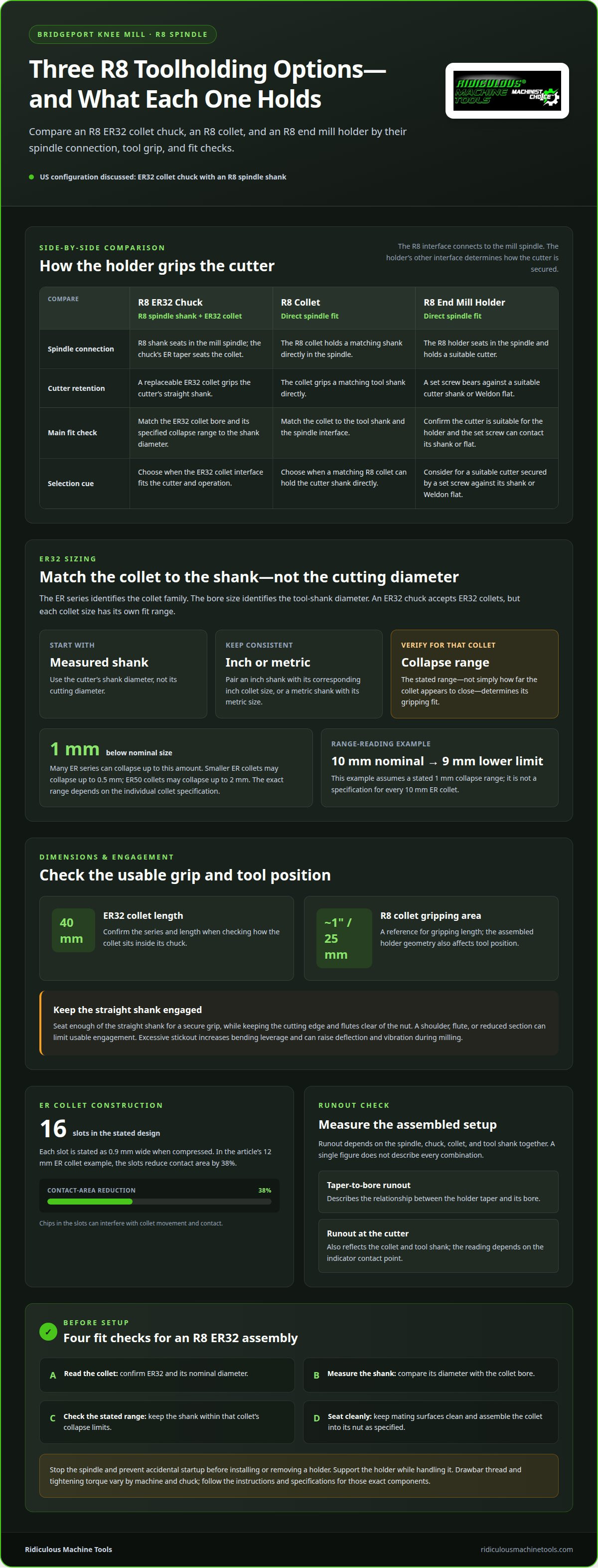
An R8 ER32 chuck holds a cutter in a replaceable ER32 collet. An R8 collet holds a matching shank directly in the spindle, while an R8 end mill holder secures a suitable cutter with a set screw against its shank or Weldon flat. Choose the interface that suits the cutter and operation.
For U.S. models, the relevant configuration is an ER32 chuck with an R8 spindle shank. The designation identifies the chuck’s collet series and spindle interface; the manufacturer’s model name is a separate identifier.
Runout on a Bridgeport mill depends on the complete assembly: spindle, chuck, collet, and tool shank. One runout figure cannot describe every combination. A measurement applies to the assembled setup and the specific point where the indicator contacts the tool.
Before installing or removing a holder, stop the spindle and prevent accidental startup. Support the holder while handling it, and follow the mill and holder instructions for drawbar engagement and release. Drawbar thread and tightening torque vary with the machine and chuck, so use the specifications for those exact components rather than assuming a universal value.
Collet dimensions and specifications
An ER32 collet measures 40 mm long, a key dimension when checking how the collet sits inside its chuck. Confirm the series and length before assembling components. ER32 identifies the collet family, while the bore size identifies the shank diameter held. Those dimensions describe different aspects of fit and should not be treated as interchangeable.
The R8 spindle interface and ER collet taper serve separate connections in the assembly. The R8 shank seats in the mill spindle; the ER taper seats the collet in the chuck. Their tapers are within 25 minutes of one another, but this does not make the interfaces interchangeable. Correct seating still depends on the specified mating geometry of each component.
R8 collets have a gripping area about 1" or 25 mm long. That figure provides a reference for evaluating the available gripping length, but the assembled chuck’s geometry also affects tool position. Compare the cutter’s straight shank with the collet’s contact area and the chuck’s internal arrangement. A shoulder, flute, or reduced section can limit usable engagement.
ER collets use slots to flex as the nut compresses the collet. The stated design has 16 slots, each 0.9 mm wide when compressed. For a 12 mm ER collet, those slots reduce contact area by 38%. This illustrates why the slotted spring structure differs from a solid sleeve. Chips in the slots can interfere with movement and contact.
Dimensions alone don’t establish the runout of an assembled tool. Taper-to-bore runout describes the relationship between a holder’s taper and its bore; runout measured at the cutter also reflects the collet and tool shank. Keep these measurement points distinct when interpreting specifications or diagnosing a setup.
ER collet sizes and collapse range
ER collet series run from ER8 through ER50, including ER32. The series identifies the collet and chuck family; the nominal bore identifies the tool-shank diameter. An ER32 chuck therefore takes ER32 collets, but it doesn’t hold every shank size equally. Match the individual collet bore and its stated collapse range to the tool.
The collapsible range is the diameter interval over which a collet can close and grip. Most ER series can collapse up to 1 mm below nominal size. Smaller ER collets can collapse up to 0.5 mm, while ER50 collets can collapse up to 2 mm. These are not interchangeable assumptions: the exact range depends on the collet size and its specification.
For a nominal 10 mm collet with a 1 mm stated range, the lower limit is 9 mm. That example illustrates how to read a range, not a specification for every 10 mm ER collet. A tool shank below the stated minimum may not receive proper support. A shank above the nominal bore won’t enter the collet correctly.
Collet collapse isn’t a substitute for selecting the correct bore. A collet should grip the shank firmly within its rated range. Excessive closure can distort contact and reduce reliable engagement. On a Bridgeport mill, the cutter’s shank needs to resist cutting forces without shifting in the holder.
- Read the marking: Confirm ER32 and the collet’s nominal diameter.
- Compare the shank: Use the actual tool-shank diameter, not its cutting diameter.
- Check the range: Keep the measured shank within that collet’s stated collapse limits.
- Seat it correctly: Keep the collet and mating surfaces clean, then assemble the collet into its nut as specified.
A collet set can cover multiple shank diameters, but each included size still has its own range. Select ER32 collets by individual bore and stated limits, not by series name alone.
Tool-shank engagement and overextension
Keep the cutter’s straight shank engaged deeply enough for the ER32 collet to grip securely. Most of the available shank should sit inside the collet, with the cutting edge and flutes clear of the nut. Excessive stickout increases bending leverage, which can raise deflection and vibration during milling.
For heavy milling or large cutters, an ER32 chuck can face greater cutting loads and greater leverage from tool overhang. If the shank slips, the cutter may move axially during the cut and damage the workpiece. A cutter that works out of its collet can cut a ramp across the surface.
Bridgeport knee-mill clearance also matters. An ER collet chuck may reduce available Z-space by about 5 inches compared with an R8 collet setup. That change can limit cutter reach, workpiece height, or fixture clearance. Check the assembled holder length against the job before committing to a setup.
A short R8 holder can create another tradeoff. An ER32 chuck fitted to a 3/4-inch R8 holder can slip out more easily during bit changes. Keep the holder seated while loosening the nut, and avoid using the cutter as a lever. The R8 interface and drawbar secure the holder in the spindle; the ER32 collet grips the tool shank.
Before cutting, inspect the usable shank length, shoulder location, and collet position. Make sure the collet grips the cylindrical shank, not the flutes, a reduced neck, or an unsupported transition. With a long-reach cutter, reduce overhang where the job allows and choose a toolholder suited to the cutting load.
- Short shank: Confirm it provides enough engagement without bottoming in the chuck.
- Long overhang: Consider deflection, vibration, and available knee-mill clearance.
- Heavy cut: Watch for tool movement and surface marks that indicate loss of grip.
Ridiculous Machine Tools: End Mill Holders
Ridiculous Machine Tools offers end mill holders as an alternative when a cutter’s shank and operation favor a dedicated holder over an ER32 collet setup. R8 end mill holders match R8 spindle tooling on compatible Bridgeport mills.
An end mill holder secures a compatible cutter with a set screw against its shank or Weldon flat. This can suit cutters with a matching flat, while an ER chuck holds tools using size-matched ER collets. Choose based on spindle interface, cutter shank, required reach, and cutting demands. Holder specifications vary, so compare the details for each product.
For a Bridgeport setup, consider an R8 end mill holder when its cutter interface fits the tool and job. Contact Ridiculous Machine Tools to discuss end mill holder options for your application.
Plan the Next Tooling Decision
For an R8 ER32 collet chuck system for a Bridgeport knee mill, make the next decision part of the shop’s job-planning process. Record the selected tooling configuration with the operation so machinists and purchasing staff share a clear reference when that work returns. This also makes future tooling decisions easier to compare against the actual job, rather than relying on memory or a general preference.
Ridiculous Machine Tools offers End Mill Holders for shops considering another toolholding option. The selection also includes Horizontal Toggle Clamps, Latch Toggle Clamps, and Vertical Toggle Clamps for fixture and workholding needs. Match your choice to the task, then proceed with a clear basis for the purchase.
A well-documented tooling choice gives your team a practical starting point for the next setup.
Frequently Asked Questions
What Is A Collet & what Are Collets Used for?
A collet is a segmented sleeve that grips a cylindrical tool or workpiece when its holder tightens. On a Bridgeport mill, it can hold a cutter by its shank; in a suitable fixture, it can also hold a small part. The collet’s size and series must match the holder, and its bore must suit the item being gripped.
What is an R8 ER32 collet chuck system for a Bridgeport knee mill?
It is a toolholding assembly that joins an R8 spindle interface to an ER32 collet system. The R8 end mounts in the mill spindle, and the ER32 chuck body, nut, and selected collet hold a compatible tool shank. This combination lets the operator change collet bores while retaining an R8 spindle connection.
Will an R8 ER32 collet chuck fit a Bridgeport spindle?
Yes, if the chuck has an R8 shank made to fit the machine’s R8 spindle. The chuck’s ER32 designation describes the collet interface, not the spindle connection. Confirm that the holder’s R8 interface and drawbar arrangement match the specific Bridgeport mill; an ER32 chuck with another spindle taper will not directly fit an R8 spindle.
What are the dimensions and capacity range of ER32 collets?
An ER32 collet is 40 mm long. Its gripping capacity depends on the individual collet’s nominal bore and stated collapse range, not on one continuous range for every ER32 collet. For selection, distinguish the collet’s overall dimensions from the tool diameter it grips. Use the specific collet’s size marking and range to determine fit.
How to choose ER32 collet sizes and accessories for a Bridgeport knee mill?
Choose the collet bore for the tool’s shank, then pair it with an ER32 chuck and compatible ER32 nut. A wrench suited to that nut supports tightening and release. For example, a cutter with a cylindrical shank needs a collet bore that grips that shank, while a tap with a square drive calls for a compatible tap collet. Keep mating parts clean and matched by series.
How accurate is ER32 collet chuck runout on a Bridgeport mill?
Runout depends on the assembled spindle, chuck, collet, and tool shank, as well as where it is measured. One reported typical ER-collet runout is 0.01 millimeters, but it does not describe every Bridgeport setup.
Article by
Ridiculous Machine Tools Technical Team
The Ridiculous Machine Tools Technical Team provides practical information about precision machine tooling, CNC tooling, workholding, and related manufacturing applications. RMT focuses on helping machinists, manufacturers, fabricators, and other customers understand tooling specifications, compatibility, selection, and proper application. Our technical content draws on product specifications, industry knowledge, and RMT's quality-control experience to provide clear, useful information for selecting and using machine tooling and workholding products.
Ridiculous Machine Tools — Machinist's Choice™