

Precision milling: Everything You Need to Know
Posted by RMT on Oct 26th 2026
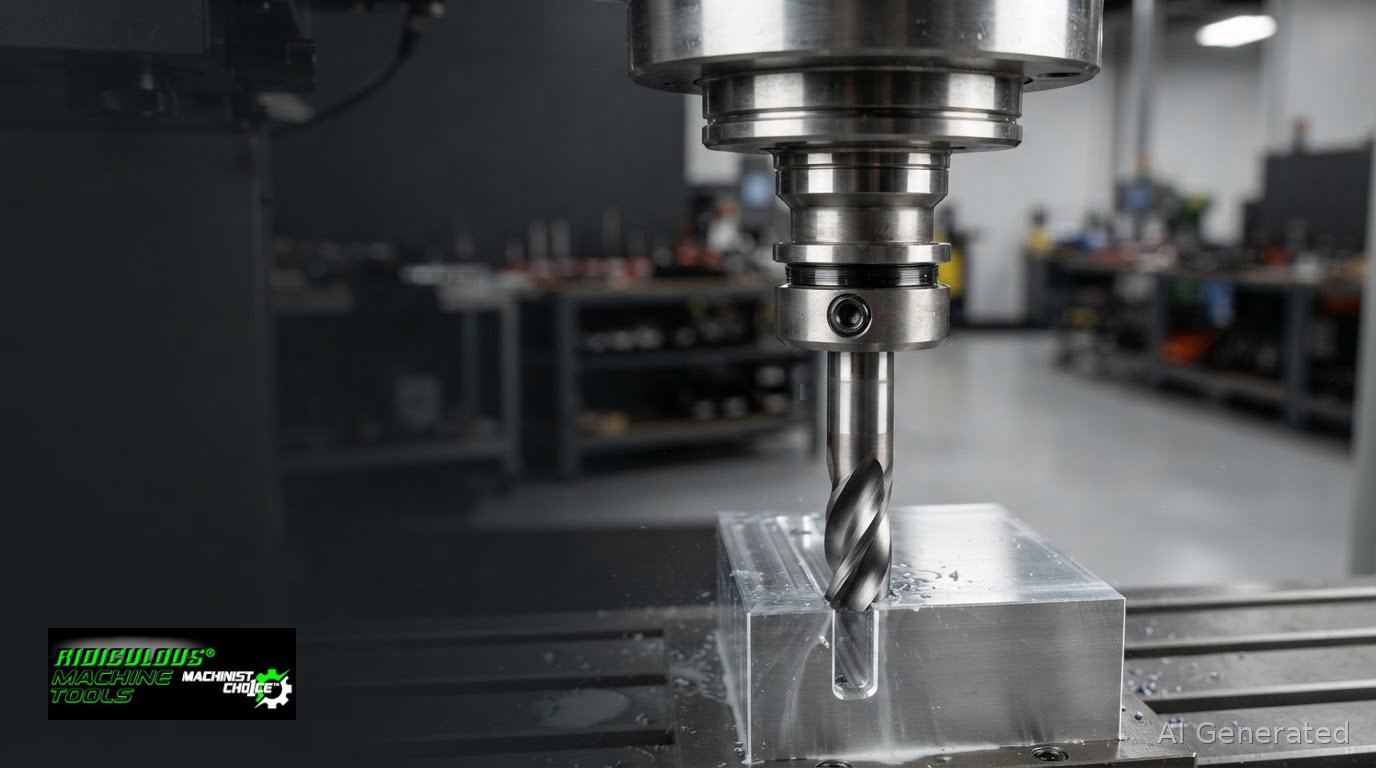
Choosing precision end mill holders starts with matching the holder to both the machine spindle and the cutter. The spindle interface, cutter shank, retention arrangement, and product-specific specifications all affect whether a holder fits the setup and suits the operation.
This guide explains how to compare those details, interpret T.I.R. in context, and select among Ridiculous Machine Tools (RMT) CAT40, CAT50, and R8 end mill holders using the specifications published for each product.
Key Takeaways
- Match the holder’s spindle interface to the machine, then confirm the cutter shank diameter and retention arrangement.
- For a side-lock holder, check that its set screw aligns with a compatible shank surface, commonly a Weldon flat.
- Read a holder’s stated T.I.R. as a measurement of the specified product feature, not the complete tool-and-holder assembly.
- Compare the exact model’s published specifications. Values for one holder do not automatically apply to other sizes or taper families.
What Precision End Mill Holders Do in a Milling Setup
An end mill holder connects a compatible cutter shank to a machine spindle. Its spindle interface seats in the machine, and its bore accepts the cutter shank. Check both connections: a holder that matches the spindle still needs the correct bore and retention arrangement for the cutter. CAT40, CAT50, and R8 are distinct interfaces, not interchangeable labels. RMT groups its end mill holders by interface.
How a side-lock holder secures an end mill
In a side-lock holder, the cutter shank enters the bore and a set screw bears against a compatible surface, commonly a Weldon flat. The shank diameter, flat position, and screw alignment all matter. If they do not match, the cutter may not seat correctly or the screw may contact an unsuitable part of the shank. Compare the cutter geometry with the holder’s specified configuration before setting up the tool.
Where runout fits into the tool assembly
T.I.R. (Total Indicator Runout) is the total variation shown by an indicator as a surface rotates through a measurement. It describes a measured condition at a particular location, not a general measure of machining accuracy. For background on milling operations and cutting tools, see Milling (machining).
A holder’s stated T.I.R. applies to the product and configuration identified in its specification. It does not automatically describe the complete spindle, holder, and cutter assembly. Spindle condition, clean and properly seated interfaces, holder fit, and cutter condition can all affect assembled-tool runout. A measurement at the holder bore also may not represent runout at the cutter’s cutting edges, so compare figures only in their stated measurement context.
Does a Precision End Mill Holder Reduce Runout by Itself?
No. A holder’s T.I.R. specification describes a stated measurement of that product or feature, not the runout of every component after assembly. The holder is one part of the setup; spindle condition, fit, and cutter condition also affect the reading at the tool. Treat the published value as one comparison point, not a guarantee of finished-part accuracy.
What a T.I.R. specification tells you
T.I.R. is the total variation recorded by an indicator as the measured surface rotates. Its meaning depends on the surface being checked and the indicator’s contact location. A taper-to-bore specification describes the relationship between those features in the holder. It does not state the runout at the cutter’s cutting edges or establish a finished-part tolerance.
For certain RMT CAT40 end mill holders, the applicable product specifications state 0.0002" to 0.0003" T.I.R. and 58 to 62 HRC. These values apply only to products whose listings include them. The Precision Machined Products Association (PMPA) offers broader industry resources, but a holder comparison should be based on the measurement description and details for the specific product.
Why the complete setup still matters
Runout can affect how consistently the cutter edges engage the work, with potential effects on tool wear and surface finish. Spindle condition, holder seating, shank fit, and cleanliness can all influence the assembled reading. If a measurement differs from expectations, inspect these factors as well as the holder rather than assigning the entire result to one specification.
For model-specific details, compare the applicable RMT end mill holder listings. Do not transfer a specification from one model or taper family to another unless it is stated for both.
How to Select Precision End Mill Holders for Your Machine
Use three checks to narrow your options: identify the spindle interface, match the cutter shank and retention features, then review specifications for the exact holder model. This sequence helps distinguish actual compatibility from a familiar taper label or a general product description.
Match the holder to the spindle and cutter
- Identify the spindle interface. Check the machine documentation or existing tooling to determine whether the spindle uses CAT40, CAT50, or R8. These interfaces are distinct, so select a holder with the matching interface.
- Confirm the cutter shank. Compare the cutter’s shank diameter and retention features with the holder listing. For a side-lock holder, confirm that the set screw can engage the cutter’s compatible flat as intended. A matching spindle taper alone does not establish cutter fit.
- Review the relevant specifications. Read the applicable product page for stated T.I.R., hardness, balance, or coolant details. Treat each value as specific to the listed product and configuration, not as a feature shared by every holder in that taper family.
For example, a CAT40 spindle and a cutter with a 1/2" shank require a holder that matches the machine interface and the cutter’s shank and retention arrangement. Confirm those details for the individual product. RMT groups CAT40, CAT50, and R8 end mill holders by interface to make the initial comparison easier.
Compare specifications without assuming they are universal
Use T.I.R. to compare the stated runout measurement. Review balance or coolant information when the exact product listing provides it and the specification matters to your setup. These details do not replace checks for spindle fit and cutter compatibility. A value shown for one model should not be applied to another size or taper family without product-specific support.
Keep the comparison tied to the machine, cutter, and operation. The individual product details provide the basis for choosing a suitable configuration.
Compare RMT end mill holders by spindle interface
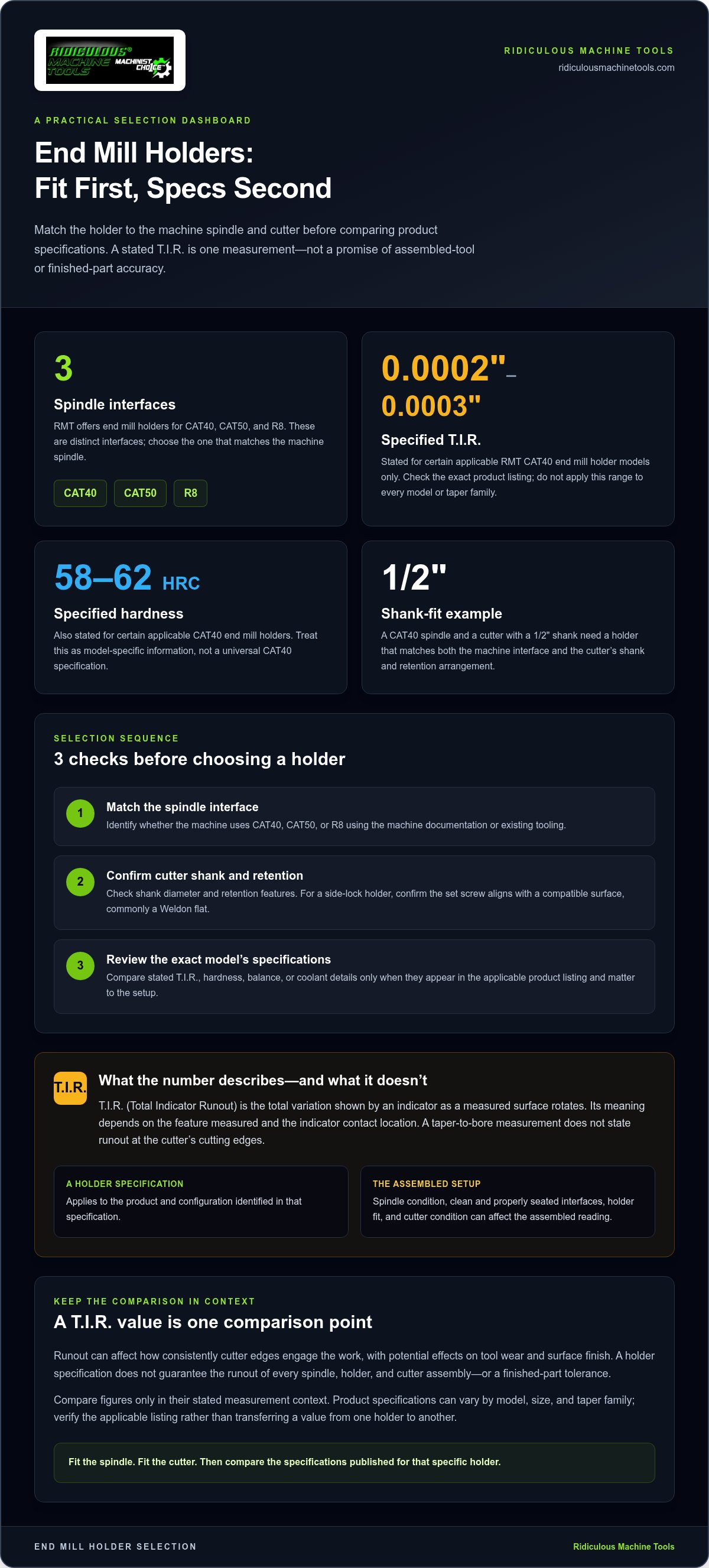
Choose and Compare RMT Precision End Mill Holders
Confirm the machine interface and cutter shank before comparing product specifications. RMT offers CAT40, CAT50, and R8 end mill holders, with specifications that can vary by model and size. The table summarizes the interface families and the verified T.I.R. information available for certain CAT40 models. Use the individual listing for the details of a specific holder.
Compare verified product details
| Interface | Cutter-shank fit | Verified T.I.R. | Application notes |
|---|---|---|---|
| CAT40 | 0.0002"-0.0003" for certain applicable models | Match the holder to the machine interface; check model-specific details. | |
| CAT50 | Match the holder to the machine interface; check model-specific details. | ||
| R8 | Match the holder to the machine interface; check model-specific details. |
Blank cells mean this comparison does not provide a verified value. They do not indicate that a product lacks a specification. For certain CAT40 holders, applicable product information also states 58 to 62 HRC. Both the T.I.R. and hardness figures apply only to models whose listings include them.
Use the individual listing to confirm shank diameter and retention details. The spindle interface alone does not establish cutter fit. The same principle applies to balance and coolant specifications: consider them only when they are documented for the exact configuration and relevant to the operation. General selection guidance helps frame the comparison; the product listing establishes the specifications for a particular holder.
Find the matching holder category
Start with machine compatibility, then check cutter fit and the documented requirements of the milling operation. Compare the applicable listing rather than carrying a specification across models. Browse RMT end mill holders to compare CAT40, CAT50, and R8 options.
Make the Next Holder Choice with Confidence
Keep the selected holder model and its verified product details with the setup documentation. That record gives machinists a consistent reference when a holder is replaced or a setup is repeated, and it helps distinguish a process change from a tooling substitution.
Ridiculous Machine Tools performs USA-based quality control and inspection according to the specifications established for each individual product. Use those product-specific details to compare holders on documented terms and retain the listing with the setup record, rather than relying on memory or assumptions about an entire product category.
For your next selection, compare RMT end mill holders by spindle interface and review the specifications for the exact model.
Frequently Asked Questions
Can I measure runout with an end mill installed?
Yes. An indicator can measure runout on an assembled setup, but the contact point determines what the reading describes. A reading on the cutter shank differs from one taken near the cutting edges, and neither is the same as a holder’s published taper-to-bore specification. Follow appropriate machine and measurement procedures, and use a consistent measurement location when comparing setups.
Does an end mill holder require a Weldon-flat cutter?
Not in every case. Side-lock holders commonly use a set screw against a compatible shank surface, often a Weldon flat, but holder and cutter configurations vary. Check the holder’s stated shank diameter and retention details against the cutter drawing or product information. Do not assume every holder uses the same set-screw arrangement, or machine a flat into a cutter without authoritative guidance.
Can coolant pass through every end mill holder?
No. Coolant-through capability depends on the holder’s design and configuration. Check the exact product listing for an explicit statement before planning coolant delivery through the toolholder. The taper type, holder category, or a similar model’s features do not establish coolant-through capability. Do not base a setup on assumed pressure, flow, or coolant performance.
Does a lower holder T.I.R. guarantee a more accurate finished part?
No. T.I.R. describes a measured condition, not a guarantee of finished-part accuracy. The machine, cutting tool, setup, workholding, and cutting conditions all contribute to the result. If a part misses its tolerance, assess the complete process and verify the finished feature with an appropriate inspection method. A holder specification informs selection but cannot predict the outcome on its own.
Article by
Ridiculous Machine Tools Technical Team
The Ridiculous Machine Tools Technical Team provides practical information about precision machine tooling, CNC tooling, workholding, and related manufacturing applications. RMT focuses on helping machinists, manufacturers, fabricators, and other customers understand tooling specifications, compatibility, selection, and proper application. Our technical content draws on product specifications, industry knowledge, and RMT's quality-control experience to provide clear, useful information for selecting and using machine tooling and workholding products.
Ridiculous Machine Tools — Machinist's Choice™