

Mini Nut vs Standard Hex Nut: Mold Cavity Clearance
Posted by RMT on Nov 17th 2026
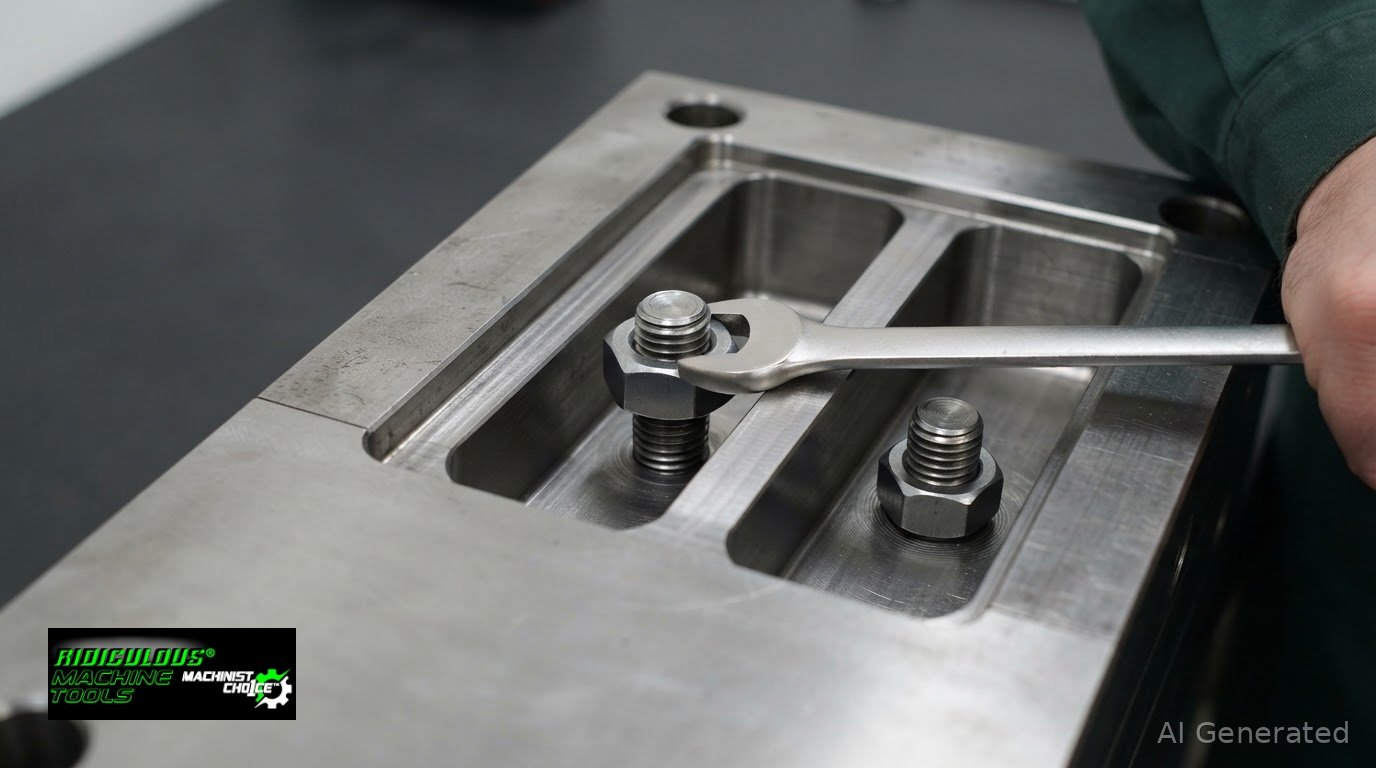
For mini nut vs standard hex nut clearance in tight mold cavities, compare across-flats width, nut height, and the space needed to turn a wrench or socket. The label “mini” alone does not establish fit. Hex geometry and tool access both affect installation and service in narrow slots and deep cavities.
Key Takeaways
- Measure both the nut’s height and its across-flats width; reduced height does not necessarily mean a smaller wrench envelope.
- Use the cavity opening and the wrench or socket’s turning path to assess access, especially in a narrow slot or deep pocket.
- Compare jam nuts by nominal size and thread compatibility: their thinner profile can save axial space while retaining the standard hex width.
- Choose the nut only after considering installation access and the fastening demands of the joint, not appearance or profile alone.
Wrench and tool clearance requirements
A comparison of mini nut vs standard hex nut clearance in tight mold cavities starts with the cavity opening, nut width across flats, and tool approach angle. A thinner nut can reduce axial space, but it may not reduce the wrench envelope. A standard 1/4-inch hex nut has a basic width across flats of 7/16 inch. The socket or wrench still needs room to fit and turn without striking the mold wall.
In a narrow slot, compare its width with both the nut’s across-flats dimension and the tool’s outside dimensions. In a deep pocket, also allow for handle swing and extension access. Standard hex jam nuts share the across-flats dimensions of standard hex nuts, so the same wrench fits both. Heavy hex nuts need more tool clearance than standard hex nuts. Check the actual tool, not just the fastener profile.
Do not assume mini hex nuts match standard nuts in strength or load capacity. Capacity depends on the nut’s material and specification, thread engagement, and mating bolt; a thin profile alone does not establish a rating. A jam nut is a locking component, not a structural substitute for a full-height nut.
To prevent a hex nut from rotating inside a mold cavity, capture its flats in a matching hex pocket or use a suitable anti-rotation feature in the fixture design. The pocket must let the nut seat and the fastener engage correctly. For a double-nut locking arrangement, thread the jam nut onto the bolt first, then tighten the full-sized nut against it while holding the jam nut with a wrench.
In a plastic injection mold, a mini nut with insufficient thread engagement can strip or pull out under tightening or service loads. Consider the nut specification, engaged thread length, surrounding material, and load path. Stainless steel describes the material, not a load rating.
| Option | Axial profile | Wrench clearance | Selection point |
|---|---|---|---|
| Standard hex nut | Full height | Standard hex envelope | Use where thread engagement and cavity depth allow. |
| Standard hex jam nut | Thinner | Same wrench size as standard hex | Use for reduced height, not as a full-height structural nut. |
| Heavy hex nut | Full height | More clearance than standard hex | Confirm cavity and tool access before installation. |
First verify the nut specification and thread engagement, then confirm that the wrench can reach and turn it inside the cavity.
Clearance for narrow slots and deep mold cavities
Measure the cavity at the fastener position, not just at its opening. A narrow slot may accept a nut but block the tool needed to install it. In a deep pocket, account for access along the full path from the opening to the threaded hole. The limiting dimension may be the socket body, extension, or handle angle.
A thin nut takes up less axial space, but may have the same hexagonal footprint. A square nut can resist rotation when captured by a matching pocket, though its corners need adequate clearance. A threaded insert is another option when the mold component needs internal threads. Each choice affects installation, retention, and load transfer.
For an insert in a plastic mold component, evaluate the base material, thread engagement, installation method, and repeated service loads. Pullout resistance depends on how the insert engages with the surrounding material, not simply on its internal thread size. In a metal component, available wall thickness and thread depth also guide selection. Corrosion resistance matters when moisture or process exposure affects the fastener material.
- Thin nut: Reduces height; verify that the wrench still fits the hex flats.
- Square nut: Can be captured against rotation in a matching pocket; allow room for its corners.
- Threaded insert: Provides internal threads in the component; assess the surrounding material and pullout loads.
Use this sequence before fixing the design:
- Record the slot width, cavity depth, and fastener position.
- Check the nut’s external dimensions against the cavity and installation path.
- Test the intended wrench, socket, or driver for access and turning clearance.
- Assess thread engagement, retention, and strength for the component materials.
For example, a thin nut may fit beneath a cavity roof but remain impractical if a socket cannot reach it. A captured square nut may prevent rotation but fail to fit if its corners interfere with nearby features. Choose an arrangement that fits the cavity and supports the mechanical load path, then confirm access using the actual tool geometry.
Hexagonal nut design
A hexagonal nut has six flat sides that give a wrench defined contact surfaces during assembly. Flats, corner radii, and dimensional tolerances all affect cavity fit: the flats set the nominal wrench size, while corners and part variation can interfere with a close-fitting pocket.
Nut Flats and Cavity Fit
The across-flats dimension is measured between opposing faces and determines the basic wrench size. In a mold pocket, it also affects how closely the nut fits between parallel walls. A hex nut’s corners extend beyond its flats, so a cavity sized only around the across-flats dimension may not accept the nut fully. Compared with a square nut, a hex nut offers more wrench orientations but has a different corner envelope.
Tolerances and Cavity Fit
Tolerances define the permitted variation in a nut’s dimensions and the cavity it enters. If both parts approach their maximum material dimensions, a nominally matching fit may bind during assembly. Corner radii and chamfers also change contact points, so the pocket’s internal corners must accommodate the nut’s actual profile. Evaluate the nut and cavity tolerances together, rather than as separate nominal values.
For example, a hex nut in a machined hexagonal recess may resist rotation as its flats bear against the pocket walls. Too much clearance can allow movement during tightening; too little can prevent the nut from seating. The right balance depends on the fastener position, assembly access, and whether the pocket must locate the nut or simply prevent rotation.
Nut geometry suits different applications. Hex nuts are common in machinery, construction, and automotive assembly because a wrench can engage their six sides. Square nuts offer broader flat faces for capture in some fixtures, while round nuts suit specialized arrangements. No profile alone establishes structural capacity; thread engagement, material, and the applicable nut specification also matter.
Profile and material also affect service conditions. A stainless nut may provide corrosion resistance where moisture is present, but material selection does not solve a poor cavity fit. In a mold assembly, confirm that the nut seats without rocking, the wrench engages its flats, and adjacent components remain clear. These checks address both geometry and installation needs.

Nut dimensions and clearance
Compare nut height, width across flats, and corner profile with the cavity and fastener position. These dimensions affect seating, tool access, and the surrounding mold material.
Wall Thickness and Edge Distance
Wall thickness is the material surrounding the nut pocket; edge distance is the material between the pocket and a nearby boundary. Set both based on the mold material, nut dimensions, fastening load, and pocket location. A thin wall or short edge distance can weaken support around the fastener, while excess material may limit cavity clearance. Evaluate the load path and mold geometry together.
Available Mini Hex Nut Standards and Sizes
“Mini” describes a compact profile, not a dimensional specification by itself. For documented standard hex nuts and jam nuts in the inch series, nominal sizes start at 1/4". A standard 1/4" hex nut measures 7/16" across flats and has a basic thickness of 7/32"; its jam nut has a basic thickness of 5/32". Match the nut’s documented size, thread, and dimensional form to the bolt.
Measuring Nut Clearance in CAD
In CAD, measure the nut envelope across flats, across corners, and through its height. Position the model at the fastener location, then compare it with the cavity walls, nearby components, and tool-access path. Check the bearing surface beneath the nut, too: a nut may fit the pocket but still interfere with a shoulder or step.
Modeling Nut Clearance in CAD
Use the nut’s drawing or measured dimensions rather than a generic hex block. Include the thread axis, pocket depth, corner radii, and relevant assembly tool geometry. Run an interference check between the nut, mold, bolt, and adjacent components. Then check the insertion path and wrench approach separately; a static fit does not prove assembly is possible.
For a useful comparison, model the standard nut and thinner alternative in the same position. Review cavity depth, edge distance, tool access, and bearing contact for each configuration. Confirm that the selected thread and nut specification suit the fastening function before releasing the mold design.
Move From Fit Check to Mold Release
Before releasing a mold design, review the selected fastener arrangement through final assembly. Confirm the nut’s position, engagement, and installation path in the finished geometry, including any tool movement needed for service. This final design pass can catch interference that a static CAD fit alone may miss.
Choosing a mini nut or standard hex nut for clearance in tight mold cavities is just one part of a fixture decision. For separate fixture-clamping needs, Ridiculous Machine Tools offers horizontal, latch, and vertical toggle clamps. Keep those workholding requirements distinct from the mold’s threaded-fastener specification.
Move the design forward with a clear view of both the fastener interface and the surrounding fixture needs.
A disciplined fit review gives your team a sound basis for the next design release.
Frequently Asked Questions
What are the dimensions of mini hex nuts versus standard hex nuts by thread size?
“Mini” is a descriptive label, not a single dimensional standard, so dimensions depend on the nut’s specified form and nominal thread size. Coarse-thread and fine-thread nuts of the same nominal size have identical outside dimensions, though their thread pitches differ. For a reliable comparison, identify the thread designation first, then use the dimensional drawing for the exact nut type rather than relying on a catalog label alone.
How much radial clearance does a hex nut need in a mold cavity?
Set radial clearance by comparing the nut’s across-corners envelope with the cavity’s internal diameter or pocket profile. For tolerance analysis, model the largest permitted nut against the smallest permitted cavity, then account for positional variation that could shift the fastener off-center. This worst-case fit check distinguishes nominal clearance from usable clearance and reduces the chance of binding during mold assembly.
What wrench or socket clearance is needed to install mini and standard hex nuts in a tight cavity?
Use the wrench or socket intended for production assembly, since equal nominal wrench sizes do not guarantee equal outside profiles. A socket’s wall thickness and drive connection can determine whether it reaches the nut; a wrench head’s shape can affect access near a cavity wall. Check the tool manufacturer’s dimensions or model its actual envelope, including the extension or handle used during assembly.

Article by
Ridiculous Machine Tools Technical Team
The Ridiculous Machine Tools Technical Team provides practical information about precision machine tooling, CNC tooling, workholding, and related manufacturing applications. RMT focuses on helping machinists, manufacturers, fabricators, and other customers understand tooling specifications, compatibility, selection, and proper application. Our technical content draws on product specifications, industry knowledge, and RMT's quality-control experience to provide clear, useful information for selecting and using machine tooling and workholding products.
Ridiculous Machine Tools — Machinist's Choice™