
Lyndex-Nikken Cat40 vs Standard CNC Toolholders
Posted by RMT on Oct 14th 2026
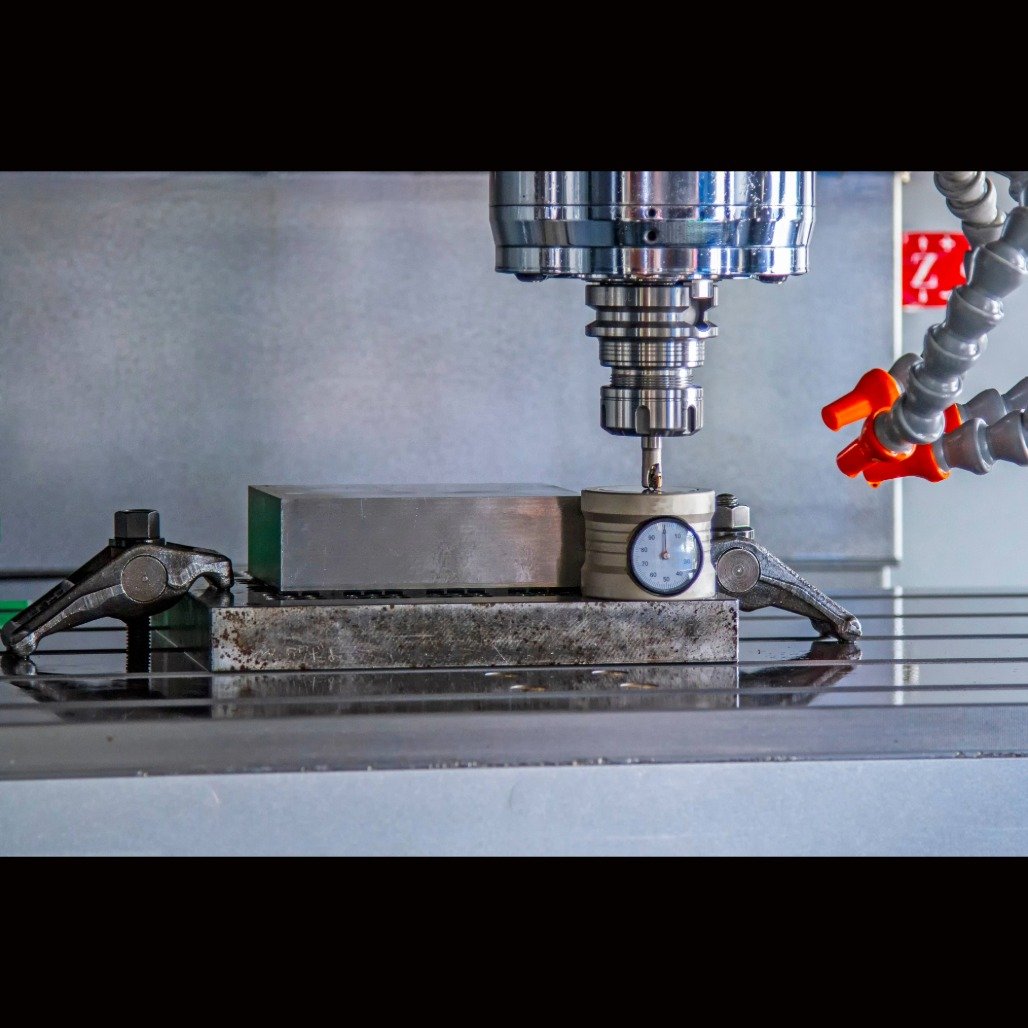
Comparing Ridiculous Machine Tools CAT40 collet chucks with standard CNC milling toolholders starts with the holder design and the cutter, not the brand label. An ER collet chuck and an end mill holder grip tooling differently, so compare compatible models using the same measurement basis for T.I.R., balance, and coolant configuration. This guide explains what to check before selecting a CAT40 holder for a specific tool and operation.
Key Takeaways
- “Standard CNC milling toolholder” covers multiple designs. Identify the specific holder type before comparing it with a Lyndex-Nikken CAT40 collet chuck.
- Compare equivalent models and check where T.I.R. was measured, along with balance and coolant details.
- Match the holder to the cutter’s shank and diameter. An ER collet chuck and an end mill holder secure tooling differently.
- Use the exact model documentation to assess interface and specifications. Treat any RMT figures as specific to the product page that states them.
Lyndex-Nikken CAT40 Collet Chucks vs. Standard Toolholders: Define the Comparison
A useful comparison starts with the exact holder design, not the word “standard.” Compare a Lyndex-Nikken CAT40 ER collet chuck with a specific CAT40 alternative, such as an end mill holder, using documented specifications and the needs of the operation. “Standard CNC milling toolholder” describes a broad category, not one defined design. Brand reputation alone doesn’t establish compatibility or performance.
What does a CAT40 ER collet chuck hold?
A CAT40 ER collet chuck fits a compatible CAT40 spindle interface and holds tooling through a matching ER spring collet. The collet grips a cylindrical shank when seated and tightened in the chuck. Check the ER series and the collet’s specified size range against the tool diameter. The CAT40 taper alone doesn’t establish that the tool fits. Compare ER collet chucks by exact model and configuration, including the specifications relevant to the operation.
Which toolholders count as standard alternatives?
An end mill holder is a distinct design. It secures a suitably sized cutter shank, typically with a set screw bearing against a suitable flat. It can be a relevant alternative when the cutter and shank match the holder, but it isn’t interchangeable with every ER setup. RMT offers end mill holders as a separate category.
Shrink-fit and hydraulic holders use different holding mechanisms, so their capabilities and specifications shouldn’t be assumed equivalent to those of an ER chuck or end mill holder. Toolholders also work within an automatic tool changer, which moves compatible holders between the spindle and tool storage. See this overview of the Automatic Tool Changer in CNC Machining. To compare Lyndex-Nikken CAT40 collet chucks with standard CNC milling toolholders, identify the holder type, tool interface, and exact model first. Then compare specifications measured on the same basis and confirm the setup suits the cutter and operation.
Compare CAT40 Toolholders by Interface, T.I.R., and Balance
Use model-specific documentation, not category averages. The examples below show why each figure needs its measurement basis and configuration. They don’t establish that the holders are equivalent.
T.I.R. (Total Indicator Runout) is the total variation shown by an indicator as a surface rotates. The measurement location and setup determine what the value describes. Taper-to-bore runout measures the relationship between a holder’s spindle taper and internal bore. It differs from runout measured on a tool installed in a collet, which also reflects the collet, nut, tool shank, and assembly.
| Manufacturer and model/configuration | Interface and holder type | Compatible tooling | T.I.R. basis | Balance | Coolant |
|---|---|---|---|---|---|
| Lyndex-Nikken CAT40 Precision ER, exact model/configuration to be verified | CAT40 ER collet chuck | Compatible ER collet and cylindrical shank | Less than 0.0001" at collet face, as stated for a Precision ER model; verify exact model | G6.3 at 18,000 RPM, as stated for a Precision ER model | Verify model documentation |
| Ridiculous Machine Tools ER 32 CAT40 Collet Chuck G2.5 x 30,000 RPM | CAT40 ER32 collet chuck | Compatible ER32 collet and tooling within its specified range | Unavailable for this exact model in the cited product details | G2.5 at 30,000 RPM | Verify product documentation |
Read runout and balance in context
Record the test setup, indicator location, collet and tool condition, balance grade, and stated RPM. If documentation doesn’t give a comparable measurement basis, treat the figures as noncomparable rather than infer equivalence. For a Lyndex-Nikken CAT40 collet chuck versus another CNC milling toolholder, a number without its model and measurement method isn’t a sound basis for choosing.
Verify the CAT40 machine interface
Check the machine manual for the spindle interface and retention-component requirements. Don’t assume CAT40 and BT40 holders interchange based on taper labels alone. Confirm coolant-through capability in the holder documentation. To compare RMT CAT40 ER options, review the ER collet chuck category and the specifications for the exact product.
Choosing Between ER Collet Chucks and End Mill Holders
Start with the cutter’s shank diameter and form, then confirm that the CAT40 holder and retention setup match the machine. An ER collet chuck grips a compatible cylindrical shank through a matching ER spring collet. It can suit setups using different tool diameters that fit the same collet series and its specified collapsible ranges. An end mill holder suits a cutter with a compatible shank, often secured by a set screw against a suitable flat. Choose based on the tool and operation, not the brand name alone.
For more selection context, consult a tool-holding selection guide alongside the holder manufacturer’s specifications. Don’t compare unlike designs as if they hold the tool in the same way.
Selection checks before ordering a CAT40 holder
Confirm the machine’s spindle interface, holder configuration, retention requirements, tool diameter, shank style, and required tool projection. Then compare documented T.I.R. and balance figures with the operation’s requirements, checking the measurement location and stated RPM. Verify coolant delivery and clearance against the holder and machine documentation. The CAT40 label alone doesn’t establish coolant-through capability or available clearance.
Account for setup, tightening, and maintenance
Inspect the holder, nut, collet, and tool for contamination, wear, or damage that could affect seating and clamping. Follow the manufacturer’s assembly and tightening procedure, using a compatible fixture where applicable. A CNC tightening fixture can support toolholder assembly; its taper and use must match the holder and procedure. Holder type alone doesn’t determine tool life or surface finish. Those results also depend on the cutter, setup, workpiece, and cutting conditions.
Compare CAT40 ER collet chuck options
Evaluate Lyndex-Nikken and RMT CAT40 Options Using Verified Product Data
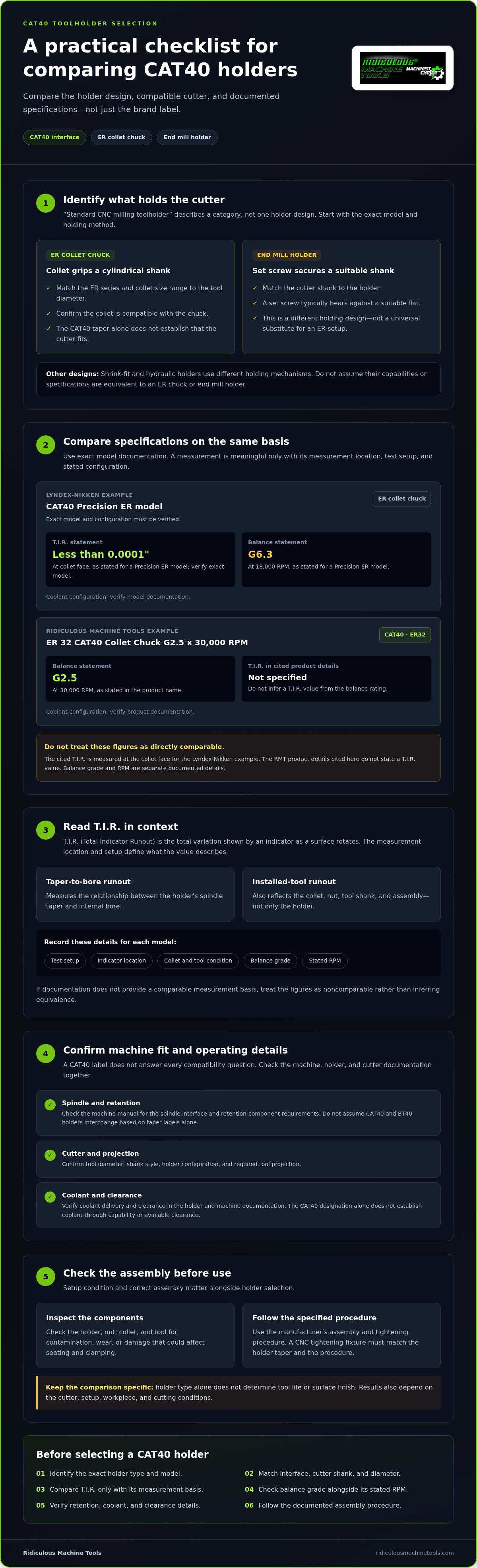
Use exact model documentation to complete the comparison. “Standard toolholder” doesn’t establish whether two products share a design, measurement basis, or intended use. Apply the same checks to each candidate, and treat missing or noncomparable figures as unresolved rather than evidence that one holder is better.
A fair model-to-model comparison checklist
- Identify each model. Record the manufacturer, model, CAT40 configuration, ER collet series, and included components.
- Match the application. Confirm that the holder and compatible collet suit the tool diameter, shank, and operation. Don’t compare an ER chuck with an end mill holder as equivalent designs.
- Compare stated specifications. Note T.I.R. and its measurement location, balance grade with its specified RPM, coolant details, and relevant interface or retention requirements.
- Flag gaps. If a value is undocumented or measured differently, mark it unavailable for direct comparison. Don’t estimate it or treat unlike figures as a ranking.
Review RMT CAT40 collet chuck specifications
RMT’s ER 32 CAT40 collet chuck listed as G2.5 at 30,000 RPM is a model-specific example, not a specification for every RMT holder. Review the product page for its exact configuration and other listed details. Taper-to-bore runout below 0.0001" applies only to models whose product pages state that value. It describes a specific measurement relationship, not automatically the runout of an assembled tool.
Use the checklist to compare documented, compatible models against the cutting task. RMT’s ER collet chuck category presents its configurations and product specifications for model-level review.
Review RMT ER collet chuck configurations
Choose CAT40 Tooling by Fit and Verified Data
The right choice between a Lyndex-Nikken CAT40 collet chuck and a standard CNC milling toolholder depends on the exact holder design, cutter shank, machine interface, and operation. Compare equivalent configurations, not broad categories. Check where T.I.R. was measured, whether balance figures include an RPM, and whether the documented coolant configuration suits the setup. A missing or differently measured specification isn’t proof that one holder performs better.
Some RMT CAT40 ER collet chuck models list G2.5 at 30,000 RPM, while certain model pages state taper-to-bore runout below 0.0001". These are model-specific figures, not category-wide claims. Review the applicable product page and compare its specifications with the cutting tool and machine requirements before selecting a holder.
Compare RMT CAT40 ER collet chuck specifications
Make the selection by matching the holder to the tool and checking the published specifications for that exact model. Browse RMT’s CAT40 ER collet chucks to compare configurations for your setup.
Frequently Asked Questions
What is the difference between a CAT40 collet chuck and an end mill holder?
A CAT40 ER collet chuck grips compatible tooling through a correctly matched ER spring collet. An end mill holder secures an appropriately sized shank using its design, commonly with a set screw against a suitable Weldon flat. Compare the cutter’s shank, holder specifications, and operation before choosing. The designs serve different setups, so neither is a universal substitute for the other.
Are CAT40 and BT40 toolholders interchangeable?
Don’t assume CAT40 and BT40 toolholders are interchangeable based on the taper designation alone. Confirm the spindle interface and retention components against the documentation for the exact machine and holder. Similar-looking taper systems can differ in interface details that affect fit and retention. Use the machine manufacturer’s specifications and the toolholder documentation to establish compatibility before installing a holder.
How do I compare T.I.R. specifications for two collet chucks?
Compare what each T.I.R. value measures, not just the number. Check whether it describes taper-to-bore runout or another setup, along with the measurement location and configuration tested. Collet condition, nut assembly, tool shank, and measurement method can affect readings on an assembled setup. Use current documentation for each exact model. Figures measured on different bases aren’t directly comparable.
Is a Lyndex-Nikken CAT40 collet chuck more accurate than a standard toolholder?
There’s no blanket answer because “standard toolholder” covers multiple designs, and specifications vary by model and configuration. Compare exact models using T.I.R. figures with the same measurement basis, plus balance grade and its specified RPM. A fair conclusion requires current, model-specific documentation for both holders, not a brand label alone.
When should I choose an ER collet chuck instead of an end mill holder?
Choose based on the cutter’s shank, required holding configuration, and operation. An ER collet chuck uses a compatible ER spring collet to grip tooling within that collet’s specified range. An end mill holder suits tooling with a compatible shank and holder configuration. Before selecting, confirm the tool dimensions, machine interface, and specifications for the exact holder setup.
Article by
Ridiculous Machine Tools Technical Team
The Ridiculous Machine Tools Technical Team provides practical information about precision machine tooling, CNC tooling, workholding, and related manufacturing applications. RMT focuses on helping machinists, manufacturers, fabricators, and other customers understand tooling specifications, compatibility, selection, and proper application. Our technical content draws on product specifications, industry knowledge, and RMT's quality-control experience to provide clear, useful information for selecting and using machine tooling and workholding products.
Ridiculous Machine Tools — Machinist's Choice™