

ISO30 ER32 Toolholder Maintenance for CNC Routers
Posted by RMT on Nov 19th 2026
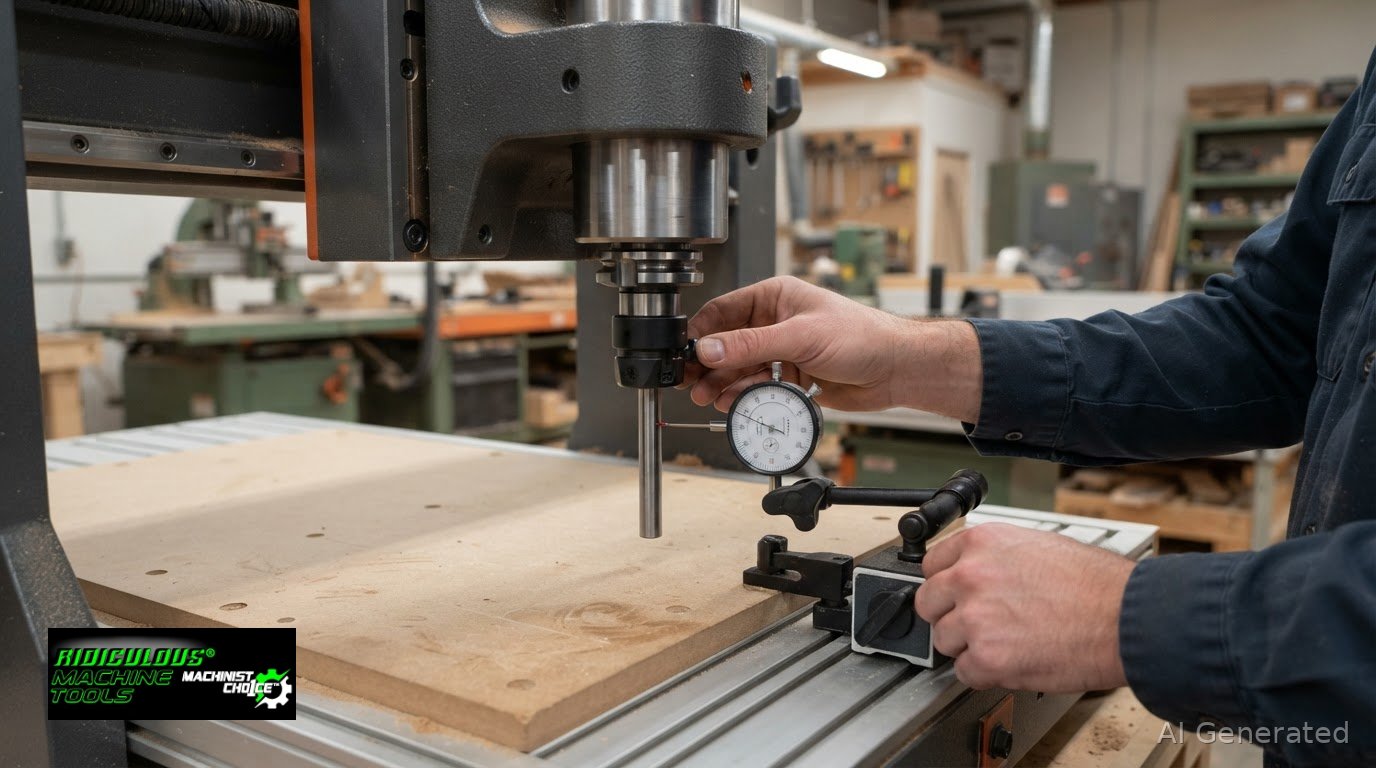
A collet’s T.I.R. should be assessed against the applicable product specification and the machining requirements; 0.01 mm is not a universal warning threshold. Effective ISO30 ER32 toolholder maintenance for CNC wood routers also means confirming spindle compatibility, checking runout and repeatability, and inspecting the holder and collet for visible damage. These checks help determine whether the holder remains suitable for the work.
Key Takeaways
- Match the holder’s ISO30 interface and flange profile to the spindle and tool fork; ISO30-ER32-45L holders usually pair with ISO30 forks.
- Measure runout at the collet and compare results with the holder’s repeatability, rather than judging wear by appearance alone.
- Inspect the taper, collet seat, and contact surfaces for damage or contamination that can affect seating and tool stability.
- Confirm the router’s tool-change interface before selecting an ER32 holder for woodworking applications, including machines from Biesse, Masterwood, and Thermwood.
Toolholder and Spindle Compatibility
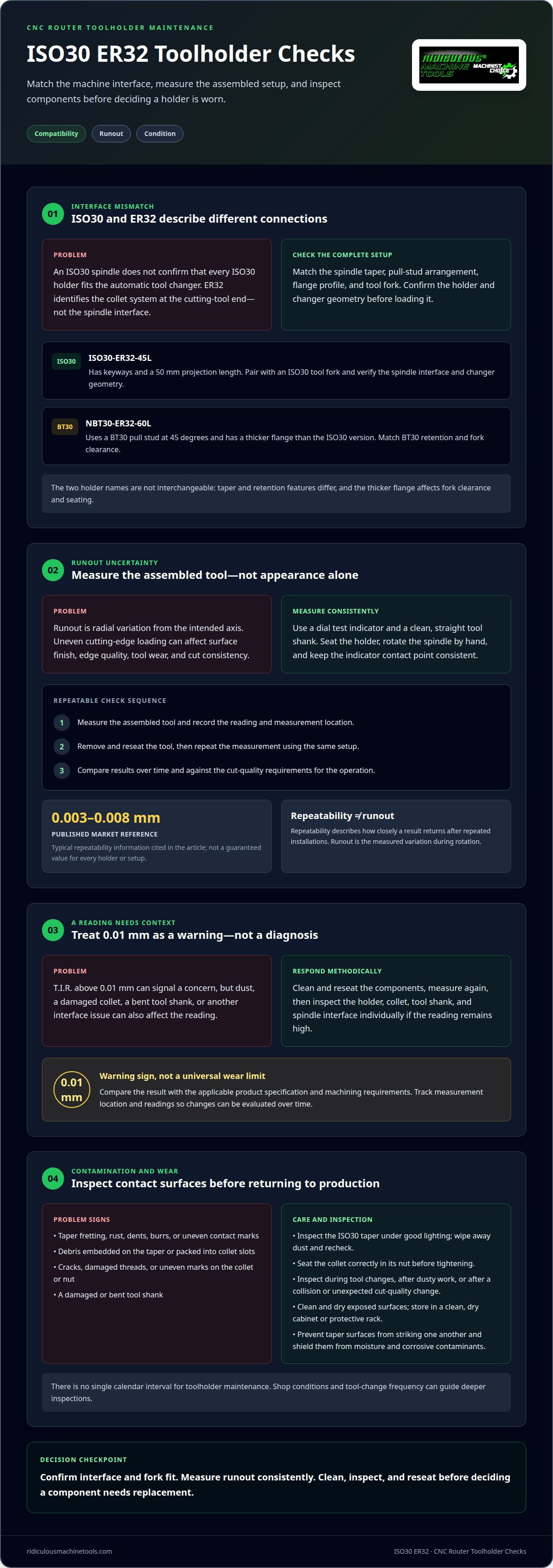
ISO30 identifies the spindle-side taper interface; ER32 identifies the collet system at the cutting-tool end. They describe different connections, so an ISO30 spindle does not by itself confirm that every ISO30 holder fits its automatic tool changer. The ISO30-ER32-45L holder has a 50 mm projection length and keyways. Confirm that the spindle taper, pull-stud arrangement, flange profile, and fork match the holder before loading it into the changer.
Compare the ISO30-ER32-45L with NBT30-ER32-60L before treating the two names as interchangeable. Their taper and retention features differ. The NBT30 version uses a BT30 pull stud with a 45-degree angle, and its flange is thicker than the ISO30 version’s flange. The thicker flange affects fork clearance and seating, so using the wrong fork can disrupt tool storage or automatic exchange.
| Holder option | Retention and flange | Compatible fork | Fit check |
|---|---|---|---|
| ISO30-ER32-45L | Keyways; thinner flange than NBT30-ER32-60L | ISO30 tool fork | Match ISO30 spindle interface and changer geometry |
| NBT30-ER32-60L | BT30 pull stud at 45 degrees; thicker flange | BT30 tool fork | Match BT30 retention and fork clearance |
Choose the holder by matching the machine’s spindle interface, pull stud, flange clearance, and fork type as a complete system, not by the ER32 label alone.
In the United States, holder and replacement-collet cost depends on the selected holder configuration and ER32 collet size and precision grade. Treat them as separate items when comparing a toolholder setup.
ER32 collet-nut torque should come from the manufacturer’s specification for that exact nut and holder combination. Find it in the product documentation or manufacturer’s technical information; don’t substitute a generic torque value.
For storage, remove dust and residue, dry the taper and exposed steel surfaces, then keep the holder in a clean, dry cabinet or protective rack. Prevent taper surfaces from striking one another, and shield them from moisture and corrosive contaminants. Before reuse, inspect for rust, nicks, or embedded debris that could interfere with proper spindle contact.
The NBT30-ER32-60L tool holder is used on CNC routers and CNC milling machines, including Laguna Smart Shop 2 auto-tool-changer routers. Check the machine’s interface and changer compatibility before installation to ensure the holder suits its intended setup.
Toolholder Runout and Repeatability
Runout is the radial variation of a rotating tool from its intended axis. In a CNC wood router, excessive runout can make some cutting edges remove more material than others. That uneven loading may affect surface finish, edge quality, tool wear, and cut consistency. The spindle, holder taper, ER32 collet, nut, and tool shank all contribute to the assembled result.
Published market information gives typical ISO30 toolholder runout repeatability as 0.003-0.008 mm. Treat that range as a reference, not a guaranteed value for every holder or setup. Repeatability describes how closely a measured result returns after repeated tool installations. Runout describes the measured variation during rotation. A holder can produce a repeatable reading that still shows more runout than a particular operation can tolerate.
Measure the assembled setup with a dial test indicator and a clean, straight tool shank. Seat the holder correctly in the spindle, then rotate the spindle by hand while observing the indicator. Keep the contact point consistent between checks. Record the reading, remove and reseat the tool, and repeat the measurement. A stable reading after reseating suggests consistent assembly; a changing reading may point to a seating, contamination, or component issue.
Separate the possible sources before replacing a holder. Clean the spindle taper and holder taper, then inspect both for debris or damage. Check the ER32 collet slots and contact surfaces, and confirm the nut and collet are assembled correctly. Test another clean tool shank in the same setup. If runout changes with the tool, inspect that shank; if it persists across tools, examine the holder and spindle interfaces.
Relate the measurement to the cut. A small cutter profiling a visible cabinet edge may reveal finish changes sooner than a roughing pass on hidden material. Compare readings using the same setup and measurement location, and track changes over time. A baseline makes maintenance decisions more useful than a single reading. For an end mill in a router, compare tool seating and measured runout with the cut-quality requirements before returning the setup to production.
Toolholder Wear Indicators
A collet T.I.R. above 0.01 mm is a warning sign of toolholder wear, not a diagnosis by itself. Dust on the spindle taper, a damaged collet, or a bent tool shank can also affect the reading. Record the measurement location and value so future inspections can be compared. A consistent approach to ISO30 ER32 toolholder maintenance for CNC wood routers starts with tracking changes over time.
Inspect the ISO30 taper under good lighting. Look for fretting, rust, dents, burrs, or uneven contact marks. Wipe away wood dust with a clean cloth, then examine the surface again. A raised burr or embedded particle can interfere with seating even if the surrounding taper looks clean.
Check the ER32 collet and nut next. Look for cracks, packed dust, damaged threads, and uneven contact marks. Seat the collet correctly in its nut before tightening. A mis-seated collet can damage contact surfaces and reduce tool grip.
Measure T.I.R. at the collet or tool shank with an indicator, using the same contact point each time. If the reading exceeds 0.01 mm, clean and reseat the components, then measure again. If it remains high, inspect the holder, collet, tool shank, and spindle interface individually.
There is no single calendar interval for maintaining CNC router toolholders, collets, and spindle tapers. Inspect them during tool changes, after dusty work, and following a collision or unexpected change in cut quality. Shop conditions and tool-change frequency can guide the timing of deeper inspections.
Common mistakes include leaving dust on the taper, tightening a mis-seated collet, and reusing a damaged collet or tool shank. These conditions can compromise seating or grip, contributing to vibration, poor cut quality, or tool pullout. Stop the operation and inspect the assembly if these symptoms appear.
Review ER collet chuck options
ISO30 ER32 Toolholder Uses for CNC Wood Routers
An ISO30-ER32-45L holder is suitable for a woodworking CNC router only if the machine has a compatible ISO30 spindle interface and tool-change setup. Its ER32 collet system holds cutting tools with matching shank diameters. In a tool-changer workflow, the router can exchange holders between programmed operations, such as roughing a panel and then cutting a finished profile. Confirm compatibility with the specific machine configuration rather than relying on the ER32 designation alone.
Do not assume that a Biesse, Masterwood, or Thermwood router accepts an ISO30-ER32-45L holder based on the brand name. Verify that the specific machine’s spindle accepts ISO30 tooling and that the holder’s retention and flange geometry suit its changer. A machine using another taper or a different tool-fork arrangement needs a matching holder, even if the cutter has an ER32-compatible shank.
In cabinet production, an ER32 setup may hold compatible-shank tools for routing panel profiles, cutting pockets, or trimming edges. For example, a shop may use one tool for a rough pocketing pass and a separate profile cutter for the visible edge. The toolholder provides the interface between spindle and cutter; the collet grips the cutter shank. Tool diameter, shank fit, cutting operation, and machine limits all matter when building the tool list.
For nested sheet work, programmed tool changes can organize distinct operations, such as cutting openings before finishing outside contours. The CAM tool definition must match the actual cutter and holder assembly, including the tool length used in the machine setup. A mismatch can affect depth and clearance even when the spindle interface fits. Before production, confirm that the holder is seated correctly, the cutter is secured in a compatible collet, and the tool-length data matches the physical assembly.
Choose an ISO30 ER32 holder for a woodworking router only after confirming that the spindle interface, automatic changer, and cutter shank are compatible. Do not infer fit from the Biesse, Masterwood, or Thermwood brand; verify the specific model and configuration. Match the holder to the machine first, then select the ER32 collet and cutter for the programmed operation.
Build a Repeatable Tooling Decision
Turn inspection results into a useful shop record. Track each holder by its identification, note its operation and cutter pairing, and record changes that affect the finished part. This gives operators a shared reference when selecting tooling for a new job or reviewing an established setup.
For replacement tooling, match the ER collet series and cutter shank to the intended assembly. Ridiculous Machine Tools offers ER collet chucks and ER spring collets in multiple precision levels. Review the relevant product details when choosing components for your CNC router.
A consistent record helps your team make informed choices about ISO30 ER32 toolholder maintenance for CNC wood routers and keep tooling decisions tied to actual shop requirements.
Use this process to keep future tooling decisions clear, practical, and focused on the work ahead.
Frequently Asked Questions
How do I know if my toolholder is worn out?
Look for a persistent change that follows the holder across different cutters or collets. Keep a simple log of the holder identification, inspection date, and setup used. If a problem follows one component after a controlled substitution, this can help narrow down the cause. Remove a suspect holder from production until its condition has been assessed against the machining requirements.
What are the ISO30 and ER32 toolholder specifications and compatible spindle requirements?
ISO30 identifies the spindle interface, while ER32 identifies the collet series. For a specific assembly, match the spindle’s stated interface and retention arrangement to the holder. Then select an ER32 collet whose marked size covers the cutter shank. ER32 names the series, not one universal gripping diameter, so it doesn’t mean every shank fits the same collet.
What are signs of wear or damage in an ISO30 ER32 holder, collet, or spindle taper?
Resin or pitch buildup from wood machining can leave residue on contact surfaces and inside collet slots. Look for deposits that remain after routine cleaning, and distinguish them from scratches, dents, or cracks. Avoid reshaping a taper or collet seat with abrasive material, as changing its geometry can affect contact. Record recurring residue or damage by holder identification.
How can toolholder runout be measured, and what runout is acceptable for CNC wood routing?
There is no single acceptable runout value for every CNC wood-routing operation. Use the tolerance stated for the specific holder and compare it with the cutter and finished-part requirements. Also distinguish a holder’s runout specification from repeatability: repeatability describes consistency across repeated setups, not the amount of runout in one assembly. Do not treat these figures as interchangeable acceptance limits.
How do you correctly install and tighten an ER32 collet and nut?
Seat the ER32 collet correctly in its nut, set the tool depth, and tighten the assembly according to the specifications and instructions for the specific nut, holder, and tightening method. A torque wrench or tightening fixture may be appropriate depending on those instructions. Avoid tightening a mis-seated collet.
Article by
Ridiculous Machine Tools Technical Team
The Ridiculous Machine Tools Technical Team provides practical information about precision machine tooling, CNC tooling, workholding, and related manufacturing applications. RMT focuses on helping machinists, manufacturers, fabricators, and other customers understand tooling specifications, compatibility, selection, and proper application. Our technical content draws on product specifications, industry knowledge, and RMT's quality-control experience to provide clear, useful information for selecting and using machine tooling and workholding products.
Ridiculous Machine Tools — Machinist's Choice™