
Industrial Latch Toggle Clamps: The Technical Guide to Pull-Action Workholding
Posted by RMT on Sep 21st 2026
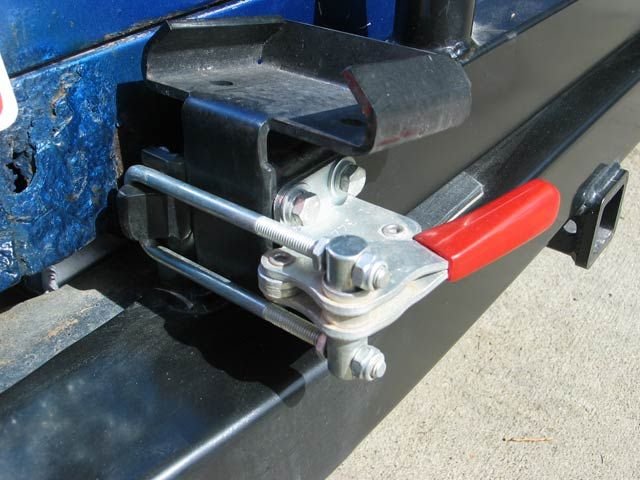
A toggle clamp latch is not a simple fastener. It's a precision-engineered component that determines whether your high-pressure seals hold or fail under the stress of industrial vibration. Professional machining environments demand hardware that performs as advertised, every single time. You've likely dealt with the frustration of inaccurate holding capacity ratings or a latch that won't stay locked during a critical cycle. These failures aren't just annoying; they're expensive bottlenecks in a precision-oriented shop.
This guide provides the technical expertise needed to master latch toggle clamp selection for airtight enclosures and secure mold fixturing. We'll analyze mechanical advantage ratios ranging from 2:1 to 10:1 and the kinematics of over-center locking. You'll learn how to calibrate threaded U-bolts for consistent gasket compression and select forged steel models capable of resisting up to 7,500 lbs of tensile load. We're breaking down everything from pivot geometry to secondary safety locks to ensure your shop achieves faster cycle times and durable clamping that survives thousands of production cycles.
Key Takeaways
- Understand the mechanics of the over-center toggle mechanism to ensure mechanical locking that resists accidental release under heavy vibration.
- Select the optimal toggle clamp latch by distinguishing between static holding capacity and dynamic exerting force for high-pressure sealing.
- Optimize mold making and vacuum enclosure cycles using pull-action hardware designed for high-cycle industrial durability.
- Master precise pull-bar calibration and mounting techniques to achieve the perfect mechanical snap and consistent gasket compression.
- Evaluate the performance trade-offs between zinc-plated carbon steel and stainless steel components to match your specific shop environment.
Understanding Latch Toggle Clamp Mechanics and Pull-Action Design
A toggle clamp latch is a specialized pull-action workholding tool. It exerts high tensile force between two mounting surfaces. Standard hold-down clamps apply vertical pressure; these devices pull components together. This makes them essential for high-pressure sealing in industrial environments. These industrial clamping tools rely on a mechanical linkage system. It transforms minimal operator effort into thousands of pounds of holding capacity. This mechanical advantage is the core of reliable fixturing.
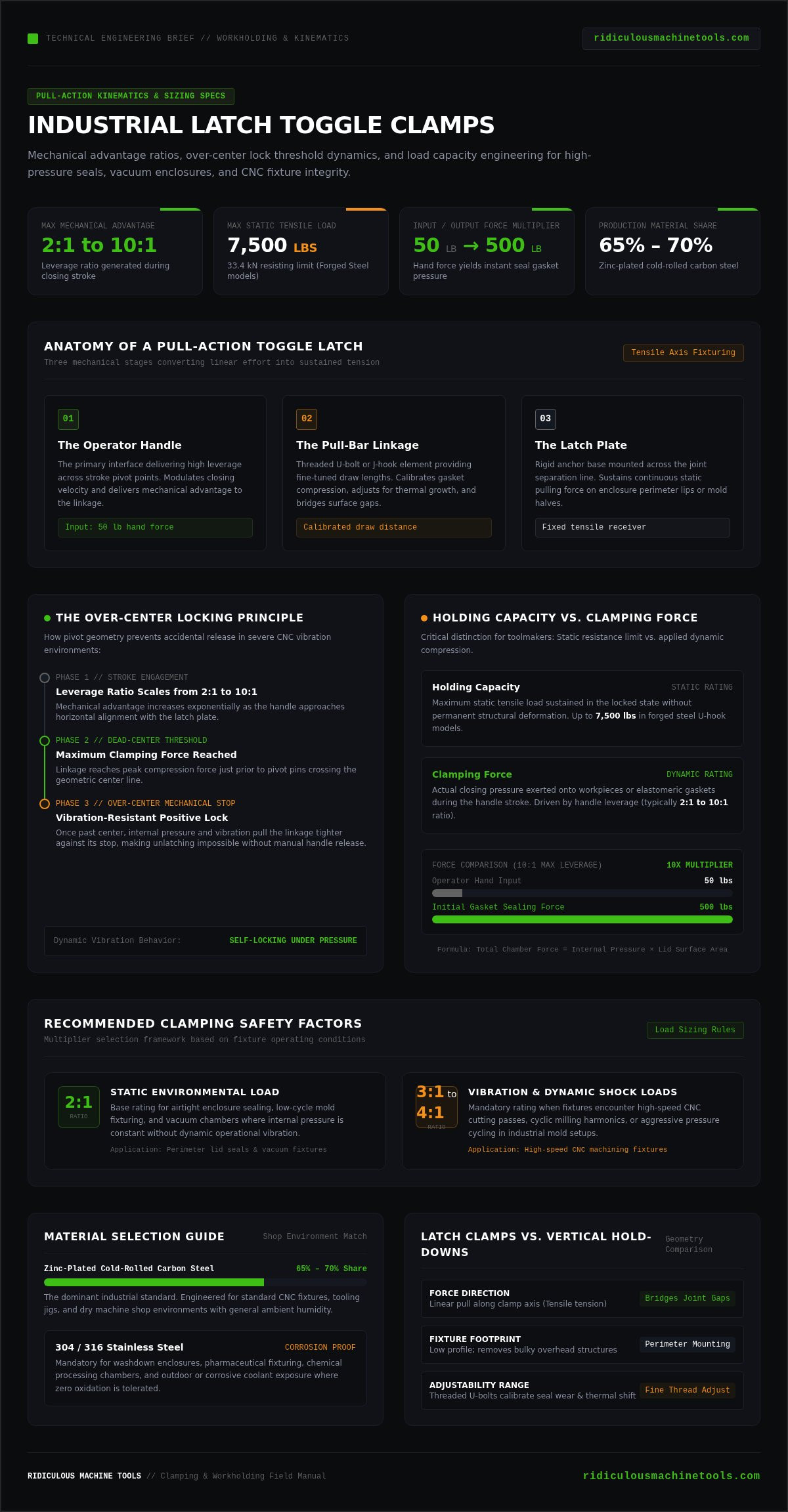
The assembly uses three primary components: the handle, the pull-bar, and the latch plate. The handle is the operator interface. The pull-bar, usually a threaded U-bolt or J-hook, provides the adjustable connection. The latch plate is the fixed anchor point. This design beats standard fasteners for securing mold halves, vacuum chamber lids, and heavy-duty enclosure doors. It offers speed and repeatability that threaded bolts can't match.
The Over-Center Locking Principle
The security of a toggle clamp latch comes from the over-center locking principle. As the operator moves the handle, mechanical advantage increases. Leverage typically ranges from 2:1 up to 10:1 during the closing stroke. This allows a 50 lb hand force to generate 500 lbs of initial sealing pressure. The linkage reaches maximum force just before pivot pins cross the center line. Once they pass this "dead center" threshold, the clamp hits a mechanical stop. It's locked. Vibration and internal pressure only pull the mechanism tighter against the stop. This prevents accidental release during high-speed CNC operations. The pull distance is calibrated by adjusting the threaded pull-bar. This ensures correct tension before the snap-lock occurs.
Latch vs. Horizontal and Vertical Clamps
Horizontal and vertical clamps provide downward pressure on a fixture plate. A latch toggle clamp provides tension. Choose pull-action to bridge a gap or compress a gasket. In tight fixtures, linear pull saves space. It removes the need for bulky overhead structures required by vertical clamping systems. The footprint is streamlined for perimeter mounting.
- Footprint: Latch models require less vertical clearance than vertical hold-downs.
- Adjustability: Threaded U-bolts allow fine-tuned draw lengths to accommodate material thermal expansion or gasket wear.
- Force Direction: Pull-action applies force along the clamp axis. This is ideal for perimeter sealing on enclosures and molds.
Choosing the right tool depends on the required force direction. If the application requires pulling two surfaces together to create an airtight seal, the pull-action design is the only viable choice. It provides the high tension and adjustable draw lengths necessary for professional machining standards.
Selection Criteria: Sizing and Holding Capacity Ratings
Selecting a toggle clamp latch requires more than a visual estimate. You must distinguish between holding capacity and actual clamping force. Holding capacity is the maximum static tensile load the clamp sustains in its locked state without permanent deformation. Clamping force is the pressure applied to the workpiece or gasket during the closing stroke. These values are not identical. Technical spec sheets often highlight holding capacity, but your application relies on the exerting force generated by the handle leverage.
Material choice dictates the operating environment. Zinc-plated cold-rolled carbon steel accounts for roughly 65 percent to 70 percent of industrial production. It's the standard for CNC fixtures and dry shop environments. Use 304 or 316 stainless steel for washdown, chemical, or pharmaceutical tooling where corrosion resistance is mandatory. Review the technical specifications of our heavy-duty Latch Toggle Clamps to match your specific material and draw requirements.
Calculating Required Holding Capacity
Use a technical framework to determine your needs. For enclosure sealing, calculate the internal pressure against the surface area of the lid. This total force must be countered by the combined capacity of your clamps. Apply a safety factor of at least 2:1 for static loads. Increase this to 3:1 or 4:1 if the fixture faces heavy vibration or shock loads from high-speed machining cycles. Current workholding and clamping technology allows heavy-duty forged steel U-hook models to resist tensile loads up to 7,500 lbs (33.4 kN) without failure.
U-Bolt vs. J-Hook Latch Designs
The hook geometry determines how the clamp interacts with the latch plate. Your choice depends on the required precision and frequency of use.
- U-Bolt Designs: These provide maximum stability and strength. Dual adjustment nuts allow you to level the pull-bar and fine-tune tension. They are the professional standard for high-pressure enclosure sealing and permanent fixtures.
- J-Hook Models: These offer faster engagement and disengagement. They are ideal when the latch point varies slightly or when the operator needs to clear the fixture quickly.
- Fixed-Hole Latches: These provide a low-profile, cost-effective solution for light-duty covers. Use these when adjustability is not a requirement and space is at a premium.
Evaluate the required draw movement before installation. This is the linear distance the hook travels from the fully open position to the latch plate. If the draw is too short, the hook won't clear the plate. If it's too long, you lose the mechanical advantage needed for a secure over-center lock.
Industrial Applications: From CNC Fixtures to Mold Making
Industrial applications for a toggle clamp latch extend far beyond simple door closures. In a professional machine shop, these tools serve as high-performance sealing components. They are indispensable for vacuum chambers and pressurized enclosures where a standard bolt is too slow. CNC operators use them for secondary fixturing to minimize downtime between cycles. The pull-action design ensures that even under heavy vibration, the fixture remains secure. This reliability is vital for maintaining tolerances during aggressive milling. Beyond the spindle, these clamps secure heavy-duty transport containers and vibration-resistant doors on mobile equipment.
Mold and Tooling Applications
Managing thermal expansion is a constant challenge in composite and plastic injection molding. As mold temperatures rise, materials expand. An adjustable toggle clamp latch allows for fine-tuned tensioning to accommodate these changes. Consistent clamping pressure prevents flash and ensures part accuracy across thousands of cycles. For large-scale molds, engineers deploy multiple latches in parallel. This distribution of force prevents warping and maintains a uniform seal along the parting line. It's a pragmatic solution for high-volume production environments where cycle times are measured in seconds. Using high-durability steel components ensures the hardware survives the abrasive nature of shop floors.
Enclosures and Access Panels
Achieving NEMA-rated seals requires consistent gasket compression. Pull-action tension provides the necessary force to compress industrial seals effectively. Ergonomic handle designs facilitate rapid access for maintenance without sacrificing security. For safety-critical panels, modern industrial latches often integrate secondary locks or locking triggers. These mechanisms prevent accidental opening due to mechanical shock or operator error. Whether it's a vibration-resistant door on a machine enclosure or a lid on a chemical processing tank, the mechanical advantage ensures a fail-safe closure. This is particularly important in environments where spindle speeds create harmonic vibrations that could disengage lesser hardware.
Quick-release fixturing for secondary CNC operations is another high-value use case. When a part requires a second operation on a different face, manual latching provides the speed needed for fast turnover. It eliminates the need for complex hydraulic systems in low-to-medium volume runs. You get the holding power of a permanent fixture with the flexibility of a manual tool. This balance of speed and security is why professional machinists prioritize quality workholding over generic alternatives.
Setup and Maintenance: Precise Latch Adjustment
Precise setup of a toggle clamp latch is the difference between an airtight seal and a safety hazard. It's not just about bolting hardware to a frame; it's about kinematic alignment. Improperly installed clamps lead to side-loading, which causes premature pin wear and inconsistent sealing pressure. To achieve professional results, you must treat the installation as a precision machining task rather than a general assembly job. Start by marking your mounting holes with the clamp in the locked position to ensure the pull-bar reaches the latch plate with sufficient thread engagement.
Installation Best Practices
Alignment is the priority. The pull-bar must be perfectly perpendicular to the latch plate axis. Even a minor angular offset creates lateral stress on the pivot pins, leading to mechanical failure over time. Use high-grade fasteners, such as Grade 8 bolts, to prevent base-plate shifting under high tensile loads. Verify the stroke length before final bolt-down. The hook must clear the latch plate entirely in the open position while maintaining enough travel to reach the over-center lock. For the most demanding environments, browse our inventory of professional-grade Latch Toggle Clamps designed for exactness and high-cycle reliability.
Adjusting the pull-bar length is the next critical step. Loosen the jam nuts and rotate the U-bolt or J-hook to fine-tune the tension. You are looking for a distinct, audible "snap" as the handle crosses the center point. If the handle springs back before locking, the pull-bar is likely too short, preventing the linkage from crossing the dead-center threshold. Conversely, if the handle requires excessive force to close, you risk deforming the linkage or the mounting surface. Aim for a firm resistance that requires a deliberate pull but doesn't strain the mechanical components.
Long-Term Maintenance for Production Shops
High-cycle production environments demand a rigorous maintenance schedule. Metal chips, coolant residue, and shop debris act as abrasives if they enter the toggle pivot points. Clean these areas weekly to prevent binding. Toggle lubrication is the application of industrial-grade grease to pivot pins every 5,000 cycles. This simple step significantly extends the service life of the tool. Inspect the pull-bar for signs of fatigue, such as stretching or hairline cracks, especially in high-pressure sealing applications. Replace any component showing plastic deformation immediately to avoid catastrophic failure during a machine cycle. Consistent inspection ensures your fixtures remain secure and your seals stay airtight through thousands of operations.
Ridiculous Machine Tools: High-Performance Clamping Solutions
Generic hardware store clamps fail in high-cycle industrial environments. Thin-gauge steel and loose pivot rivets won't survive a 24/7 machining schedule. We build Latch Toggle Clamps for the professional machinist who requires technical precision and absolute reliability. Our forged steel components resist deformation under loads that would buckle standard hardware. This is hardware engineered for high-stakes environments where a single clamp failure can scrap an expensive workpiece or compromise a high-pressure seal.
Precision workholding is only one part of the equation. A toggle clamp latch is most effective when paired with high-performance tool holding. Our inventory bridges the gap between secure fixturing and accurate spindle performance. Whether you use our ultra precision ER spring collets or our universal CNC tightening fixtures, the goal remains the same. We eliminate the variables that cause inaccuracy. This synergy ensures that your setup is rigid from the table to the tool tip.
We've streamlined the procurement process by cutting out the industrial distributor markup. You get direct-to-shop pricing on professional-grade hardware without the middleman tax. This disruptive approach allows us to offer heavy-duty 7,500 lb capacity clamps at prices that make sense for a growing business. We serve the entire US national market with a focus on streamlining shop logistics and reducing procurement friction.
Precision Engineering for the Professional Shop
Our Latch Toggle Clamps feature heavy-duty steel construction designed for industrial use. We use precision-ground pivot pins to ensure smooth operation and consistent over-center locking through thousands of cycles. The ergonomic handles provide a secure, non-slip grip. This reduces operator fatigue during long shifts and ensures a positive lock every time. These clamps integrate seamlessly with our collet systems and tightening fixtures, providing a unified solution for your workholding needs.
The Ridiculous Value Proposition
We offer aggressive pricing on hardware that actually performs. There's no need to settle for consumer-grade tools when professional-grade components are available at these rates. We maintain a deep inventory to ensure fast national shipping because your production line doesn't have time to wait for backordered parts. We prioritize reliability and speed to keep your shop running at peak efficiency. It's time to stop overpaying for name-brand markups and start investing in performance.
Upgrade your shop with Ridiculous Latch Toggle Clamps
Optimizing Your Shop for High-Cycle Precision
Precision workholding is the foundation of every successful machining cycle. Mastering the mechanics of the over-center lock ensures your high-pressure seals and mold fixturing remain secure under the stress of industrial vibration. A professional-grade toggle clamp latch is only as reliable as its installation and calibration. Proper alignment and routine lubrication prevent the mechanical failures that stall production lines and scrap expensive workpieces. You now have the technical framework to select and maintain these essential pull-action tools with confidence.
Don't settle for generic hardware that compromises your shop's tolerances. Our inventory features industrial-grade steel construction and high-rated holding capacities designed specifically for the most demanding machining environments. We offer fast national US shipping and direct-to-shop pricing to keep your operations efficient and competitive. By prioritizing quality workholding, you're investing in the long-term accuracy and speed of your production. Shop Professional Latch Toggle Clamps at Ridiculous Machine Tools and secure your fixtures today. Your next high-precision project is waiting for the right hardware.
Frequently Asked Questions
What is the difference between clamping force and holding capacity?
Holding capacity is the maximum static load a toggle clamp latch can resist in its locked state without permanent deformation. Clamping force refers to the actual pressure exerted on the workpiece or seal during the handle's stroke. In a high-cycle environment, you must ensure the holding capacity exceeds your application's peak load by a significant margin to prevent mechanical fatigue. This distinction is critical when specifying hardware for high-pressure enclosures or vacuum chambers.
How do I adjust the tension on a U-bolt latch toggle clamp?
Adjusting tension requires rotating the jam nuts on the threaded U-bolt to change its effective length. Loosen the rear nut and tighten the front nut to increase pull-action tension, or reverse the process to decrease it. You're aiming for a firm over-center snap that provides consistent gasket compression without requiring excessive operator force. Always tighten the jam nuts securely after adjustment to prevent slippage during high-vibration machining cycles.
Can latch toggle clamps be used for overhead lifting applications?
Latch toggle clamps are strictly workholding and fixturing tools; they are never rated for overhead lifting or life-safety applications. These devices are designed for tensile loads in a stationary environment. Using them to suspend loads overhead violates industrial safety standards and risks catastrophic failure. For lifting, you must use certified hardware like hoist rings or eye bolts that carry specific overhead lifting ratings and safety certificates for professional use.
What material is best for latch clamps in wash-down environments?
Stainless steel is the mandatory choice for wash-down, chemical, or food-grade environments. While zinc-plated carbon steel is standard for CNC shops, it will oxidize quickly when exposed to moisture or corrosive cleaning agents. Models made from 304 or 316 stainless steel provide the necessary corrosion resistance to maintain pivot pin integrity and handle functionality. This ensures the hardware survives thousands of cleaning cycles without seizing or losing its rated holding capacity over time.
Why does my toggle clamp handle pop open under load?
A handle that pops open usually indicates the linkage hasn't fully crossed the dead center threshold into a locked state. This happens if the toggle clamp latch is adjusted with the pull-bar too long, preventing the mechanism from reaching its mechanical stop. Intense vibration can also jar a poorly calibrated clamp loose. Check for wear on the pivot pins and ensure the handle provides a distinct snap during closure to verify a secure lock.
How much draw movement can I expect from a standard latch clamp?
Draw movement varies significantly based on the size and geometry of the specific model. Smaller light-duty clamps might offer a draw of 1 to 1.5 inches, while heavy-duty industrial models can provide a travel distance exceeding 4 inches. This linear travel determines how far the hook or U-bolt moves to engage the latch plate. Always verify the required clearance for your fixture to ensure the pull-bar can fully disengage from the latch plate.
Are latch plates included with the toggle clamp assembly?
Most industrial-grade assemblies include a matching latch plate as part of the standard SKU. However, some heavy-duty or specialized models are sold as standalone units to allow for custom mounting or integration into existing fixtures. At Ridiculous Machine Tools, we provide the necessary hardware to ensure immediate deployment in your shop. Always verify the product specifications before purchase to confirm the inclusion of the latch plate and the necessary mounting fasteners.
What safety factor should I use when choosing a latch clamp for a pressurized vessel?
For pressurized vessels or vacuum enclosures, a safety factor of at least 2:1 is the baseline for static loads. If the application involves internal pressure fluctuations or external vibration from machining, increase this to 3:1 or 4:1. This redundancy accounts for material fatigue and potential shock loads. If your calculated internal force is 500 lbs, select a clamp with a rated holding capacity of at least 1,000 to 1,500 lbs to ensure safety.