

High-Tolerance Milling with Balanced Tool Holders
Posted by RMT on Oct 2nd 2026
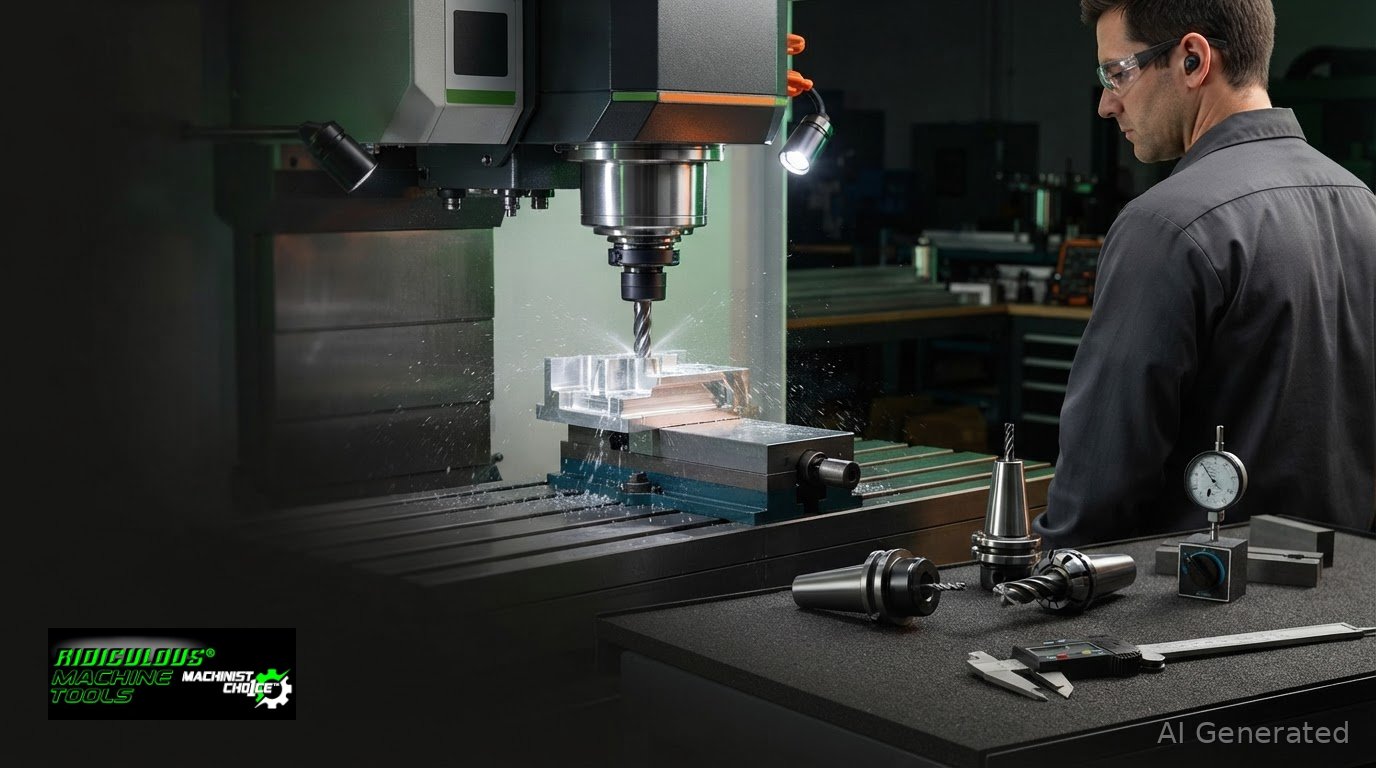
A balance label alone doesn’t confirm that a high-speed tool setup is ready to run. Balanced tool holders for high speed machining must be assessed as part of the complete assembly, including the holder, collet or other retention method, cutting tool, and machine interface.
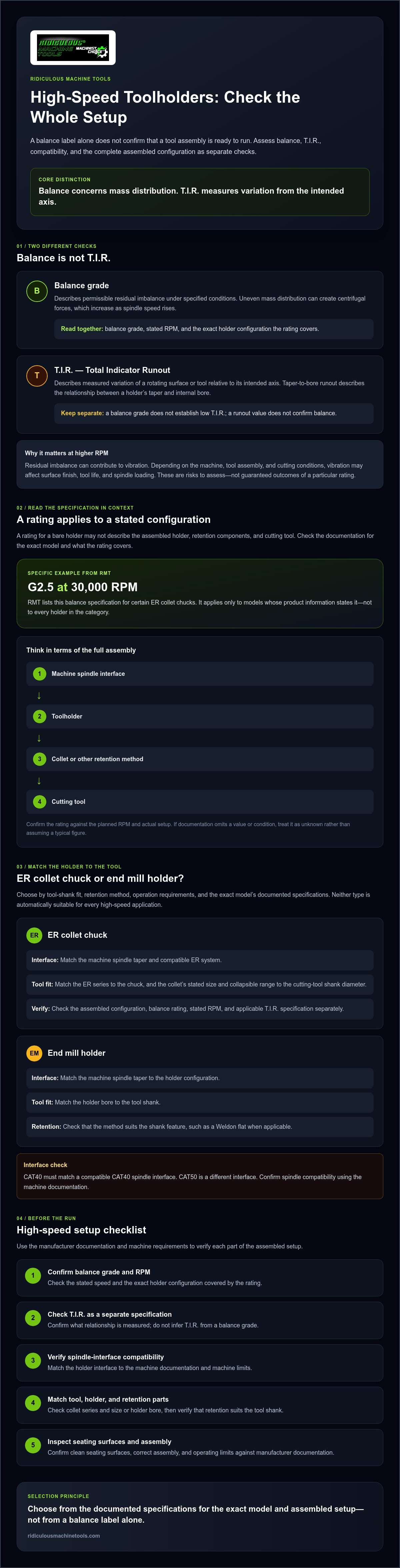
Balance and runout describe different conditions: balance relates to mass distribution during rotation, while T.I.R. measures variation from the intended axis. Use this checklist to verify the stated balance grade and applicable RPM, distinguish balance claims from runout specifications, and check compatibility across the holder, collet, tool shank, and spindle interface. It also compares ER collet chucks with end mill holders by application, so you can select tooling based on the operation and the specifications documented for the exact model.
Key Takeaways
- Read a balance rating alongside its stated RPM and the exact toolholder configuration.
- Evaluate balanced tool holders for high speed machining by checking balance and T.I.R. as separate specifications.
- Compare ER collet chucks and end mill holders by tool-shank fit, retention method, and operation requirements.
- Use a pre-run checklist to confirm machine-interface compatibility, clean seating surfaces, and correct assembly.
Balanced Tool Holders for High-Speed Machining: What the Balance Rating Tells You
A balance rating describes the permissible residual imbalance of a rotating component under specified conditions. Uneven mass distribution can create centrifugal forces, which increase as spindle speed rises. A balance grade helps you assess that risk, but it is not a complete measure of toolholder performance.
What a balance grade does, and does not tell you
Check the rating alongside its stated RPM and the configuration it covers. A rating for a bare holder may not describe the assembled holder, retention components, and cutting tool. For example, RMT lists certain ER collet chucks as G2.5 at 30,000 RPM. That specification applies only to models whose product information states it, not to every holder in the category.
Balance and runout require separate checks. Balance concerns mass distribution around the axis of rotation. T.I.R. describes measured variation as a surface or tool rotates; see this overview of Total Indicator Runout. A balance grade does not establish low T.I.R. or cutting accuracy, and a runout value does not confirm balance.
Why high-speed precision milling makes verification important
At higher RPM, residual imbalance can contribute to vibration. Depending on the machine, tool assembly, and cutting conditions, vibration may affect surface finish, tool life, and spindle loading. These are risks to assess, not guaranteed outcomes of a particular balance rating.
For balanced tool holders for high speed machining, compare the documentation with the planned RPM and actual setup. Confirm the spindle interface and machine limits, then check the complete holder, retention method, and cutting tool. The application matters too: a finishing pass and a demanding roughing operation may have different requirements for runout, retention, and operating limits. Choose only when the documented specifications and setup requirements align.
Check Balance, T.I.R., and Compatibility Before Choosing a Toolholder
Compare specifications for the exact holder model and assembled configuration. Note the balance grade, its stated RPM, and which components the rating covers. Sandvik Coromant explains balancing according to ISO 16084. The practical point is to confirm what the balancing information applies to, rather than treating a grade as a blanket rating for every setup. If the documentation omits a value or condition, treat it as unknown rather than assuming a typical figure.
Read balance and runout specifications separately
T.I.R. is the measured variation of a rotating surface or tool relative to its intended axis. Check the measurement relationship and configuration. Taper-to-bore runout describes the relationship between a holder’s taper and internal bore, and should only be assumed when the product documentation specifies it. Balance and T.I.R. describe different properties, so neither value can stand in for the other.
Match the holder to the machine and cutting tool
Confirm the spindle interface against the machine documentation. A CAT40 holder, for example, must match a compatible CAT40 spindle interface; CAT50 is a different interface. Then check the connections through the rest of the assembly:
- ER collet chuck: Match the ER series to the chuck, and the collet’s stated size and collapsible range to the cutting-tool shank diameter.
- End mill holder: Match the holder bore to the tool shank and check that its retention method suits the shank feature, such as a Weldon flat, when applicable.
- Complete setup: Verify retention components and operating limits against manufacturer documentation and machine requirements.
Apply the same checks when comparing balanced tool holders for high speed machining. Ridiculous Machine Tools lists ER collet chucks and end mill holders. Review the specifications for each model before deciding whether it matches your machine and tool.
ER Collet Chuck vs. End Mill Holder for High-Speed Milling
Choose between these holders by matching the retention method to the cutting tool and operation, then checking the exact model’s specifications. Neither type is automatically suitable for every high-speed application. The balance rating, spindle interface, tool fit, and operating limit all matter to the assembled setup.
| Check | ER collet chuck | End mill holder |
|---|---|---|
| Interface | Must match the machine spindle taper and compatible ER system. | Must match the machine spindle taper and holder configuration. |
| Tool fit | Uses a compatible ER spring collet sized for the cutting-tool shank. | Bore must fit the shank; retention commonly uses a set screw against a suitable shank feature. |
| Stated specifications | Check model-specific balance, RPM, and any stated runout measurement. | Check model-specific balance, RPM, T.I.R., and other published limits. |
| Verification | Confirm chuck taper, ER series, collet size, tool diameter, and assembly instructions. | Confirm spindle interface, bore size, shank feature, and retention setup. |
When an ER collet chuck may fit
An ER collet chuck can hold suitable cylindrical tooling through a compatible ER spring collet. Verify the chuck taper, collet series, tool diameter, and documented operating limits as one system. RMT lists a CAT40 ER32 collet chuck specified as G2.5 at 30,000 RPM. That rating applies to that listed model, not to all ER collet chucks.
When an end mill holder may fit
An end mill holder may suit a tool with a shank and retention feature compatible with its bore and set-screw arrangement. Confirm the bore size and spindle interface, then review the specifications for the exact model. RMT offers CAT40, CAT50, and R8 end mill holders; do not transfer a specification from one interface or product family to another.
For balanced tool holders for high speed machining, select by verified fit and documented limits, not holder category alone.
A Pre-Run Checklist for Balanced Toolholders in Precision Milling
A specification is useful only if it applies to the assembled setup. Use this sequence to catch mismatches before the tool enters the spindle, and follow the machine, holder, and cutting-tool manufacturers’ instructions for inspection and operation.
Before assembly: verify the components and documentation
- Confirm the interface. Match the holder taper to the machine spindle and verify the exact holder model.
- Check tool fit. For an ER collet chuck, confirm the collet series and that the tool diameter falls within the collet’s stated range. For an end mill holder, check bore size and shank compatibility.
- Read the documented limits. Verify the balance grade and stated RPM, plus any T.I.R. value and the measurement relationship it describes. Apply these values only to the documented model and configuration.
- Inspect before assembly. Check mating surfaces and components for contamination, burrs, or damage using established shop procedures. Clean and seat parts as directed by the manufacturer.
After assembly: review the setup before cutting
Assemble and tighten the holder, collet or other retention components, and cutting tool according to their instructions. Check tool projection and retention, then compare the planned spindle speed and operating conditions with the documented limits for the holder, tool, and machine. A holder rating alone does not establish that the entire setup is suitable.
Before running, check that the assembled tool is seated correctly and that the machine’s operating limits and shop procedures are followed. For repeat jobs, record the holder model, tool and retention configuration, projection, and applicable verified balance and T.I.R. specifications. This gives the next setup a traceable reference instead of relying on memory or a label that may not describe the full assembly.
Use this checklist when evaluating balanced tool holders for high speed machining. Review RMT ER collet chucks and end mill holders and compare each model’s listed specifications with your setup requirements.
Select a Verified RMT Toolholder for Your High-Speed Machining Setup
Make the selection in order: confirm the machine interface, choose a holder type, match the cutting tool and retention method, then verify balance, T.I.R., and operating limits for the exact configuration. If a specification does not identify the applicable model or configuration, it cannot confirm suitability for your setup.
Use product-page specifications to compare configurations
Ridiculous Machine Tools offers ER collet chucks and end mill holders in multiple configurations. Check each product page for the exact taper and size, balance grade and stated RPM, plus any runout value and measurement relationship. Certain RMT ER collet chuck models specify G2.5 at 30,000 RPM; certain models also state taper-to-bore runout below 0.0001". Those figures apply only where listed for the specific model. Details vary by product family and configuration, so do not transfer a figure between models.
Choose a holder category that matches the verified setup
An ER collet chuck may suit tooling held with a compatible ER spring collet. An end mill holder may suit a tool shank that matches its bore and retention arrangement. Neither category is a blanket recommendation for high-speed work. Compare the documented limits with the machine, tool, and operation. RMT states that its products receive USA-based quality control and inspection against individual product specifications; this does not mean they are manufactured in the United States.
Review RMT’s toolholding options and verify the current model specifications before purchase and setup. Review RMT toolholding options. Choose tooling by fit and documented limits. Machinist's Choice™.
Make the Final Toolholder Check Before You Buy
Choose balanced tool holders for high speed machining by checking the complete setup, not just a balance label. Confirm the spindle interface, holder type, tool fit, stated balance grade and RPM, T.I.R. measurement, and operating limits. Balance and runout describe different properties, and neither confirms compatibility on its own.
Certain RMT ER collet chucks specify G2.5 at 30,000 RPM, but that rating applies only to models whose product pages state it. Verify the exact model and configuration before relying on any specification. RMT states that product inspection and quality control are performed in the USA against individual product specifications; this does not mean products are manufactured in the United States.
Review RMT’s toolholding options, compare the listed details with your machine and application, and follow the relevant setup instructions. Review RMT toolholding options and verify the specifications for your setup. A careful check helps you make a more informed tooling decision.
Frequently Asked Questions
Does a balanced toolholder eliminate runout?
No. Balance and T.I.R. describe different properties. A balance grade addresses residual mass imbalance, while T.I.R. measures variation relative to an axis or reference surface. Check the holder’s documented T.I.R. separately, including which surfaces or features were measured and for what configuration. If the exact product documentation does not state a value, treat runout as unspecified rather than estimating it from the balance rating.
What does G2.5 at 30,000 RPM mean for a toolholder?
It identifies a balance quality grade and associated rotational speed for the specified product configuration. It does not establish spindle compatibility, T.I.R., or suitability of every assembled tool. Verify that the rating applies to the exact holder and configuration. Then check the machine, collet or other retention components, cutting tool, and operating conditions before using the assembly at the stated speed.
Can I use any ER collet in a balanced ER collet chuck?
No. The ER spring collet must match the chuck’s ER series, and the cutting-tool shank diameter must fall within that collet’s specified collapsible range. Confirm those details in the holder and collet documentation. Also check the machine interface and operating limits. Collets from different ER series or configurations should not be assumed interchangeable just because they look similar.
Is taper-to-bore runout the same as tool runout?
No. Taper-to-bore runout describes the measured relationship between the holder taper and its internal bore. It does not necessarily represent the total runout of the assembled cutting tool. The measurement method, component condition, assembly, and interfaces affect what a reading describes. Follow the product’s stated measurement definition, and check assembled-tool runout separately when the operation calls for it.
Are ER collet chucks or end mill holders better for high-speed milling?
Neither type is universally better. An ER collet chuck grips compatible cylindrical tooling through an ER spring collet. An end mill holder secures a suitable shank through its bore and retention design. Compare the tool shank, spindle interface, retention method, documented balance and runout, and operating limits. Select the holder that fits the actual tool and operation, not a category-wide assumption.
How do I choose a balanced toolholder for precision milling?
Start with the machine’s spindle interface and cutting-tool shank. To select balanced tool holders for high speed machining, choose a compatible holder type, then verify the balance grade and stated RPM separately from T.I.R. and other relevant specifications. Check that the complete assembly follows manufacturer instructions and stays within machine limits. If a product page omits a value, treat it as unverified and seek model-specific information before relying on it.
Article by
Ridiculous Machine Tools Technical Team
The Ridiculous Machine Tools Technical Team provides practical information about precision machine tooling, CNC tooling, workholding, and related manufacturing applications. RMT focuses on helping machinists, manufacturers, fabricators, and other customers understand tooling specifications, compatibility, selection, and proper application. Our technical content draws on product specifications, industry knowledge, and RMT's quality-control experience to provide clear, useful information for selecting and using machine tooling and workholding products.
Ridiculous Machine Tools — Machinist's Choice™