

Guide to ER Collets: Sizing, Runout, and Tool Holding
Posted by RMT on Sep 21st 2026
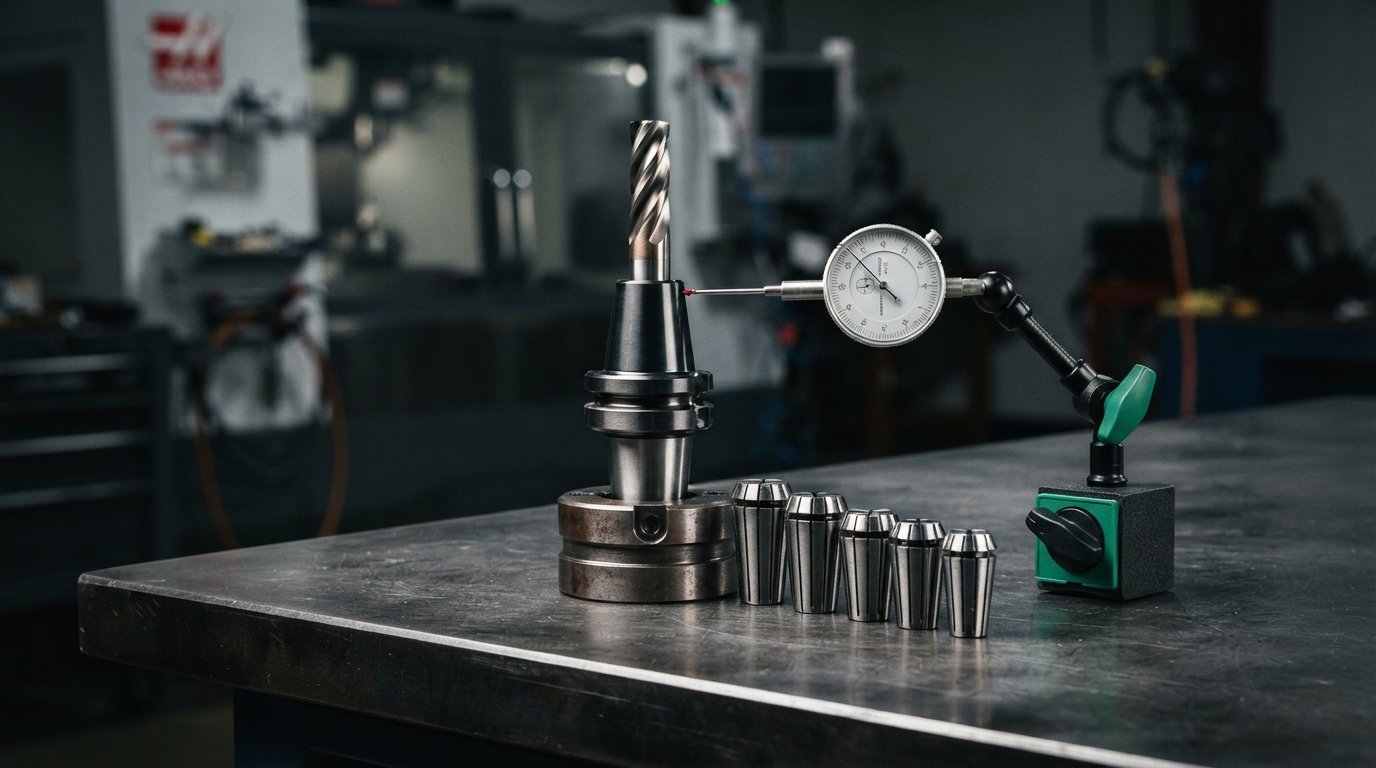
Every 0.0001 inches of excess tool runout cuts solid carbide end mill life by roughly 10 percent. Machinists know the frustration of chasing chatter, dimensional drift, and snapped cutters when an end mill slips during an aggressive roughing pass. High-end CNC machining centers cannot overcome sloppy toolholding, and running worn or improperly torqued er collets instantly ruins surface finishes and burns through tool life.
Predictable machining requires total control at the spindle interface. You can eliminate tool runout below 0.0002 inches TIR by mastering taper mechanics, collapse limits, and proper assembly practices. Matching the correct precision series to your tool shanks prevents slippage, stabilizes your cutting flutes, and protects machine spindle bearings during high-RPM cuts. We break down ISO 15488 sizing standards, precision grades, and verified tightening procedures to ensure secure fastening and maximum tool life on your shop floor.
Key Takeaways
- Understand the DIN 6499 and ISO 15488 standards governing 16-degree included angle taper mechanics to optimize rigid toolholding.
- Match tool shank sizes accurately across ER8 through ER50 series and prevent tool slip by respecting strict collapsible range limits.
- Identify how selecting ultra-precision er collets rated down to 0.0001 inches TIR protects carbide tool life and surface finish.
- Implement the required eccentric nut extraction snap-in sequence alongside calibrated torque specifications to eliminate assembly-induced runout.
- Select balanced toolholder packages featuring AT3 tapers and AD+B coolant capabilities to handle high-RPM production milling demands.
What Is an ER Collet? Mechanics and Industrial Standards
An ER collet is a slotted, cylindrical spring collet engineered to clamp cutting tools and cylindrical workpieces with balanced concentricity. Developed by Rego-Fix in 1972 as an evolution of the earlier E-collet design, the system quickly became the global benchmark for CNC toolholding. Today, the system is strictly governed by DIN 6499 and ISO 15488 specifications. These standards define the fitting dimensions, clamping nut profiles, and mechanical tolerances required for predictable, high-precision machining across milling machines, lathes, and Swiss-style CNC turning centers.
The 8-Degree Taper and DIN 6499 Specifications
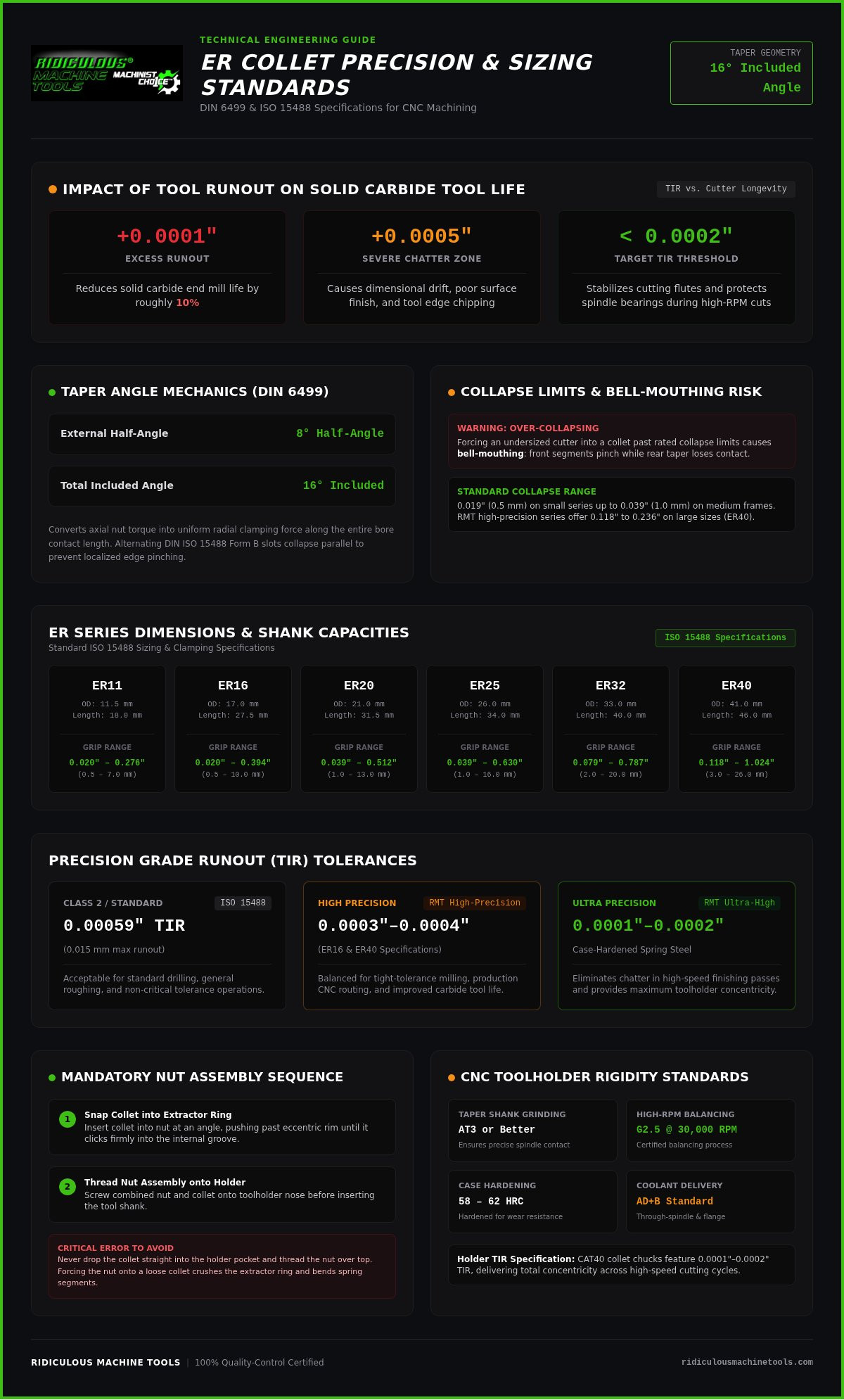
The mechanical efficiency of er collets relies on an 8-degree half-angle external taper, which creates a 16-degree included angle. This steep-taper geometry delivers substantial mechanical advantage, converting axial nut torque into uniform radial clamping force along the entire bore contact length. Under DIN ISO 15488 Form B standards, alternating slots cut from both ends enable parallel collapse across the grip length. This design avoids the localized edge pinching typical of single-angle systems like TG or DA collets, delivering superior concentricity and dampening vibration during heavy milling.
The Role of the Eccentric Extraction Ring
Modern ER clamping nuts feature an integrated, off-center extractor ring designed for positive tool extraction. This eccentric ring mates directly with the relief groove machined into the collet body. During setup, the internal cam hooks into the groove to pull the collet free from the holder taper during loosening. Proper assembly follows a mandatory two-step sequence:
- Insert the collet into the nut at an angle, pushing past the eccentric extraction rim until it clicks firmly into the internal groove.
- Thread the combined assembly onto the toolholder nose before inserting the tool shank.
Never drop the collet straight into the toolholder pocket and thread the nut over top. Forcing the nut onto a loose collet crushes the eccentric extractor against the collet rim. This bends the spring segments, creates irreversible assembly-induced runout, and destroys the collet chuck seating surface.
ER Collet Sizing: Dimensions, Shank Capacities, and Collapse Ranges
Selecting the correct series requires balancing tool clearance against rigid holding capacity. Sizing ranges from micro-machining ER8 units up to heavy-duty ER50 designs built for large-diameter drilling and roughing. Standard industrial er collets collapse between 0.019 inches (0.5 mm) on smaller series and 0.039 inches (1.0 mm) on medium frames, while RMT high-precision series offer an extended collapsible range of 0.118 inches to 0.236 inches on larger sizes like the ER40.
Standard ER Size Chart and Tool Shank Capacities
Every standard series features distinct external dimensions and maximum shank clamping limits:
- ER11: Outer diameter 11.5 mm, overall length 18 mm. Grips shanks from 0.020 in to 0.276 in (0.5 mm to 7.0 mm).
- ER16: Outer diameter 17 mm, overall length 27.5 mm. Grips shanks from 0.020 in to 0.394 in (0.5 mm to 10.0 mm).
- ER20: Outer diameter 21 mm, overall length 31.5 mm. Grips shanks from 0.039 in to 0.512 in (1.0 mm to 13.0 mm).
- ER25: Outer diameter 26 mm, overall length 34 mm. Grips shanks from 0.039 in to 0.630 in (1.0 mm to 16.0 mm).
- ER32: Outer diameter 33 mm, overall length 40 mm. Grips shanks from 0.079 in to 0.787 in (2.0 mm to 20.0 mm).
- ER40: Outer diameter 41 mm, overall length 46 mm. Grips shanks from 0.118 in to 1.024 in (3.0 mm to 26.0 mm).
Understanding Collapse Range and Grip Mechanics
Multi-slit spring steel compresses inward as the nut forces the taper into the holder cavity. When selecting tooling, shops running diverse shank tolerances can source high precision er spring collets to secure cylindrical shanks reliably across varied operations. Forcing an undersized cutter into a collet past its rated collapse limit causes bell-mouthing. The front bore segments pinch the tool shank while the rear taper loses contact with the chuck cavity. This uneven clamping force destroys concentricity, introduces severe chatter, and causes end mills to walk out under heavy axial cutting loads.
Precision Grades: Standard vs. High Precision vs. Ultra Precision
Precision grades determine how accurately the centerline of the cutting tool aligns with the machine spindle. Standard commercial er collets conform to ISO 15488 Class 2 specifications, allowing up to 0.00059 inches (0.015 mm) Total Indicated Runout (TIR). For high-performance CNC operations, this baseline allowance introduces unacceptable chatter. RMT high-precision ER16 and ER40 series tighten this tolerance to 0.0003–0.0004 inches. For micro-machining and aerospace finishing passes, RMT ultra-precision series hold runout to 0.0001–0.0002 inches TIR.
Runout Tolerances and TIR Measurement Standards
Standardized TIR checks measure runout using a precision ground pin clamped at a projection of 3× the shank diameter from the collet face. This distance reflects the real-world lever arm acting against cutting tools. RMT ER20 collets use case-hardened spring steel with specialized heat treatment to ensure the bore maintains elasticity and resists wear over thousands of cycles.
Excessive runout destroys solid carbide tooling unevenly. When a four-flute end mill operates with 0.0005 inches of runout, one cutting flute bears the brunt of the chip load while the opposing flute cuts fresh air. This dynamic imbalance causes premature micro-chipping along the cutting edge, generates harmonic vibration, and forces machinists to derate feed rates. Keeping TIR under 0.0002 inches ensures equal chip loading across every tooth, yielding superior milled surface finishes and preventing tool breakage.
Specialty Collet Types: Sealed and Rigid Tapping Designs
Modern production facilities often bypass standard spring collets when specific coolant or synchronization requirements dictate specialized holding geometry:
- Steel Sealed ER Collets: Engineered with metallic or vulcanized rubber seals between the expansion slots. These units channel high-pressure through-spindle coolant up to 2,000 PSI directly through the cutting tool, eliminating bypass leakage without requiring external coolant discs or sealing caps.
- Rigid Tap Collets: Incorporate an internal square drive pocket at the base of the bore to mechanically lock the tap drive tang. This positive drive stops the tap from slipping inside the collet during rapid spindle reversals.
Equipping machines with sealed collets preserves clean spindle delivery, while tap collets ensure secure fastening during high-speed threading cycles where frictional grip alone fails.
Proper Collet Assembly, Tightening Torque, and Maintenance
Precise toolholding requires disciplined bench habits. Cleanliness and correct assembly dictate actual runout at the machine spindle. Microscopic swarf chips trapped between taper seats or improper nut torque instantly compromise the concentricity of precision er collets, accelerating cutting edge breakdown.
Step-by-Step Collet Insertion and Nut Seating
Careless installation ruins clamping accuracy. Follow this mandatory sequence for every tool change:
- Wipe the toolholder cavity, collet surfaces, and nut threads clean using a lint-free cloth and solvent. A single piece of trapped grit creates runout.
- Angle the collet into the clamping nut, hooking the relief groove onto the eccentric extractor rim.
- Push the collet base firmly until it clicks past the retention shoulder. It should rotate freely inside the nut.
- Thread the collet and nut assembly onto the chuck body two or three turns by hand before sliding the tool shank inside.
- Insert the tool shank past the full gripping length of the bore, leaving flute washouts clear of the collet face.
Never slide the cutter shank into a loose collet before snapping it into the nut. Doing so locks the collet straight, preventing the eccentric cam from engaging and causing severe runout when tightened.
Torque Requirements and Clamping Hardware Selection
Guessing torque with standard open-end spanners produces inconsistent holding force. Over-torquing deforms spring steel slots permanently, causes bore bell-mouthing, and galls threads. Under-torquing allows tools to push back or spin under heavy axial chip loads. Use a calibrated torque wrench with dedicated collet crowfoot attachments to match manufacturer specifications:
- ER11: 25 to 30 Nm (18 to 22 ft-lbs)
- ER16: 50 to 60 Nm (37 to 45 ft-lbs)
- ER20: 70 to 80 Nm (52 to 60 ft-lbs)
- ER25: 90 to 115 Nm (66 to 85 ft-lbs)
- ER32: 100 to 140 Nm (74 to 105 ft-lbs)
- ER40: 130 to 170 Nm (96 to 125 ft-lbs)
For demanding jobs, friction-reducing ball-bearing nuts convert up to 30 percent more wrench torque into direct axial holding capacity without twisting the collet body. Prevent bench accidents and protect taper ground surfaces by mounting holders into a universal CNC tightening fixture during all tool changeovers.
Selecting ER Tool Holding for Production CNC Milling
Collet chuck selection directly influences cutter life, surface integrity, and spindle longevity. While set-screw end mill holders offer positive mechanical retention for heavy roughing, their set screws push the tool off-center, generating 0.0004 to 0.0010 inches of immediate radial runout. Premium ER chucks deliver uniform 360-degree radial grip. RMT ER16 CAT40 collet chucks are precision hardened to 58-62 HRC and ground to deliver 0.0001–0.0002 inches TIR, giving shops maximum concentricity for high-speed machining cycles.
Matching Collet Systems to Machining Operations
ER systems provide the accuracy needed for drilling, reaming, thread milling, and high-speed finishing. Their full-perimeter grip dampens harmonics and prevents cutting edge chatter. Heavy roughing with large end mills presents different demands. Excessive radial side loads can overcome the frictional clamping force of spring collets, leading to micro-deflection or tool pullout. When roughing demanding alloys with cutters over 0.500 inches, switch to dedicated set-screw holders or milling chucks to lock tools in place. For finishing, drilling, and profiling, running er collets maintains the runout control required to hold tight part tolerances.
Spindle Health, High-Speed Balancing, and Total Rigidity
Toolholder balance becomes critical as spindle speeds climb. Centrifugal imbalance forces expand quadratically with rotational speed. An uncertified holder spinning at high velocity generates destructive centrifugal vibrations that ruin machine spindle bearings. RMT balances ER chucks to certified G2.5 standards at 30,000 RPM to protect spindle health and maintain stable cutting geometry.
Mating accuracy between the machine spindle and the toolholder body relies on precision manufacturing. AT3-or-better taper-shank grinding ensures greater than 80 percent taper surface contact, preventing fretting corrosion and micro-movement under heavy cutting loads. Combined with dual-delivery AD+B through-spindle and flange coolant channels as standard, these toolholders keep cutting zones clear and temperatures stable. Equip your machine setup with precision ER spring collets from Ridiculous Machine Tools to lock down runout and maximize cutter performance across every production run.
Lock In Machining Precision Across Every Setup
Tight tolerances and consistent cycle times start at the spindle interface. Controlling runout protects expensive cutting edges, stabilizes high-feed passes, and prevents premature spindle bearing failure. Pairing verified torque practices with tooling bodies case-hardened to 58-62 HRC and ground to AT3 taper tolerances eliminates deflection under load. When running high-speed toolpaths, certified G2.5 balancing rated to 30,000 RPM ensures stable cutting geometry where standard commercial holders falter.
Precision CNC operations leave zero room for tool slippage or concentricity errors. Upgrading to ultra-precision er collets delivering 0.0001 to 0.0002 inch TIR accuracy balances chip loads across every flute, extending carbide tool life and guaranteeing mirror surface finishes. Equip your shop with high-precision ER spring collets engineered for tight tolerances and zero slippage, and execute your most demanding milling programs with complete confidence.
Frequently Asked Questions
Can an ER collet clamp tools with shanks smaller than its marked size?
Yes, standard Form B spring collets collapse below their nominal diameter within verified limits. An ER16 or ER32 collet safely accommodates shanks up to 0.039 inches (1.0 mm) below nominal size, while smaller ER11 series collapse up to 0.019 inches (0.5 mm). Clamping tools smaller than the rated collapse boundary causes bell-mouthing, reducing surface contact and inducing severe runout.
How much runout is acceptable for standard precision machining operations?
General machining tolerates standard Class 2 runout up to 0.00059 inches (0.015 mm) measured at 3x tool diameter. Demanding CNC production programs require tighter thresholds. High-precision tooling limits runout to 0.0003–0.0004 inches, while ultra-precision er collets hold runout between 0.0001 and 0.0002 inches TIR. Keeping runout below 0.0002 inches ensures uniform tooth engagement and prolongs carbide cutting life.
What happens if you insert the collet into the chuck before the nut?
Inserting the collet into the chuck pocket before the nut forces the eccentric extraction cam directly against the collet rear taper. As the nut threads down, this off-axis contact prevents the spring slots from collapsing concentrically. This assembly mistake bends the outer segments, crushes the extractor ring, and introduces permanent runout that destroys part tolerances and toolholder concentricity.
Is an ER collet suitable for heavy roughing with solid carbide end mills?
ER collet chucks handle medium milling, profiling, drilling, and high-speed finishing reliably. Heavy roughing passes with end mills exceeding 0.500 inches diameter generate extreme radial side loads that can overcome frictional spring resistance. For deep slotting or heavy hogging cuts in tough alloys, dedicated set-screw end mill holders eliminate the risk of tool pullout or axial creep.
How do you clean and inspect ER collets to maintain precision?
Disassemble the nut and collet completely after each job cycle. Wash the internal bore, external taper, and nut threads using a degreasing solvent, then wipe them dry with a clean, lint-free shop cloth. Inspect the clamping slots under bright light for metal chips or galling. Discard any collet displaying score marks, fretting corrosion, or collapsed slits that fail to spring back.
Can you run through-coolant tooling with standard ER spring collets?
Standard er collets cannot seal coolant because high-pressure cutting fluid escapes through the open spring slots. Delivering fluid directly through the cutting tool requires steel sealed ER spring collets or specialized sealing ring nuts. Sealed designs incorporate metallic or vulcanized rubber fillers between the slots to contain coolant pressures up to 2,000 PSI without external discs.