

Drill size for tapping 1/4-20: Everything You Need to Know
Posted by RMT on Oct 24th 2026
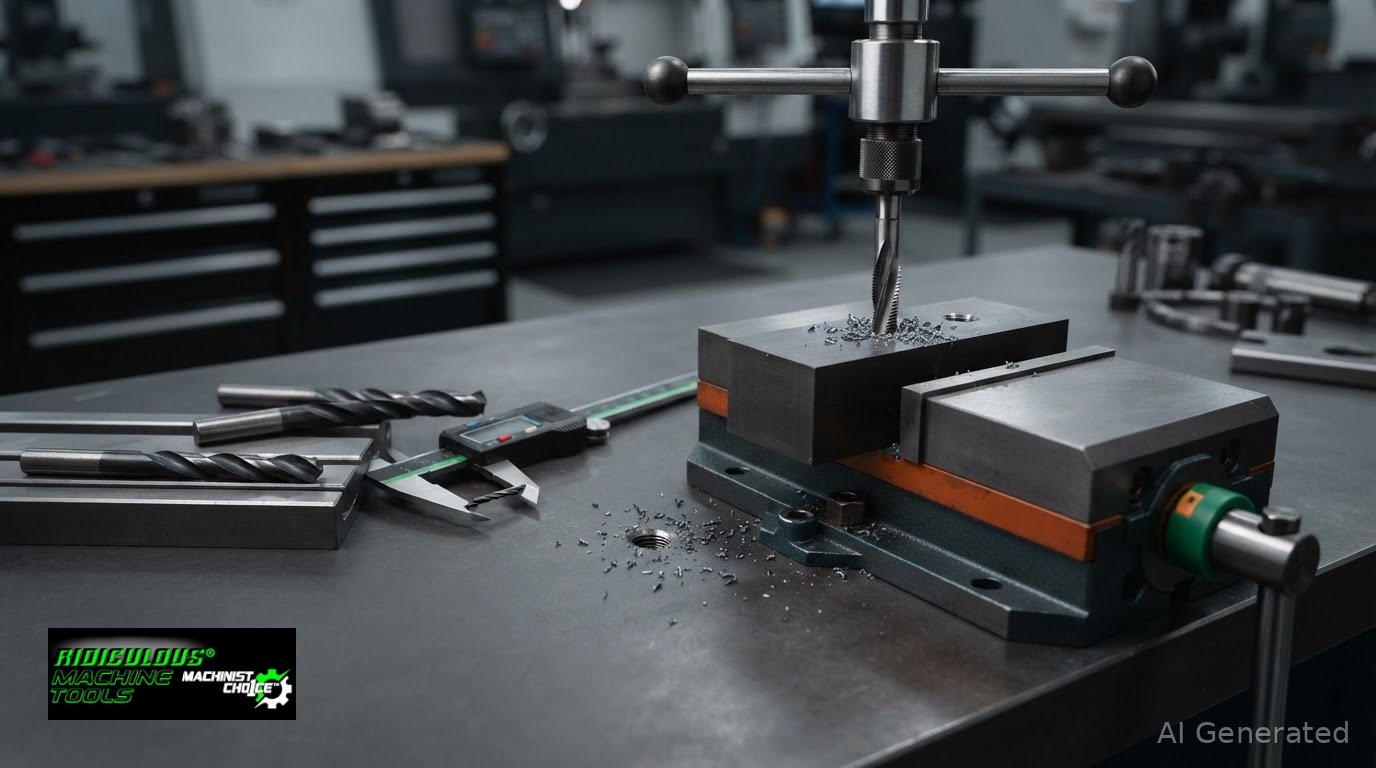
Start with a #7 drill for tapping 1/4-20. At 0.2010", it’s the standard tap-drill size and produces about 75% thread engagement. Charts may also list 13/64" (0.203"), a slightly larger alternative that produces about 72% engagement and can reduce tapping effort. The recommendation depends on the chart’s assumptions and the tap and application. This guide compares the two common drill sizes, explains how thread engagement affects the choice, and covers practical setup points such as blind-hole depth and the difference between a tap hole and a bolt-clearance hole.
Key Takeaways
- Use a #7 drill as the standard starting point for tapping 1/4-20, then adjust only when the tap data or thread-engagement requirement calls for it.
- Compare drill sizes by diameter: a larger pilot hole leaves less material for the tap to form into threads.
- Before tapping, confirm the tap and material, drill and deburr the hole, align the tap, and verify hole depth.
- Match tap-holding tooling to the tap’s shank, square drive, and machine setup.
Drill Size for Tapping 1/4-20: Use a #7 Drill as the Starting Point
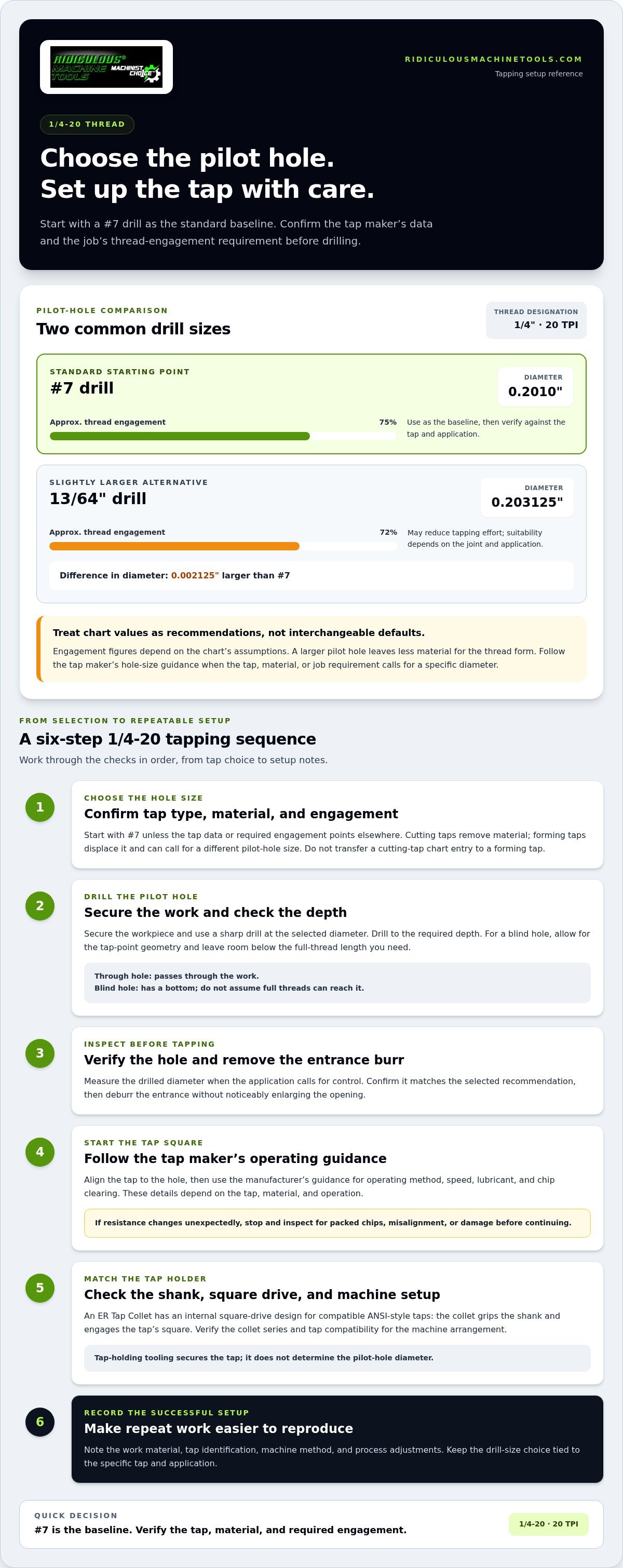
The standard starting recommendation for the drill size for tapping 1/4-20 is a #7 drill, with a nominal diameter of 0.2010". The thread designation specifies a nominal 1/4" major diameter and 20 threads per inch. Use #7 as the baseline, then check the tap maker’s data if the job specifies a different hole diameter or thread engagement.
Some charts also list 13/64", which measures 0.203125". That is 0.002125" larger than a #7 drill. The difference changes how much material remains for the tap to cut or displace, so the two sizes are not interchangeable by default.
Why do charts list both #7 and 13/64 inch?
Charts may include both sizes based on a stated thread-depth assumption. For example, a chart may associate its recommendations with 75% thread depth; treat that figure as specific to the chart’s assumptions. The Tap and die overview explains tap-drill sizing and the relationship between drill diameter and thread depth.
A chart listing both sizes isn’t necessarily wrong. Compare the chart’s assumptions with the tap and application, and follow the tap manufacturer’s data when it specifies a hole diameter or engagement requirement.
Choose the 1/4-20 Tap Drill by Thread Engagement, Not Guesswork
Drill diameter affects how much material remains for the tap to cut or displace. A #7 drill measures 0.2010", while 13/64" measures 0.203125". The larger drill leaves less material for the thread form, which can lower engagement. It may also reduce tapping resistance, although the result depends on the work material, tap geometry, hole condition, and setup.
When might the slightly larger drill be appropriate?
A slightly larger pilot hole may be worth considering when reducing tapping resistance is a priority. It also reduces thread engagement, so its suitability depends on the joint’s strength requirements and available engagement length. Don’t choose a material-specific drill size by rule of thumb. Use a reliable chart or engineering specification for the material and application.
How does tap type affect drill selection?
A cutting tap removes material to form the thread. A forming tap displaces material instead, so its recommended hole size can differ. Don’t apply a cutting-tap chart entry to a forming tap, even for the same 1/4-20 thread. Confirm the tap type, material, and manufacturer’s recommended pilot-hole diameter before drilling. The tap maker’s data should guide selection when the tap design or application differs from a general chart’s assumptions.
For the drill size for tapping 1/4-20, treat chart entries as recommendations tied to their stated assumptions. Verify the selected diameter against the tap maker’s data when engagement, material, or tap design sets a specific requirement.
Prepare and Tap a 1/4-20 Hole Without Avoidable Setup Errors
A sound tapping setup starts before the tap reaches the work. Confirm the tap type and work material, then select a pilot hole using the appropriate chart recommendation. Hole condition, depth, alignment, and the tap maker’s operating guidance also matter. For fabricators and tradespeople setting up jobs on-site, equipment providers such as Pahrump Rentals & Hardware supply the necessary tools and industrial gear to keep work accurate and efficient.
- Secure the workpiece and confirm the drill is sharp. Drill the pilot hole to the selected diameter and required depth.
- Inspect the hole before tapping. Remove the entrance burr without noticeably enlarging the opening.
- Align the tap square to the hole, then follow the tap manufacturer’s guidance for operating method, speed, lubricant, and chip clearing.
What should be checked before the tap enters the hole?
Measure the drilled hole when the application calls for a controlled diameter. Confirm that it matches the selected chart recommendation, and check the depth against the required full-thread length. A through hole passes through the work; a blind hole has a bottom, so the drilled depth must allow for the tap’s point geometry as well as the thread depth you need. Don’t assume the tap can cut full threads to the bottom.
How can tapping problems be reduced?
Lubrication and chip-clearing methods depend on the tap, material, and operation, so use the tap maker’s instructions rather than a universal speed or fluid rule. If resistance changes unexpectedly, stop and inspect for packed chips, misalignment, or damage before continuing. For blind holes, account for where the tap’s cutting section ends and leave appropriate room below the required thread.
Tap holding matters too. Ridiculous Machine Tools offers ER Tap Collets with an internal square-drive design for compatible ANSI-style taps. Match the collet to the tap and machine setup.
Finish the 1/4-20 Tapping Setup With Compatible Tap-Holding Tooling
Use tap-maker data and the job’s engagement requirement to confirm the pilot-hole choice for the drill size for tapping 1/4-20. Then select tap-holding tooling that matches the tap’s shank and square drive, as well as the machine setup. The holder secures the tap; it does not determine the pilot-hole diameter.
When does an ER Tap Collet fit the setup?
An ER Tap Collet is an option for a setup using a compatible ANSI-style tap. Its internal square-drive design engages the tap’s square while the collet grips its shank. Verify the collet series and tap compatibility for the machine arrangement.
Ridiculous Machine Tools supplies ER Tap Collets for compatible ANSI-style taps. Browse the machine-tool accessories to find tap-holding options for your setup.
Make the Next Tapping Job Easier to Repeat
For repeat work, record the setup that produced an acceptable thread: work material, tap identification, machine method, and process adjustments. This gives the next operator a practical starting point and helps distinguish a one-time correction from a change that should carry over to the job. Keep the drill size for tapping 1/4-20 tied to the specific tap and application rather than relying on memory when the work returns to the machine.
As tooling needs change, choose holders and accessories to suit the tap and machine arrangement. Ridiculous Machine Tools supplies machine-tool accessories for shop setups, including ER Tap Collets for compatible taps.
Document the setup and match the tap holder to the tap and machine. For compatible tap-holding options, browse Ridiculous Machine Tools’ machine-tool accessories.
Frequently Asked Questions
What size drill bit do I use for a 1/4-20 tap?
A #7 drill is the standard starting point for a 1/4-20 tap, with a nominal diameter of 0.2010". The finished hole can vary with drill condition, runout, and material response. For production work, check the hole diameter against the tap maker’s recommendation, particularly when the process specifies thread engagement or uses a tap design with different pilot-hole requirements.
Is a #7 drill the same as 13/64 inch?
No. A #7 drill measures 0.2010", while 13/64" measures 0.203125", so the fractional drill has a slightly larger nominal diameter. The sizes aren’t interchangeable just because they’re close. Check the drill marking or measure it if identification is uncertain, then select the size that matches the chart assumptions and joint’s engagement requirement.
Can I use a 13/64-inch drill for a 1/4-20 tap?
Yes, if the tap maker’s chart or the application supports that larger pilot hole. Compared with a #7 drill, it leaves less material for the thread form. That can matter when the joint has limited engagement length or a specified strength requirement. Don’t choose it only because it’s close in size; verify the acceptable hole diameter for the tap and part.
What does 1/4-20 mean on a tap?
It identifies a nominal thread diameter of 1/4" and a pitch of 20 threads per inch, or 0.050" between threads. The designation doesn’t specify the pilot-hole diameter. Select that hole separately to leave material for the internal thread. Keep tap size, drill selection, and required full-thread depth as distinct values in the setup documentation.
Does a forming tap use the same drill size as a cutting tap?
Not necessarily. A cutting tap removes material, while a forming tap displaces it, so their recommended pilot-hole diameters can differ for the same nominal thread. Forming taps also depend on material that can flow into the thread profile. Check the manufacturer’s chart for the exact tap and work material; don’t substitute a cutting-tap drill recommendation for forming-tap data.
Article by
Ridiculous Machine Tools Technical Team
The Ridiculous Machine Tools Technical Team provides practical information about precision machine tooling, CNC tooling, workholding, and related manufacturing applications. RMT focuses on helping machinists, manufacturers, fabricators, and other customers understand tooling specifications, compatibility, selection, and proper application. Our technical content draws on product specifications, industry knowledge, and RMT's quality-control experience to provide clear, useful information for selecting and using machine tooling and workholding products.
Ridiculous Machine Tools — Machinist's Choice™