
Drill Bit Sizes for 1/4-20 Tapping Operations
Posted by RMT on Oct 3rd 2026
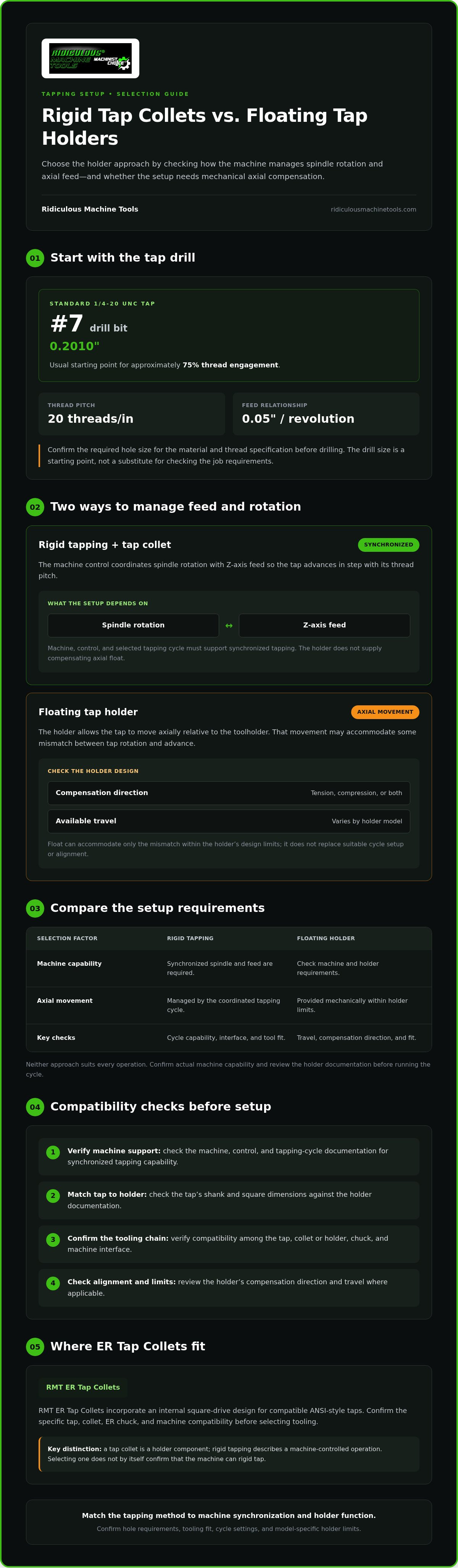
For a standard 1/4-20 UNC tap, a #7 drill bit measuring 0.2010" is the usual starting point for approximately 75% thread engagement. The choice between rigid tap collets vs floating tap holders is another key setup decision: it depends on whether the machine synchronizes spindle rotation with axial feed or the holder must provide axial compensation. Confirm the hole-size requirement for your material and thread specification before drilling.
This article covers the drill size and the holder-selection checks that follow. Ridiculous Machine Tools offers ER Tap Collets with an internal square-drive design for compatible ANSI-style taps. Verify the specific tap, collet, chuck, and machine compatibility before selecting tooling.
Key Takeaways
- Choose a holder based on whether your machine’s tapping cycle synchronizes spindle rotation and axial feed.
- Compare rigid tap collets vs floating tap holders by how they handle axial movement and feed mismatch.
- Before setup, check the tap’s shank and square dimensions against the holder’s documentation.
- RMT ER Tap Collets have an internal square drive for compatible ANSI-style taps. Confirm exact fit before selecting one.
Rigid Tap Collets vs. Floating Tap Holders: What Is the Difference?
Rigid tapping relies on the machine coordinating spindle rotation with axial feed. A floating tap holder allows axial movement to accommodate some mismatch between the tap’s rotation and its advance. The distinction in rigid tap collets vs floating tap holders involves more than hardware: a rigid tap collet is a holder component, while rigid tapping is a machine-controlled operation.
A tap cuts internal threads, while a die cuts external threads, as described in Wikipedia’s Tap and die overview. How the tap is held and how the machine advances it are separate parts of the setup.
What does rigid tapping mean on a CNC machine?
In a rigid tapping cycle, the control synchronizes spindle rotation with the Z-axis feed so the tap advances by the thread pitch as it turns. The machine’s control and spindle system must support that synchronization, and the selected tapping cycle must be configured for it. Don’t assume a CNC machine can rigid tap based on its age or general capabilities alone. Check the machine and control documentation.
What does a floating tap holder do?
A floating tap holder lets the tap move axially relative to the toolholder. That movement can accommodate some feed mismatch, which may help when the machine does not provide synchronized tapping. The amount and direction of compensation depend on the holder design. Some holders provide tension, compression, or both, and their functions and travel vary by model.
Neither approach removes the need for a sound setup. Machine capability, holder design, tap geometry, and workpiece alignment all matter. Treat the holder as one part of the system, and check its operating limits before running the cycle.
How Rigid Tap Collets and Floating Holders Manage Feed and Alignment
In rigid tapping, the machine coordinates spindle rotation and Z-axis movement so the tap advances in step with its thread pitch. For a 1/4-20 tap, 20 threads per inch corresponds to 0.05" of axial advance per spindle revolution. The programmed feed must match that relationship for the tapping cycle to track the tap’s lead.
Synchronization, pitch, and axial movement
The control manages the relationship between spindle speed and feed during the cycle, including reversal at the bottom of a blind or through hole. Matching feed to pitch helps limit axial loading caused by a mismatch between the tap’s rotation and advance. Confirm that the machine, control, and selected tapping cycle support synchronized tapping. Consult their documentation rather than assuming the capability.
Manufacturing references from the Society of Manufacturing Engineers can provide broader context on machining processes. For machine-specific cycle behavior, refer to the machine and control documentation.
Where axial compensation enters the setup
A floating holder introduces mechanical axial movement between the spindle and tap. If feed and rotation differ slightly, that movement may accommodate some of the mismatch instead of transferring it directly to the tap. The response depends on the holder’s construction: it may provide tension, compression, or both, and available travel varies by model. Check the holder documentation for its compensation direction and range.
Float does not replace the correct tapping cycle, suitable machine setup, or alignment between the tap and hole. It can accommodate only the mismatch within the holder’s design limits. Excess mismatch can still load the tap or affect the thread. This is a general description of holder behavior, not an RMT product specification. RMT’s ER Tap Collets have an internal square-drive design for compatible ANSI-style taps. Review the ER Tap Collet product information and verify fit against the tap and ER chuck documentation before selecting a setup.
Rigid Tapping vs. Floating Tap Holders: Applications and Tradeoffs
Neither setup suits every machine or tapping operation. Rigid tapping requires confirmed spindle-feed synchronization. A floating holder may suit a process that needs axial compensation, within the holder’s limits. For more background, Cutting Tool Engineering’s comparison of rigid and floating tapping discusses the tradeoffs between the methods.
| Selection factor | Rigid tapping with a tap collet | Floating tap holder |
|---|---|---|
| Machine requirements | Machine, control, and tapping cycle must support synchronized tapping. | May suit a setup where axial compensation is needed, subject to machine and holder requirements. |
| Axial movement | The holder does not supply compensating axial float; the cycle coordinates spindle and feed. | Allows axial movement as specified by the holder design. |
| Setup checks | Verify cycle capability, machine interface, and tap, collet, and chuck compatibility. | Check travel, compensation direction, tap-shank fit, and holder limits. |
| Possible use | Repeatable CNC operations on a verified rigid-tapping setup. | Processes where the machine setup or application calls for axial compensation. |
When a rigid tapping setup may fit
A rigid setup may be appropriate for repeatable CNC work if the machine and control documentation confirm synchronized tapping. The tap, collet, chuck, and machine interface must also match. A rigid cycle alone does not confirm tooling compatibility or guarantee a particular thread result.
When a floating holder may fit
A floating holder may be useful when the process calls for axial compensation and the holder’s design supports it. Check the model’s specified travel and direction of compensation, along with tap-shank compatibility. Use the holder manufacturer’s documentation for operating limits rather than assuming all floating holders behave alike.
Selection depends on machine capability and holder design. That is the practical distinction behind rigid tap collets vs floating tap holders: verify synchronization for rigid tapping, or confirm that the holder’s axial compensation suits the process.
How to Choose Between a Rigid Tap Collet and Floating Holder
Use this sequence to separate machine capability from tap and holder fit. When comparing rigid tap collets vs floating tap holders, verify the machine’s tapping method first, then confirm that every connection in the tooling stack matches.
Verify the machine and tapping cycle first
Check the machine and control documentation for rigid tapping support and the functions available in the selected cycle. Confirm that the setup coordinates spindle rotation with programmed axial feed for the tap pitch. A CNC label alone does not confirm synchronized tapping capability.
Check tap and holder compatibility
Once the machine-side checks are clear, verify the tool-side connections separately. A compatible spindle interface does not necessarily mean the tap fits the collet or holder.
- Machine capability: Confirm rigid tapping support or determine whether the process calls for axial compensation.
- Tapping cycle: Check the selected cycle’s operation and setup instructions against the machine documentation.
- Tap geometry: Measure or confirm the tap’s shank and square dimensions. Match both to the exact collet or holder documentation.
- Holder interfaces: Confirm the collet series fits the ER collet chuck, and that the chuck or holder matches the machine interface.
- Workpiece setup: Check that the workpiece is secured and the hole is positioned for the intended tap entry. Misalignment can affect the operation regardless of holder type.
For broader interface considerations, consult the published tool-holding selection guide alongside the machine and tooling documentation. If a fit detail is not listed, ask the applicable manufacturer to confirm it rather than inferring compatibility from nominal tap size.
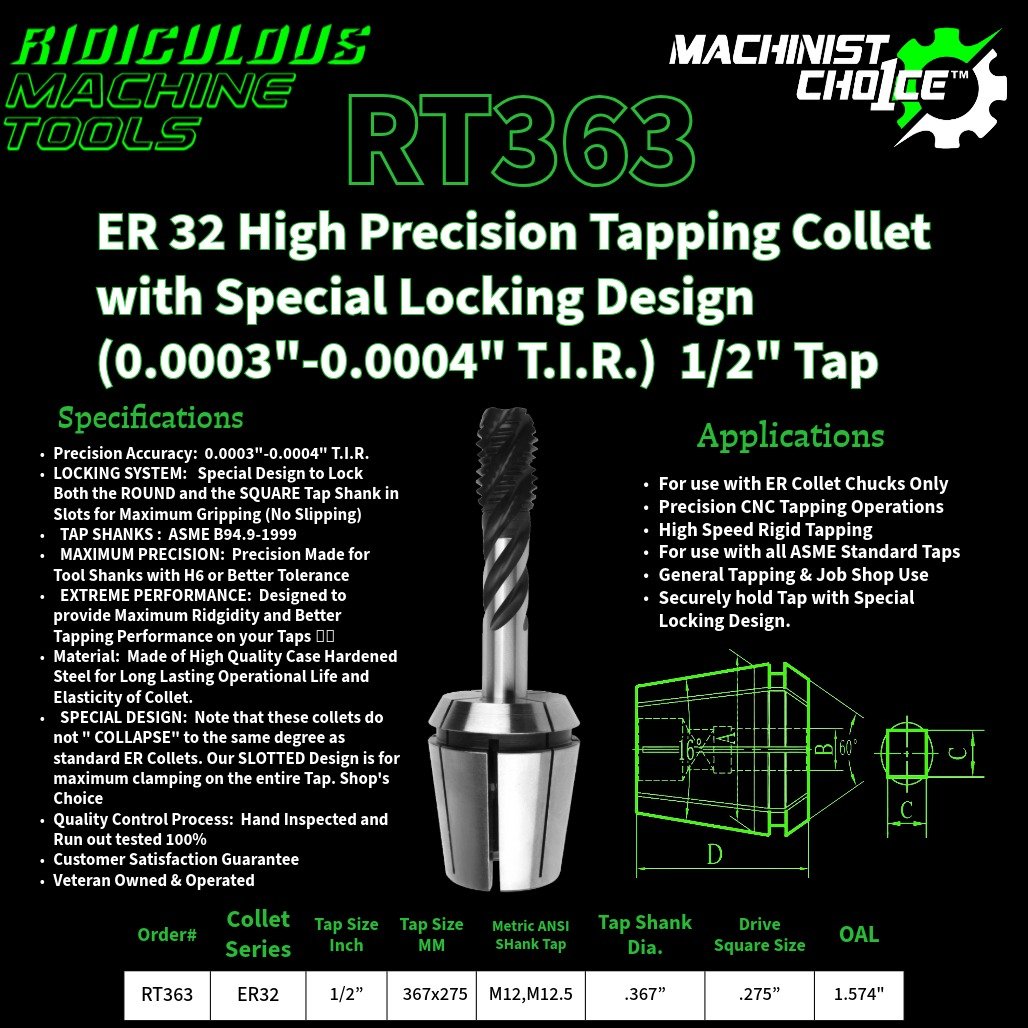
Ridiculous Machine Tools offers ER Tap Collets with an internal square-drive design for compatible ANSI-style taps. Check the applicable product details and confirm fit across the tap, collet, chuck, and machine interface before selecting one. Explore ER Tap Collets.
Using RMT ER Tap Collets as Part of a Compatible Rigid Tapping Setup
After confirming that the machine supports the intended tapping cycle and checking the full toolholding stack, an ER Tap Collet may be an option for a compatible setup. Ridiculous Machine Tools offers ER Tap Collets with an internal square-drive design for compatible ANSI-style taps. This describes the collet’s tap-drive design. It does not establish fit with a specific tap or chuck, or enable rigid tapping on a machine that lacks synchronized tapping capability.
What RMT confirms about its ER Tap Collets
The confirmed product detail is the internal square drive for compatible ANSI-style taps. Check model-level specifications and compatibility individually. Do not assume a collet suits a particular tap size, shank, square, or ER chuck unless the applicable product documentation confirms it.
Final checks before selecting a holder
Before choosing between rigid tap collets vs floating tap holders, work through the machine-side and tooling-side checks separately:
- Confirm the machine and control support the tapping method and cycle planned for the operation.
- Match the tap’s shank and square dimensions to the exact collet or holder documentation.
- Verify the ER collet series, chuck interface, and machine connection independently.
- For a floating holder, check its documented compensation direction and travel. For a rigid setup, confirm the cycle’s synchronization requirements.
If the product documentation does not establish a fit, do not infer one from the tap’s nominal thread size. Verify the complete combination before putting it into the machine. Review Ridiculous Machine Tools tooling options for relevant tooling information.
Choose the Holder Around the Machine and Operation
The choice between rigid tap collets vs floating tap holders starts with the machine, not the holder label. Rigid tapping depends on verified synchronization between spindle rotation and axial feed. A floating holder provides axial movement that may suit an operation needing compensation, within that model’s documented limits.
Before selecting tooling, confirm the tapping cycle, machine interface, tap shank and square dimensions, ER system, and holder specifications. These checks can catch fit or capability issues before the tap enters the workpiece.
Ridiculous Machine Tools offers ER Tap Collets with an internal square-drive design for compatible ANSI-style taps. Specifications and compatibility vary by model, so check the applicable product information rather than assuming a fit. Review Ridiculous Machine Tools tooling options as you evaluate the complete setup. Confirm the machine capability and tooling interfaces before selecting a holder.
Frequently Asked Questions
What is the difference between a rigid tap collet and a floating tap holder?
A rigid tap collet holds a compatible tap, while rigid tapping is a machine operation that synchronizes spindle rotation with axial feed. A floating tap holder adds mechanical axial movement that may accommodate some mismatch. The terms describe different parts of the setup: one names a holding component, the other a holder mechanism. Select based on machine capability and the compensation the operation calls for.
Can I use a rigid tap collet without rigid tapping capability?
A rigid tap collet does not add synchronization between spindle rotation and Z-axis feed. Without rigid tapping capability, the collet alone cannot perform that machine function. Whether it can be used with another tapping method depends on the machine procedure and the holder’s documented design. Check both before setup, and do not assume a collet provides axial float or feed compensation.
Does a floating tap holder prevent tap breakage?
No holder can guarantee that a tap will not break. A floating design may accommodate some axial mismatch, but its compensation depends on its mechanism, direction, and travel. It will not correct every cause of failure, such as an unsuitable tapping cycle, poor alignment, or incompatible tooling. Check the holder specifications and review the complete setup if taps break or threads show defects.
How do I know if my CNC machine supports rigid tapping?
Check the machine and control documentation for rigid tapping or synchronized tapping-cycle support. Confirm that the specified cycle coordinates spindle rotation with Z-axis feed for the tap’s pitch, and follow the machine maker’s setup instructions. A CNC label alone does not confirm the feature. If documentation is unclear, verify the control’s available functions before selecting a rigid tapping setup.
Will an ER Tap Collet fit any tap?
No. Fit depends on the tap’s shank and square dimensions, the ER Tap Collet’s specifications, and compatibility with the ER collet chuck. Ridiculous Machine Tools offers ER Tap Collets with an internal square-drive design for compatible ANSI-style taps, but that does not establish universal fit. Check the exact product documentation against the tap and chuck before selecting a collet.
When should I choose a floating tap holder instead of rigid tapping?
Consider a floating tap holder when the machine process or application calls for axial compensation, or when synchronized tapping is unavailable and the documented setup supports a floating holder. Verify the holder’s compensation direction, travel, and tap-shank fit. If the machine supports rigid tapping, that capability alone does not decide the choice. Weigh the operation’s requirements against the holder’s design and limits.
Article by
Ridiculous Machine Tools Technical Team
The Ridiculous Machine Tools Technical Team provides practical information about precision machine tooling, CNC tooling, workholding, and related manufacturing applications. RMT focuses on helping machinists, manufacturers, fabricators, and other customers understand tooling specifications, compatibility, selection, and proper application. Our technical content draws on product specifications, industry knowledge, and RMT's quality-control experience to provide clear, useful information for selecting and using machine tooling and workholding products.
Ridiculous Machine Tools — Machinist's Choice™