

Complete Carter products toggle clamps vs destaco for woodworking jigs Guide for Success
Posted by RMT on Nov 2nd 2026
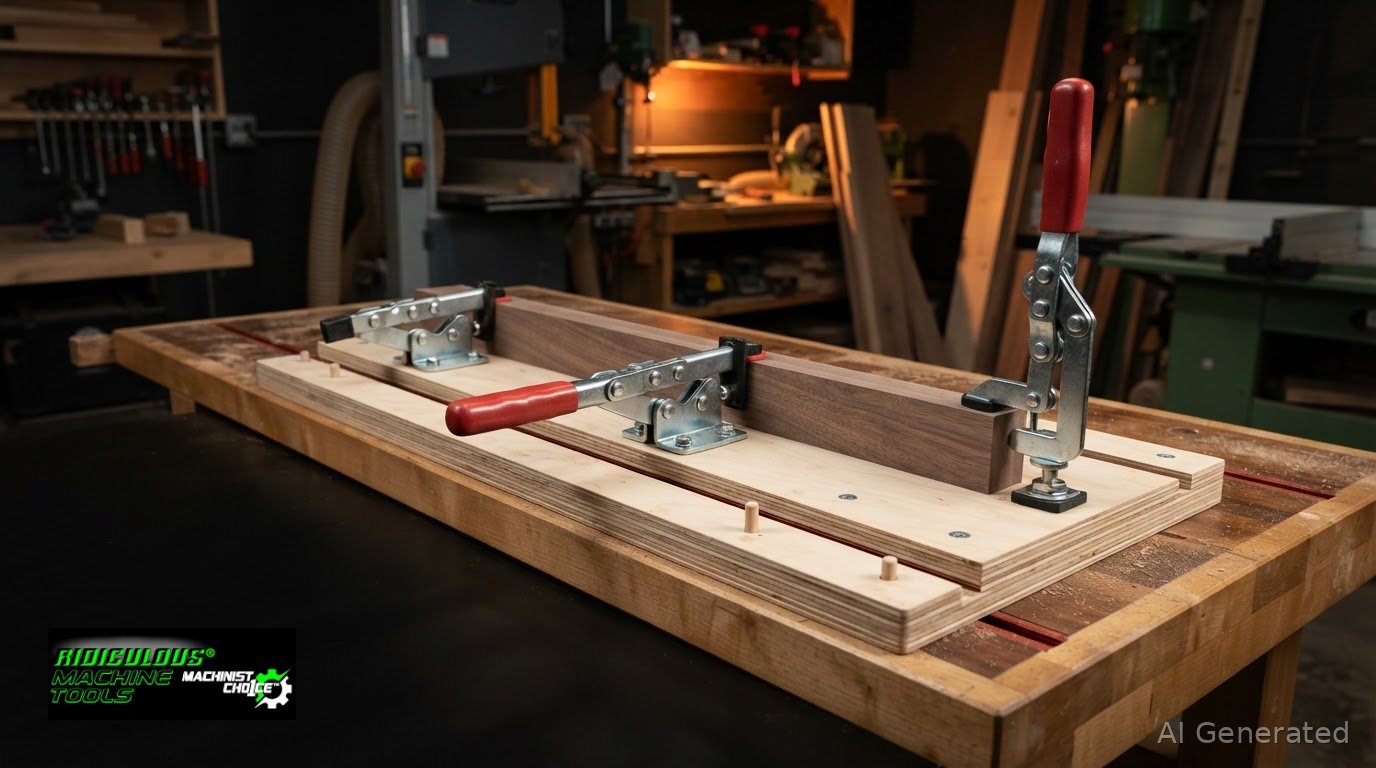
Neither Carter Products nor Ridiculous Machine Tools is automatically the right choice for every woodworking jig; compare specific clamp models against the workpiece, fixture layout, and operation rather than relying on brand reputation. A useful comparison of Carter Products toggle clamps and Ridiculous Machine Tools for woodworking jigs starts by defining the actual task, identifying the workpiece’s locating surfaces, noting how often the fixture changes jobs, and matching each candidate’s published model information to those needs. This approach gives the brand comparison a practical basis: assess each option against the jig’s intended use, identify which model details matter, and avoid treating product names or catalog categories as proof of suitability; the sections ahead provide a structured way to compare application fit, setup demands, and model information before finalizing a jig layout or purchase. It also helps distinguish operational design differences from specifications relevant to the workholding decision, keeping the selection grounded in the fixture’s requirements rather than broad brand claims.
Key Takeaways
- Separate clamping force from holding capacity so the rating you compare matches the load the clamp must resist.
- Plan for a safety factor of 1.5:1 to 4:1 over estimated peak force, based on the application’s load conditions.
- Check the jig’s mounting surface, fastener layout, and handle clearance before choosing a clamp size or orientation.
- Match vertical, horizontal, latch, or push-pull action to how the workpiece needs to be held and released.
What About "Exerting/Clamping Force" & "Holding Capacity"?
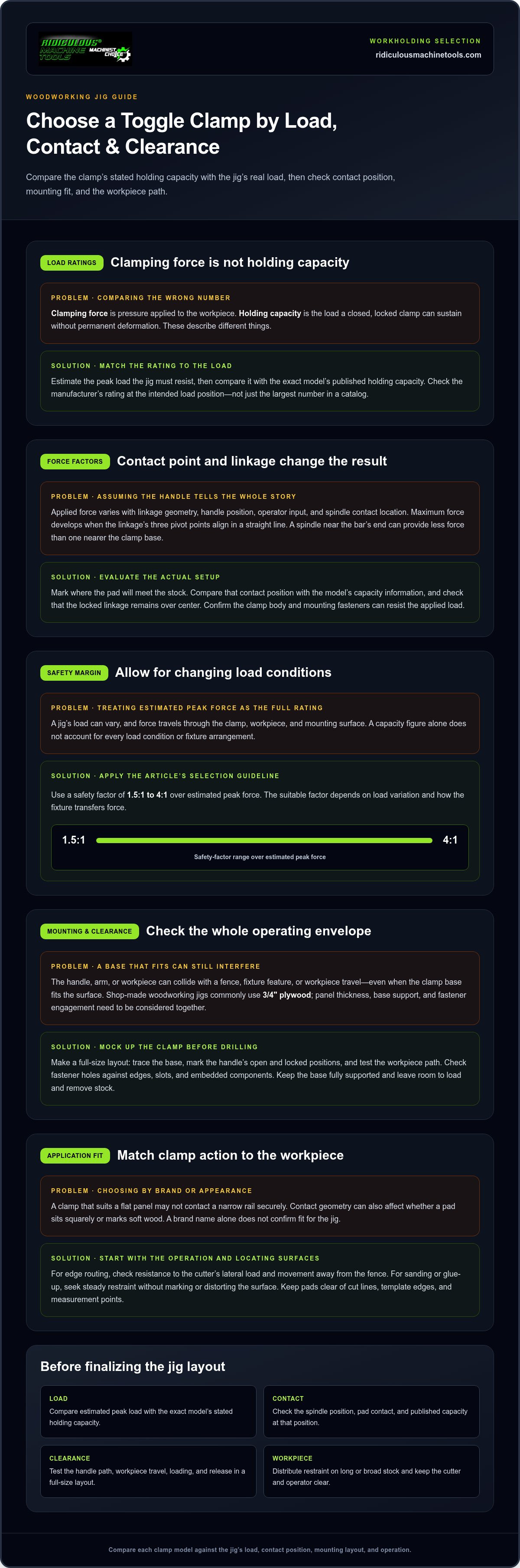
Compare Carter Products and Destaco models by the load each clamp must resist, not by a force label alone. Clamping force describes pressure on the workpiece; holding capacity describes the load a locked clamp can sustain without permanent deformation.
Factors Affecting Clamping Force
A toggle clamp’s linkage, handle position, and spindle contact point all affect its clamping force. Maximum force develops when the linkage’s three pivot points align in a straight line. The operator’s input matters, too: hand force and grip position change the force transmitted through the handle and links.
Contact location on the work-holding bar matters as well. A spindle near the clamp base can apply more force than one near the bar’s end. For a woodworking jig, check where the pad meets the stock, then compare that position with the manufacturer’s capacity information.
Manual Force and Holding Capacity
Manual clamping force starts at the operator’s hand. Linkage geometry creates mechanical advantage, but the pressure at the spindle also depends on hand position and where force is measured. Two clamps with similar-looking handles may feel different in use, even before workpiece thickness enters the setup.
Holding capacity is a separate rating: the maximum load a closed, locked clamp can sustain without permanent deformation. It is not necessarily the pressure applied to the wood. For example, a clamp may hold a jig component against movement while its clamping force varies with spindle adjustment and contact position.
Safety Factors and Load Ratings
Estimate the peak load the jig will experience, then compare it with the clamp’s stated holding capacity. A selection guideline uses a safety factor of 1.5:1 to 4:1 over estimated peak force. The suitable factor depends on load variation and how the fixture transfers force through the clamp, workpiece, and mounting surface.
Read the manufacturer’s rating for the exact model and load position. Capacity can decrease as the spindle moves toward the end of the bar, so don’t assume the maximum rating applies at every contact point. Check that the locked linkage stays over center and that the jig’s mounting fasteners and body can resist the applied load.
Mounting options and available space
Mounting starts with the jig body and the clamp’s footprint. Toggle clamps can attach to plywood or MDF using standard fasteners. Shop-made woodworking jigs commonly use 3/4" plywood, so check the panel thickness, clamp base, and fastener engagement together. A clamp that fits the top surface may still interfere with a fence, sacrificial insert, or workpiece travel.
Before comparing Carter Products and Destaco models, mark the clamp base location on the jig. Measure the clearance needed for the handle to open and close, the arm’s path, and the spindle’s contact point. A handle that strikes a fence or router-table component can prevent full operation, even when the mounting holes align.
Orientation also affects usable space. A vertical hold-down clamp places the handle above its base, while a horizontal design keeps the handle lower when locked. On a coping sled, check clearance between the clamp handle, sled fence, and workpiece before drilling mounting holes. Leave room to load and remove stock without moving the clamp.
Fastener placement matters on a plywood or MDF jig. Keep the clamp base fully supported, and position its holes so screws do not conflict with an edge, slot, or embedded component. If the jig has a replaceable top, avoid mounting hardware where it could block removal. Use the manufacturer’s mounting drawing to compare each model’s base layout and operating envelope.
Make a simple full-size layout before committing to either brand. Trace the base, mark the handle’s open and locked positions, then test the workpiece path. This reveals collisions that a top-view footprint misses. For a low-clearance fixture, compare horizontal toggle clamp configurations against the available envelope, then confirm the selected model’s mounting details.
Clamping requirements and applications
Choose a clamp arrangement based on the operation’s direction of movement and the workpiece’s locating surfaces. For edge routing, the fixture must resist the cutter’s lateral load without letting the board drift from its fence. For sanding or glue-up, the workpiece may need steady restraint without pressure that marks or distorts its surface. Identify the dominant movement before comparing models.
For a Carter Products toggle clamps versus Destaco comparison for woodworking jigs, assess equivalent configurations under the same working conditions. Review each model’s contact geometry, adjustment method, mounting pattern, and published load rating. A model suited to a flat panel may not contact a narrow rail securely. The useful comparison is how well the clamp fits the stock, not a general brand ranking.
Consider where the clamp pad meets the material. A small contact area can leave an impression on soft wood, while an angled pad may not sit squarely on a flat reference surface. Choose a suitable contact arrangement for the workpiece, and check that the clamp does not cover a cut line, template edge, or location needed for measurement.
A long or broad workpiece may need multiple clamps to prevent shifting or lifting. Distribute restraint across supported areas rather than concentrating pressure at one end. For a panel-routing fixture, check that the panel remains seated along its locating edges throughout the tool path. The clamp layout should leave the cutter and operator clear access.
Before committing to a jig layout, test the intended work sequence with a representative piece. Confirm that loading, clamping, tool access, and release work in that order. This application-first check helps narrow the model choice and reveals interference or contact problems before repeated shop use.
What safety factors and load ratings should be checked when choosing a toggle clamp?
Read the manufacturer’s load chart for the exact clamp model and configuration. Check the stated loading direction, spindle position, and any conditions attached to the rating. A figure for a straight-line pull does not automatically describe resistance to twisting or side loading. Match the published test arrangement as closely as possible to how the clamp will work in the jig.
Next, assess the complete fixture load path. The clamp transfers force through its base, fasteners, and jig body, so each connection must support the application. On a plywood fixture, check whether the base sits on a supported area and whether the fasteners engage the panel securely. A strong clamp cannot compensate for a loose mounting surface or flexible jig body.
Consider how the operation loads the workholding over time. Repeated routing passes, vibration, or changing workpiece contact can create conditions unlike a single static setup. For a sanding jig, evaluate whether hand pressure shifts the stock; for a drill-press fixture, consider the direction of force as the bit enters and exits. Choose a rating and installation suited to the operation, not just hand-clamping during setup.
If a fixture uses multiple clamps, don’t assume each carries an equal share. Workpiece shape, clamp placement, and fixture stiffness affect load distribution. Check each contact point and mounting location separately, especially where a long panel could lift or rotate. Periodically inspect fasteners and the jig body for movement, loosening, or visible damage.
Use the model’s installation instructions and load information to compare options consistently. Keep the clamp, fasteners, and fixture support within their stated use conditions; don’t substitute one component’s rating for another’s. Reviewing manual toggle clamp configurations can help you compare available styles and model-specific details.
An over-center toggle clamp locks its arm in position with a single downward motion and resists opening under load. Consider that locking action alongside the model’s rated capacity and the fixture’s support.
Ridiculous Machine Tools: Horizontal Toggle Clamps
Ridiculous Machine Tools offers horizontal toggle clamps for jig layouts where a low handle position helps preserve clearance. Compare each model’s holding-capacity rating, mounting footprint, spindle adjustment, and operating space with your fixture requirements. A horizontal design may suit a sled or push fixture, while vertical, latch, and push-pull straight-line clamps address different force directions and closure needs.
For a woodworking jig, start with the workpiece contact point and available clearance, then match the clamp configuration to the loading sequence. Review the individual model specifications before choosing, since capacities, base styles, and mounting requirements vary. This ties the selection to the actual jig rather than brand preference alone.
Compare horizontal toggle clamps at ridiculousmachinetools.com.
Turn the Comparison Into a Jig Plan
Treat the Carter Products toggle clamps vs. Destaco comparison for woodworking jigs as a model-by-model decision, not a brand-wide verdict. Before building or modifying a fixture, sketch the clamp location alongside the workpiece path, fence, and tool access. This can reveal handling conflicts before they become problems in the finished jig.
Then define what the fixture must do for the work you expect. Consider whether stock thickness will stay consistent, how parts will be loaded, and whether the setup may change later. These requirements help you choose a clamp configuration suited to the jig’s actual use, without adding capacity or features the application doesn’t need.
Ridiculous Machine Tools offers horizontal, latch, and vertical toggle clamps for woodworking workholding. Review the product options against your fixture layout, then choose based on the specifications that matter to your application.
Contact Ridiculous Machine Tools
A clear layout and model-specific comparison put your next jig decision on solid ground.
Frequently Asked Questions
What clamp styles and sizes are best for common woodworking jig applications?
Match the clamp style to the jig’s force direction: vertical hold-down clamps suit router-table and drill-press fixtures, while horizontal clamps fit sleds and push fixtures. Medium-size clamps suit many coping sleds holding standard cabinet door rail stock. For other jig sizes, compare each model’s holding-capacity rating, spindle reach, and adjustment range with the workpiece and fixture layout.
How do Carter Products and DESTACO compare in clamp holding capacity and reach?
Compare the exact models’ published holding-capacity ratings and contact positions. Capacity is greatest near the base and decreases as the spindle approaches the end of the bar. This article does not provide a brand-specific reach comparison.
Are Carter Products and DESTACO clamps compatible with standard jig mounting patterns?
Toggle clamps can be mounted to plywood or MDF with standard fasteners, but mounting patterns vary by model. Check each model’s mounting drawing and confirm that the base and fasteners fit the jig.

Article by
Ridiculous Machine Tools Technical Team
The Ridiculous Machine Tools Technical Team provides practical information about precision machine tooling, CNC tooling, workholding, and related manufacturing applications. RMT focuses on helping machinists, manufacturers, fabricators, and other customers understand tooling specifications, compatibility, selection, and proper application. Our technical content draws on product specifications, industry knowledge, and RMT's quality-control experience to provide clear, useful information for selecting and using machine tooling and workholding products.
Ridiculous Machine Tools — Machinist's Choice™