
CNC Workholding Hacks for Complex Geometries
Posted by RMT on Sep 30th 2026
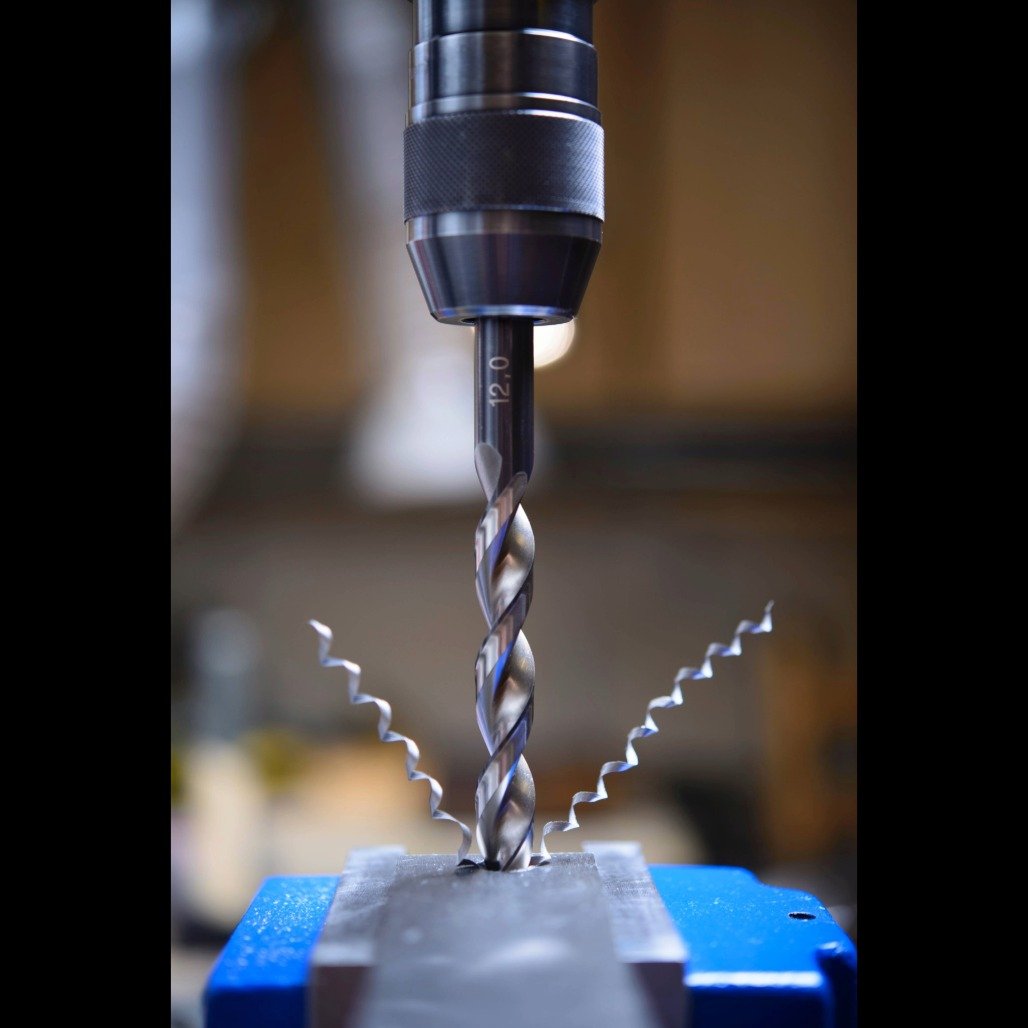
A precision keyless drill chuck holds the drill or reamer used to machine a complex workpiece, not the workpiece itself. Its runout can affect the result, but a “high precision” label alone doesn’t state a measured T.I.R. or explain the test conditions.
To compare options, check the chuck’s published runout and capacity, confirm compatibility from the chuck through the arbor to the machine interface, and match those details to the drilling operation.
This guide explains how to assess a precision keyless drill chuck and distinguish toolholding selection from the separate task of locating and securing complex parts.
Key Takeaways
- Compare a precision keyless drill chuck by its published T.I.R. and measurement conditions, not by its precision label alone.
- Trace the complete mounting path from chuck to arbor to machine, matching every interface before selecting components.
- Use the drill’s shank diameter and intended duty to narrow chuck capacity and performance requirements.
- Compare RMT’s standard precision, high precision, and high-performance nickel-coated categories, then verify each model’s specifications.
What Makes a Keyless Drill Chuck a Precision Chuck?
A keyless drill chuck grips a compatible round tool shank. Turning its sleeve by hand moves the jaws to hold or release the tool. A keyed chuck uses a chuck key engaged with the chuck’s gearing to move the jaws. Both hold drilling tools, but the tightening method alone doesn’t establish runout or make a chuck a precision model. For a general overview of chuck types and mechanisms, see Chuck (engineering).
A precision keyless drill chuck is a hand-tightened chuck whose suitability for precision work should be judged by its stated T.I.R., measurement conditions, and compatibility with the assembled tooling system. The chuck is only one part of that system. An arbor connects it to a compatible spindle or holder, and the chuck’s jaws hold the drill.
How the Keyless Chuck Mechanism Holds a Drill
Turning the sleeve moves the internal jaws inward or outward to grip or release the drill shank. With a keyed chuck, the operator inserts a chuck key and turns it to actuate the jaws. For either type, check that the tool shank falls within the chuck’s published capacity and that the chuck and arbor connections match.
What Precision Means in Chuck Selection
T.I.R., or Total Indicator Runout, is the difference between the highest and lowest indicator readings as a rotating surface or tool completes a revolution. It describes measured variation at a particular location under stated conditions, not every aspect of machining accuracy. A “precision” label without a published T.I.R. value and measurement basis doesn’t tell you how much runout to expect.
In general machining practice, the assembled result can be affected by the chuck, arbor, seating surfaces, and machine spindle condition. Dirt or damage at a mounting interface can also prevent proper seating. A chuck’s individual specification shouldn’t be treated as the T.I.R. of the complete setup or as a measurement at the drill tip. Check the specifications for the exact chuck and arbor configuration rather than applying one model’s figures to another.
How to Compare Precision Keyless Drill Chucks by Runout
Compare specifications for the exact chuck model and mounting configuration, not just the product tier. Use this checklist to organize the information:
| Specification | What to record | What to verify |
|---|---|---|
| Published T.I.R. | Value, measurement location, and stated test conditions | Does the value apply to the chuck alone, the arbor, or the assembled setup? |
| Capacity | Published tool diameter range | Does it include the intended drill shank diameter? |
| Mounting arrangement | Chuck mount and compatible arbor connection | Does the arbor fit both the chuck and the machine interface? |
| Stated application | Manufacturer’s listed duty or use | Does it match the drilling operation? |
Runout can affect the cutting tool’s rotation and contribute to hole-size variation, changes in surface finish, uneven tool loading, and inconsistent results across repeat setups. Hole location also depends on factors such as workpiece location, fixturing, and machine setup, so chuck runout alone doesn’t determine the finished hole position. For complex parts, chuck selection concerns the toolholding system. Locating and securing the part is a separate workholding task, as discussed in this overview of CNC workholding for complex parts.
A precision label is less useful than verified, model-specific T.I.R. stated with its measurement basis. Don’t treat values measured at different locations or under different conditions as directly comparable, and don’t assume a lower chuck T.I.R. guarantees a finished-part tolerance.
Compare the RMT Categories by Verified Specifications
Ridiculous Machine Tools offers standard precision, high precision, and high-performance nickel-coated keyless drill chuck categories. These names identify product categories, not a shared T.I.R., capacity, or operating limit. Let the drilling requirements guide the comparison, then confirm the specifications for each model on its product page. Review RMT keyless drill chuck options while comparing the details.
Chuck, Arbor, and Machine Compatibility: Check Every Interface
A compatible precision keyless drill chuck setup depends on matching each connection: the chuck mount to the arbor, then the arbor to the machine spindle or holder. Similar-looking components may use different tapers, threads, or shank dimensions. Confirm the exact interface and size in the product details rather than relying on appearance or a broad category name.
Compatibility rule: Verify every mating interface and its size before ordering.
Choosing Among Morse Taper, R8, Threaded, and Straight-Shank Arbors
These arbor types serve different mounting arrangements. The machine interface determines what fits the spindle or holder, while the chuck’s mounting requirements determine the arbor’s other end. RMT offers drill chuck arbors in Morse Taper, R8, threaded, and straight-shank configurations. Those category names alone don’t confirm a match. Check the specific chuck and arbor details together, including the stated taper or thread size and machine-side connection.
Confirming Capacity and Tool-Shank Fit
Compare the drill’s shank diameter with the selected chuck model’s published capacity. A chuck that mounts correctly may still be unsuitable if the shank falls outside that range. Also confirm that the tool and drilling operation are appropriate for the machine setup. Don’t infer capacity, compatibility, or operating limits from a product photo or category label.
- Identify the machine’s spindle or holder interface.
- Match that interface to the arbor’s machine-side connection.
- Confirm the arbor’s chuck-side mount matches the chuck.
- Check the drill shank against the chuck’s published capacity.
- Review model-specific operating information for the intended work.
This sequence helps catch a mismatch at any point in the stack and confirms that the selected chuck can accept the intended drill. Verify each connection against the applicable product specifications before assembling the setup.
Choose a Precision Keyless Drill Chuck for the Actual Operation
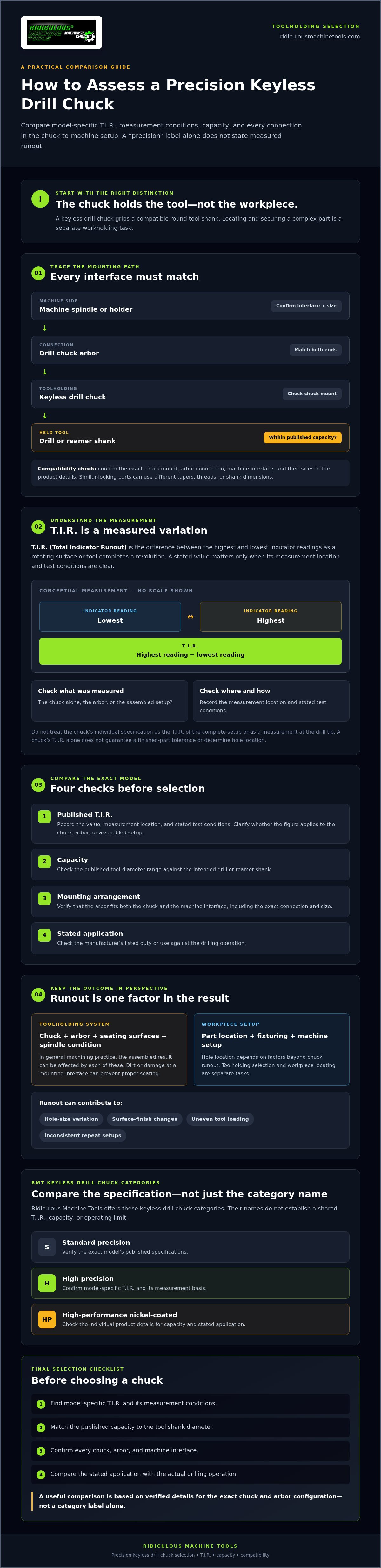
Select a chuck by working through the operation, not by starting with a precision label. Define the drilling duty, confirm the drill’s shank diameter, check the chuck-to-arbor and arbor-to-machine interfaces, then compare verified specifications for the exact configuration.
Match Precision Level to Holemaking Requirements
Start with the part feature and process: What hole quality is required? How consistently must holes repeat, and what will inspection measure? These requirements help determine how important chuck runout is, but they don’t identify a suitable product tier by themselves. Compare stated T.I.R. only when the measurement basis and chuck configuration are clear. RMT’s Tool Holding: Precision Machining Selection Guide provides broader context for choosing among toolholder types.
Check Setup Conditions Before Blaming the Chuck
If a setup shows unexpected runout or inconsistent drilling, inspect the full stack before drawing conclusions. Clean and check the chuck-arbor and arbor-machine seating surfaces. Examine the drill and its shank for damage or contamination, and assess setup rigidity. A reading from the assembled setup includes more than the chuck. Troubleshooting can help isolate possible causes, but it doesn’t by itself establish that a product is defective or outside its stated specification.
Use the selection sequence to narrow the requirements, then verify the exact model details before choosing. Compare RMT keyless drill chuck options against your tooling interfaces and drilling requirements.
RMT Keyless Drill Chucks and the Next Product Checks
Ridiculous Machine Tools offers standard precision, high precision, and high-performance nickel-coated keyless drill chuck categories. These categories provide a starting point, but they don’t replace checking the specifications for the exact model. Compare a precision keyless drill chuck by its published capacity, mounting arrangement, T.I.R. if stated, and operating information relevant to the job.
What to Verify on an RMT Product Page
Before selecting a chuck, confirm its stated tool capacity and mounting requirements. Check whether the page publishes T.I.R. and what the figure applies to. Then verify that the arbor’s chuck-side connection matches the chuck and that its machine-side interface suits the spindle or holder. RMT offers Morse Taper, R8, straight-shank, and threaded drill chuck arbor categories. Compatibility depends on the specific configuration, not the category name alone. Use the applicable product pages for current specifications, price, and other purchasing details.
Selecting the Next Step for Your Setup
Compare chuck categories against the process requirements you established: tool size, drilling duty, and how much runout matters to the result. For broader tooling context, consult RMT’s Tool Holding: Precision Machining Selection Guide alongside the chuck and arbor details. Specifications vary by model, so keep the comparison tied to the actual items under consideration.
Review current chuck and arbor product details before settling on a configuration. Ridiculous Machine Tools offers options across these categories, with product-specific information to support an informed comparison. Match the documented specifications to the operation, then confirm every interface.
Choose the Setup by Verified Specifications
Choose a precision keyless drill chuck by its published, model-specific T.I.R., capacity, and stated application, not by its label alone. Confirm that the chuck, arbor, and machine interfaces match, then assess the assembled setup before attributing runout to one component. The chuck holds the drill; a suitable fixture locates and secures the complex workpiece.
Ridiculous Machine Tools offers standard precision, high precision, and high-performance nickel-coated chuck categories, plus Morse Taper, R8, threaded, and straight-shank arbor categories. These names help narrow your search, but the current product details determine capacity, mounting fit, and applicable performance claims. Check each component’s specifications before pairing them. This keeps the selection tied to your drilling requirements rather than appearance or assumption.
Review RMT keyless drill chucks and compatible arbor options to compare current product details and identify a configuration that fits your setup. Confirm the interfaces and specifications before choosing.
Frequently Asked Questions
What is a precision keyless drill chuck?
A precision keyless drill chuck is a hand-tightened chuck for gripping compatible round-shank drills and similar tooling. Judge its precision by measured specifications such as T.I.R. The word “precision” alone doesn’t establish a runout value or explain how it was measured. Check the exact model’s published T.I.R., capacity, mounting arrangement, and stated application. Also consider the arbor and machine interface, since the chuck is only one part of the assembled setup.
Is a keyless drill chuck suitable for a milling machine?
A keyless drill chuck may be suitable for drilling on a milling machine if its mounting interfaces, capacity, and operating specifications match the machine and operation. It isn’t a general-purpose holder for milling cutters: side loads and cutting forces differ from drilling. Use a holder intended for the cutter and operation, and check the machine and chuck manufacturer’s limits before running the setup. Secure the workpiece with suitable workholding.
How do I check runout on a keyless drill chuck?
With the machine stopped and the setup secured, place an indicator against a suitable cylindrical surface, such as a straight drill shank held in the chuck. Rotate the spindle by hand and note the highest and lowest readings. Their difference is the indicated variation at that measurement point. Record where you measured and which components were assembled. This is a system reading, not necessarily the chuck’s standalone T.I.R. specification.
Can I use any drill chuck arbor with a keyless chuck?
No. The arbor must match the chuck’s mounting connection on one end and the machine spindle or holder interface on the other. Check the specific connection type and size, not just the arbor’s general appearance. Morse Taper, R8, threaded, and straight-shank arbors serve different interfaces. Confirm the chuck-to-arbor fit and arbor-to-machine fit in the applicable product details before ordering or assembling the tooling.
What is the difference between a standard and high precision keyless drill chuck?
The category label indicates a product tier, but it doesn’t provide a comparable runout value by itself. To assess a standard versus high precision keyless drill chuck, compare published T.I.R. values for the exact models and check the measurement location, conditions, capacity, and mounting configuration. If a listing omits those details, the label alone can’t establish which chuck better suits the operation. Match documented specifications to the holemaking requirements.
Why does my drill run off-center in a keyless chuck?
Possible causes include debris or damage on the drill shank, uneven jaw contact, a bent drill, contamination at a mounting surface, or runout elsewhere in the arbor or spindle. Remove and inspect the drill and accessible interfaces, then reseat the tool and check runout at a consistent location with an indicator. A reading from the assembled setup doesn’t identify the cause by itself, so isolate components before concluding the chuck is out of specification.
Article by
Ridiculous Machine Tools Technical Team
The Ridiculous Machine Tools Technical Team provides practical information about precision machine tooling, CNC tooling, workholding, and related manufacturing applications. RMT focuses on helping machinists, manufacturers, fabricators, and other customers understand tooling specifications, compatibility, selection, and proper application. Our technical content draws on product specifications, industry knowledge, and RMT's quality-control experience to provide clear, useful information for selecting and using machine tooling and workholding products.
Ridiculous Machine Tools — Machinist's Choice™