
Choosing the right toolholding system for tight tolerance cnc milling: Everything You Need to Know
Posted by RMT on Oct 21st 2026
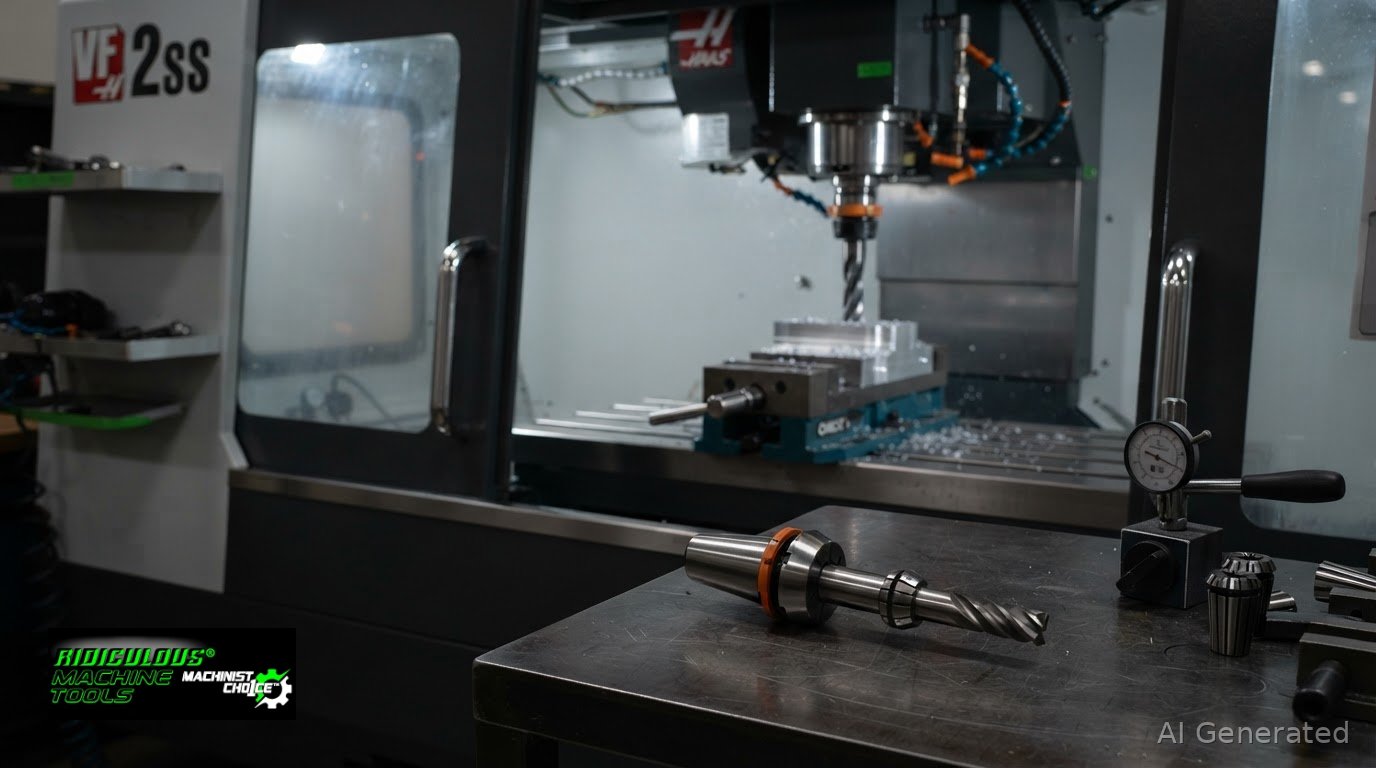
Choosing the right toolholding system for tight tolerance cnc milling starts with matching the spindle interface, holder, gripping component, and cutter shank. A low-runout holder alone cannot ensure consistent results if another connection is incompatible, dirty, damaged, or poorly assembled.
Start with the machine interface and tool shank, then consider the operation, required tolerance, tool projection, and retention method. An ER collet chuck holds compatible shanks through a matching collet; an end mill holder grips a matching shank directly. The right setup depends on the complete assembly and the cut.
This guide explains how to compare holder types, check compatibility, interpret T.I.R. specifications, and make practical setup decisions for tolerance-sensitive milling.
Key Takeaways
- Toolholding secures the cutter; workholding locates and restrains the workpiece. Both affect the cut, but solve different setup problems.
- A holder’s stated taper-to-bore T.I.R. does not describe runout at the cutting edge in the assembled system.
- Start with the spindle interface, tool shank, operation, and process tolerance before comparing holder configurations.
- Compare ER collet chucks and end mill holders by shank fit, access, retention, and the specifications listed for the specific product.
What Toolholding Means for Tight-Tolerance CNC Milling
Toolholding is the mechanical chain between the machine spindle and the cutter. It supports the tool, transmits spindle rotation and cutting forces, and helps maintain the cutter’s position during a pass. The complete system includes the spindle interface, holder, retention method, gripping component, and cutting-tool shank.
Toolholding is separate from workholding. The toolholder secures the cutter; a vise, fixture, or other workholding device locates and restrains the workpiece. Both influence machining results, but they address different parts of the setup. A suitable holder can support consistency, but it cannot guarantee a finished-part tolerance. Machine condition, cutter geometry and wear, toolpath, cutting conditions, and workpiece stability also affect the result.
Which parts make up a CNC milling toolholding system?
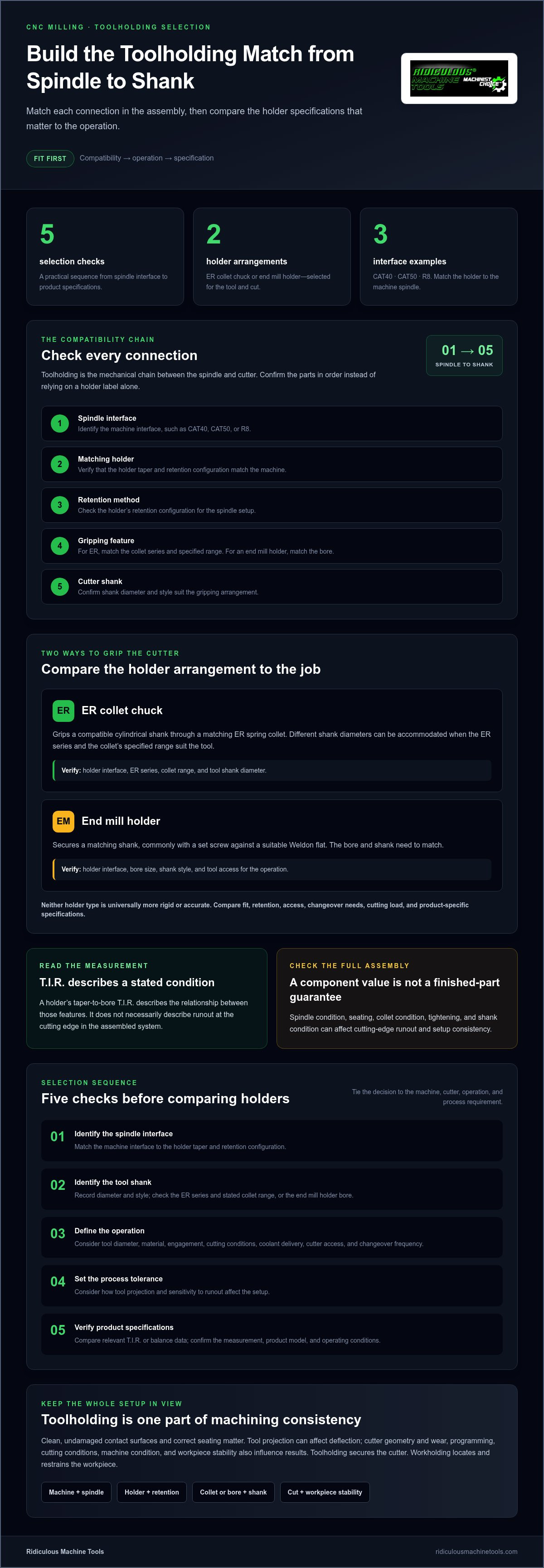
Check compatibility from the spindle outward: spindle taper and interface, matching holder, retention method, gripping feature, and cutter shank. An ER setup, for example, needs a holder with the correct spindle interface, a compatible ER series, and a collet whose specified range includes the tool shank diameter. An end mill holder needs a matching bore and suitable shank, often with a Weldon flat for the set screw. ER collet chucks and end mill holders use different gripping arrangements. Verify each connection and dimension rather than assuming that similar-looking components will fit.
Why does the system matter when tolerances are tight?
Runout can cause the flutes to share the cut unevenly. Excessive tool projection can increase deflection, and inadequate retention can allow the cutter to shift under load. Contact-surface condition, component seating, and repeatable tightening also affect setup consistency. These are important factors, but a suitable holder cannot compensate for spindle problems, a worn or unsuitable cutter, incorrect programming, or a workpiece that moves in its fixture. Consider the whole setup when choosing the right toolholding system for tight tolerance CNC milling.
How Runout, Tool Retention, and Compatibility Affect Milling
T.I.R. (Total Indicator Runout) is the total indicated variation measured as a part rotates against an indicator. Interpret the value according to what was measured. A holder’s taper-to-bore runout describes the relationship between those features; it does not necessarily represent runout at the cutting edge after the holder, collet, tool, and spindle are assembled. A holder specification applies to the stated product and measurement condition.
ER collet chuck or end mill holder?
An ER collet chuck grips a compatible cylindrical shank through a matching ER spring collet. It can accommodate different shank diameters when the collet series and specified collapsible range suit each tool. An end mill holder secures a matching shank, commonly with a set screw against a suitable Weldon flat. Choose between them based on tool geometry, changeover needs, cutting load, and access. Neither type is universally more rigid or accurate. Compare the actual setup with the job and the available end mill holder options.
What does a published T.I.R. value tell you?
Read the measurement description along with the value. Confirm whether it applies to the holder, the taper-to-bore relationship, or another specified feature. Runout at the cutting edge also depends on the spindle, clean and undamaged contact surfaces, collet condition and seating, tightening, and shank condition. A component specification does not guarantee assembled runout or finished-part tolerance.
Tool projection is another selection factor. Greater stickout can increase deflection under cutting forces, while the retention method must suit the tool shank and operation. Keep mating surfaces clean, seat the collet correctly, and follow the holder maker’s tightening instructions. For spindle-interface background, MSC Industrial Supply Co. explains CNC tapers and toolholder connections. These checks help make the selection based on fit and measured conditions rather than the holder category alone.
A Practical Selection Process for Tight-Tolerance CNC Milling
Use a consistent sequence to narrow the options. It keeps the decision tied to the machine, cutter, and operation rather than the holder label alone.
- Identify the spindle interface. Match the machine’s interface, such as CAT40, CAT50, or R8, to the holder taper and retention configuration.
- Identify the tool shank. Record the tool diameter and shank style. For an ER setup, match the holder’s ER series and the collet’s stated range to the shank. For an end mill holder, match the bore to the shank.
- Define the operation. Consider tool diameter, material, engagement, cutting conditions, coolant delivery, cutter access, and how often the tool needs to be changed.
- Set the tolerance requirement. Establish the process requirement, then consider how tool projection and the cut’s sensitivity to runout affect the setup.
- Verify product specifications. Compare T.I.R. or balance data when relevant, and confirm the measurement, product model, and applicable operating conditions.
Match the holder to the spindle and cutting tool
Spindle interface and shank dimensions are basic compatibility checks. A CAT40 holder does not match a CAT50 spindle, and an ER collet must match the holder’s ER series and suit the tool diameter within its specified range. Review RMT’s ER spring collet options by series, size, and listed specifications. A nominal diameter alone does not establish compatibility.
Select specifications around the operation
Long projection can increase deflection, while cutter access may limit holder size or shape. Consider engagement and cutting forces alongside spindle speed and coolant needs. Balance specifications are relevant when they apply to the speed and setup, but confirm that the stated data covers the exact holder configuration. For a direct shank-gripping option, compare the tool dimensions and operation with the listed end mill holder configurations. A useful selection accounts for both compatibility and the product’s documented specifications.
Compare ER collet chuck configurations
Applying the Selection Framework to RMT Toolholding Options
Ridiculous Machine Tools offers ER collet chucks and end mill holders in different spindle interfaces and configurations. Start by matching the machine and cutter, then compare the specifications published for the specific product. A category name alone does not establish fit or describe runout across the assembled system.
When an RMT ER collet system fits the selection criteria
An ER setup pairs a spindle-mounted ER collet chuck with an ER spring collet that matches the chuck series and tool-shank diameter. This arrangement can suit cylindrical shanks within the collet’s specified range. An end mill holder instead requires a matching bore and suitable shank. RMT offers CAT40, CAT50, and R8 end mill holders. Confirm the machine interface, shank fit, and exact holder configuration before selecting one.
| System type | Interface to verify | Tool-shank fit | Specification to inspect |
|---|---|---|---|
| ER collet chuck | Machine taper and ER series | Shank diameter within the compatible collet’s stated range | Applicable T.I.R., balance, and coolant configuration |
| End mill holder | Machine taper and holder configuration | Matching bore and appropriate shank style | Applicable T.I.R. and other listed product details |
Compare the relevant specifications before ordering
Use the individual product listing to check taper, size, stated T.I.R., balance, and coolant configuration. Treat T.I.R. figures as specific to the product and measurement, not as a promise of assembled runout or finished-part tolerance. RMT’s ER spring collets include multiple precision levels. Compare the published specification for the exact collet instead of applying one figure across the category. Match each connection, then assess the listed specifications in relation to the cut.
Compare RMT toolholding options
Put the Selection to Work on Your Next Setup
Make the selection repeatable by recording the holder configuration and relevant product specifications with the tool and operation. That gives future setups a clear reference and helps distinguish a tooling change from other process changes.
Ridiculous Machine Tools provides USA-based quality control and inspection according to each product’s established specifications. Compare the applicable listings and select the option that matches your machine and cutter requirements.
Browse RMT machine-tool accessories to compare toolholding options for your setup.
Use measured results from the cut to refine the process and guide future tooling decisions.
Frequently Asked Questions
Can a toolholder alone guarantee a tight-tolerance milled part?
No. A holder is one part of the process, not a guarantee of the finished dimension. A stable toolholding setup will not correct thermal growth, tool wear, or a workpiece shifting during a finishing pass. If a part moves out of tolerance, review the complete process, including machine condition, cutter condition, offsets, cutting parameters, and workpiece support.
Does a toolholder’s stated T.I.R. equal the runout of the installed cutting tool?
No. A stated T.I.R. applies to the feature and measurement condition named in the specification. To assess a particular setup, measure the assembled holder, gripping component, and cutter at a consistent point on the shank, then near the cutting end if access allows. Comparing readings can help identify where variation enters the assembly. Follow appropriate shop procedures and instrument guidance.
How do I choose between an ER collet chuck and an end mill holder?
Choose based on the cutter shank and demands of the job. An ER collet chuck can hold compatible shank diameters using matching collets, which can be useful when a tool library includes different diameters. An end mill holder suits a matching shank and retention arrangement, such as a Weldon flat. For tight-tolerance CNC milling, weigh tool changes, access, stickout, and cutting load against the specific setup.
How often should I inspect an ER spring collet?
Inspect it before installation and when a tool slips, runout changes unexpectedly, or the finish deteriorates. Check for chips in the slots, burrs, cracks, corrosion, and wear or damage on the gripping surfaces. Clean it according to the maker’s guidance, and remove damaged collets from service. Inspection frequency during production depends on use and cutting conditions, so follow shop procedures and the product manufacturer’s recommendations.
Article by
Ridiculous Machine Tools Technical Team
The Ridiculous Machine Tools Technical Team provides practical information about precision machine tooling, CNC tooling, workholding, and related manufacturing applications. RMT focuses on helping machinists, manufacturers, fabricators, and other customers understand tooling specifications, compatibility, selection, and proper application. Our technical content draws on product specifications, industry knowledge, and RMT's quality-control experience to provide clear, useful information for selecting and using machine tooling and workholding products.
Ridiculous Machine Tools — Machinist's Choice™