
Bison vs Import Morse Taper Sleeves: Which to Choose?
Posted by RMT on Oct 8th 2026
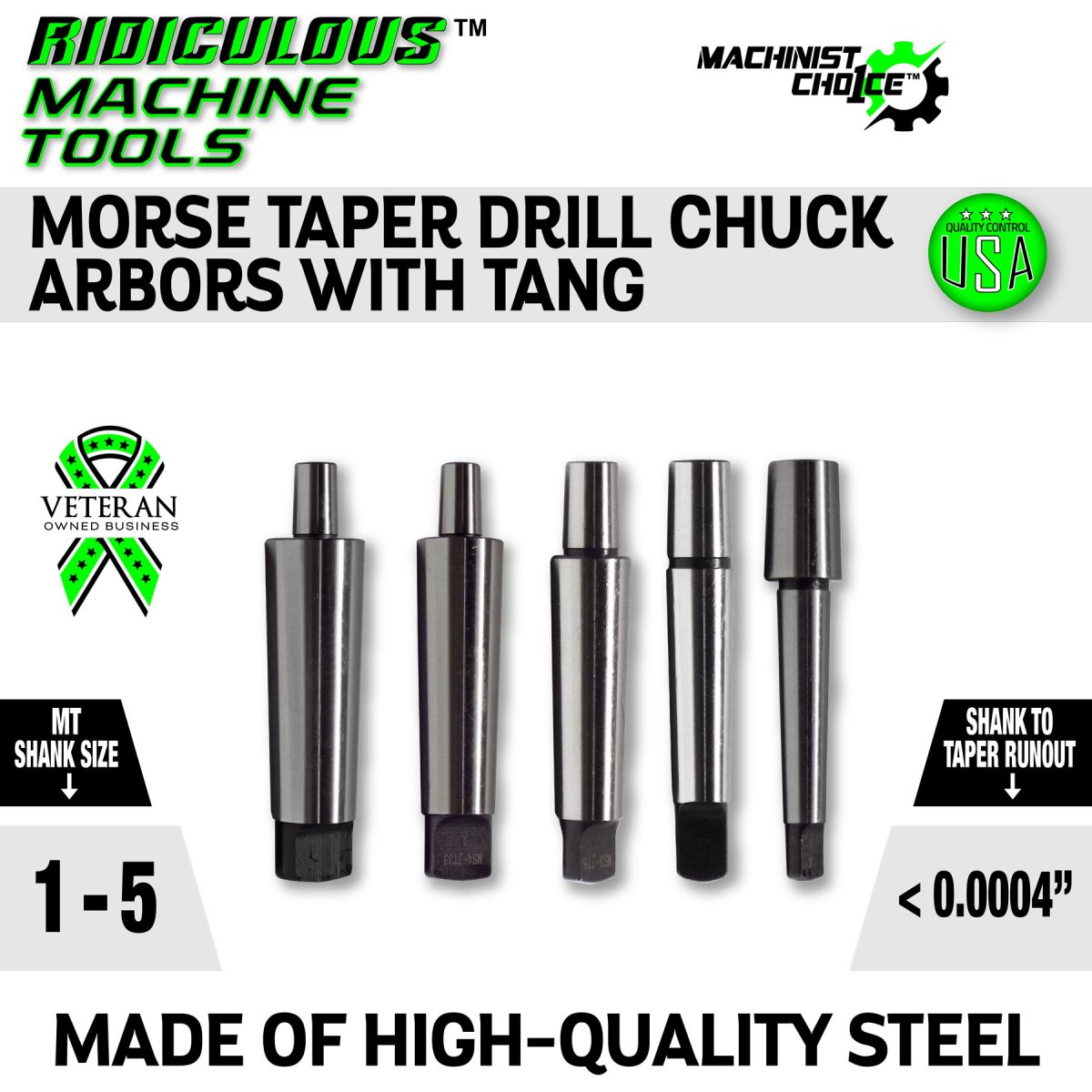
An imported Morse Taper drill adapter may not substitute for a Bison Morse Taper sleeve because the names can describe different connections. If you’re weighing bison morse taper sleeves vs import morse taper drill adapters, start by identifying what each part needs to connect. A reducing sleeve fits a smaller Morse Taper shank into a larger Morse Taper socket, such as MT2 into MT3. A drill chuck arbor connects a compatible spindle or holder to a drill chuck interface.
This comparison explains the difference and shows what to check before ordering: male and female taper sizes, any Jacobs Taper or threaded connection, and published details about dimensions, runout, material, or standards. Those details help you assess fit and compare documented specifications. A brand name or country of origin alone does not confirm compatibility or performance.
Key Takeaways
- Don’t assume a Morse Taper sleeve and a drill chuck arbor do the same job. Match the part to the connection your setup needs.
- Use “bison morse taper sleeves vs import morse taper drill adapters” as a starting point, then confirm the exact taper sizes and interfaces for each product.
- Compare model-specific dimensions and published specifications. Separate manufacturer data from seller claims, and note when information is missing.
- Before ordering, check whether your setup uses a tang, threaded connection, or another stated retention arrangement.
Bison Morse Taper Sleeves vs. Import Drill Adapters: What Is Each Part For?
The names alone don’t tell you whether a Bison Morse Taper sleeve and an imported drill adapter do the same job or fit the same machine. A sleeve typically joins two Morse Taper interfaces of different sizes. A drill chuck arbor connects a compatible spindle or holder to a drill chuck, often through a specified Jacobs Taper interface. Confirm the actual configuration before comparing products.
How a Morse Taper sleeve differs from a drill chuck adapter
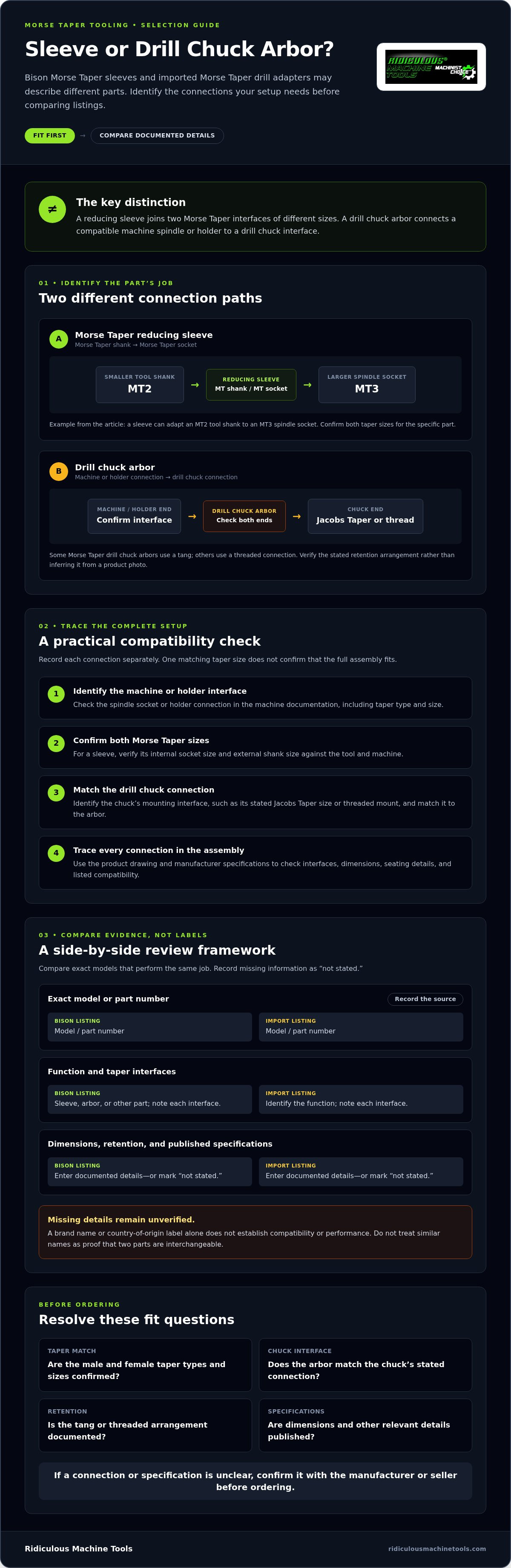
A reducing sleeve has an internal Morse Taper socket and an external Morse Taper shank. For example, it can adapt an MT2 tool shank to an MT3 spindle socket. Both connections are Morse Taper interfaces.
A drill chuck arbor serves a different purpose. It connects the machine or holder to a compatible drill chuck. Both ends must match the equipment: check the machine-side interface and the chuck-side connection. Some Morse Taper drill chuck arbors use a tang, while others use a threaded connection. Check the product listing rather than assuming that every arbor uses the same retention arrangement. For background on the taper system, see this Morse taper overview.
Why the product label is not enough
“Bison,” “import,” “sleeve,” and “adapter” identify a brand, an origin claim, or a broad product category. None confirms the exact taper sizes, mating interfaces, dimensions, or published specifications. Products with similar names may still be different components.
The mating taper interfaces, not the product labels, establish basic fit. For a useful bison morse taper sleeves vs import morse taper drill adapters comparison, check the documentation for each exact model. Record the male and female taper sizes, chuck connection, and any stated dimensions or specifications. Treat missing details as unverified, not as evidence that two parts are interchangeable.
Check Taper Sizes and Interfaces Before Comparing Specifications
Check the full connection path before weighing brand or price. Write down each interface separately, then confirm that every adapter or arbor matches the component it connects to.
A practical compatibility check for the machine and chuck
- 1. Identify the machine or holder interface. Check the spindle socket or holder connection in the machine documentation, including the specified taper type and size.
- 2. Confirm the Morse Taper size. For a sleeve, verify the internal socket size and external shank size against the tool and machine.
- 3. Check the chuck connection. Identify the drill chuck’s mounting interface, such as its stated Jacobs Taper size or threaded mount, and match it to the arbor.
- 4. Trace every connection. Confirm that the machine, intermediate component, and chuck form a compatible chain. Use the product drawing and manufacturer specifications to check dimensions, seating details, and listed compatibility.
One matching taper size does not confirm that the full assembly fits. The other end of the component, its dimensions, and the chuck connection must also match.
When tang and threaded arbor details matter
Retention and removal depend on the spindle and arbor configuration. A Morse Taper drill chuck arbor may be listed with a tang or a threaded connection. Confirm which arrangement your machine and chuck setup requires. Don’t infer the retention method from a product photo. Look for it in the description, drawing, or manufacturer documentation.
For the bison morse taper sleeves vs import morse taper drill adapters comparison, treat any missing interface, dimension, or retention detail as unresolved. Ask the manufacturer or seller to confirm the specification before ordering instead of guessing from the product name. Ridiculous Machine Tools lists machine-tool accessories and drill chuck arbor configurations. Check the applicable product details against your setup.
Compare Bison and Import Options Using Evidence, Not Assumptions
Start with exact models that perform the same job. A reducing sleeve and a drill chuck arbor aren’t equivalent products, even if a listing calls both an “adapter.” Use the table to compare manufacturer documentation and seller listings side by side. Mark absent details as “not stated” instead of filling gaps with assumptions.
| Check | Bison listing | Import listing |
|---|---|---|
| Exact model or part number | Record from manufacturer documentation | Record from manufacturer or seller listing |
| Function and taper sizes | Identify sleeve, arbor, or other adapter; note each interface | Identify function; note each interface |
| Dimensions and retention | Record documented dimensions and stated retention details | Record documented dimensions and stated retention details |
| Published specifications | List stated material, hardness, runout, or standard, if provided | List stated material, hardness, runout, or standard, if provided |
| Evidence and origin | Separate manufacturer-published facts from seller claims | Verify manufacturer and country of origin; don’t infer them |
Which product details are meaningful in a shop
Fit and retention details help establish whether the assembly seats and stays connected as intended. For repeatable setup or drilling work, compare the documented taper interfaces and retention arrangement first. Consider runout, material, or hardness only when the source provides product-specific information. A manufacturer-published specification is verifiable product information; an unsupported marketplace claim is not.
How to assess value without a brand shortcut
In a bison morse taper sleeves vs import morse taper drill adapters comparison, compare prices only after confirming equivalent function, taper sizes, and configuration in current listings. A lower listed price is not a like-for-like comparison if one item is a sleeve and the other is an arbor. Treat country of origin as a detail to verify, not as evidence of accuracy, durability, or suitability. If key specifications are missing, ask the seller or manufacturer before drawing a conclusion.
Review Morse Taper adapter and drill chuck arbor options.
Choose the Right Morse Taper Tooling and Confirm the Order
Choose by function first, then confirm every mating interface and compare the specifications published for the exact model. A brand name or “adapter” label can’t confirm fit. For the bison morse taper sleeves vs import morse taper drill adapters decision, choose the component that matches the machine and chuck setup. Ask the seller or manufacturer to resolve conflicting or incomplete listing details before ordering.
A pre-purchase checklist for Morse Taper components
- Confirm the machine-side spindle or holder interface and required Morse Taper size.
- Identify the component’s function: reducing sleeve, drill chuck arbor, or another adapter.
- For a drill chuck setup, verify the chuck-side connection and stated retention arrangement, such as tang or threaded.
- Check the applicable product page or drawing for dimensions, seating details, listed compatibility, and any published runout specification.
- Confirm that the assembled configuration suits the machine and intended operation. If listing details conflict, get clarification before purchasing.
Ridiculous Machine Tools offers Morse Taper adapters and drill chuck arbors in tang and threaded configurations. These are relevant product categories to review, not evidence that an arbor is equivalent to a Bison sleeve. Check each product’s specifications against your required interfaces. For broader tooling selection context, consult the Tool Holding: Precision Machining Selection Guide alongside the product documentation.
Review Morse Taper adapter options.
Make the Fit the Deciding Factor
Choose Morse Taper tooling by function, confirmed interfaces, and documented specifications, not by brand or origin label alone. A sleeve and a drill chuck arbor can connect different components, so they aren’t interchangeable just because a listing calls both an adapter. For the bison morse taper sleeves vs import morse taper drill adapters comparison, exact model details are the basis for a meaningful decision.
Ridiculous Machine Tools offers Morse Taper and Jacobs Taper adapters, along with Morse Taper drill chuck arbors in tang and threaded configurations. Fit and specifications vary by product and configuration, so check the product information against your machine, chuck, and intended operation. Resolve unclear or conflicting listing details with the seller or manufacturer before ordering.
With the interfaces confirmed, compare options using the specifications available for each exact model. Review RMT Morse Taper tooling options.
Frequently Asked Questions
Are a Morse Taper sleeve and a Morse Taper drill chuck adapter the same thing?
Not necessarily. A Morse Taper sleeve joins specified Morse Taper interfaces, while a drill chuck adapter connects a compatible spindle or holder to a chuck setup. Some adapters include a Morse Taper interface, but that alone doesn’t make them equivalent to a sleeve. Compare the exact configuration, taper sizes, chuck connection, and manufacturer specifications. Confirm each interface against the machine and tooling documentation before ordering.
How do I know which Morse Taper size my machine uses?
Check the machine documentation, spindle information, or existing tooling for a confirmed Morse Taper size. Don’t identify a fit-critical size from appearance alone; similar-looking tapers don’t establish compatibility. Once confirmed, verify the adapter’s machine-side interface and chuck-side connection independently. If documentation is unavailable or a listing is unclear, contact the machine or tooling supplier and request confirmation for the specific machine and adapter model before ordering.
Can I use an imported Morse Taper drill adapter with a Bison sleeve?
Only if the documented interfaces and dimensions match the intended assembly. Confirm the sleeve’s mating tapers and the arbor’s relevant Morse Taper connection, along with any chuck interface and stated retention details. Brand or country of origin doesn’t establish compatibility. If either listing omits a fit-critical dimension or connection, ask the manufacturer or seller to confirm that the specific components are compatible before combining them.
What specifications should I compare when buying a Morse Taper adapter?
Start with the required Morse Taper size and the interface at each end. Then check dimensions, retention configuration, and any manufacturer-published runout or material information relevant to the application. Confirm that each specification applies to the exact model you’re considering. Missing values aren’t evidence that a product matches another model’s published specifications. Ask the seller about any fit-critical detail the listing doesn’t provide.
Does a lower-priced imported adapter offer the same value as a Bison sleeve?
Price alone can’t establish equivalent value. In a bison morse taper sleeves vs import morse taper drill adapters comparison, first confirm that the products perform the same function and match the same interfaces. Then assess current listing prices alongside documented specifications and product details. Don’t assume brand or country of origin predicts performance; base the decision on verified information for the exact models.
Article by
Ridiculous Machine Tools Technical Team
The Ridiculous Machine Tools Technical Team provides practical information about precision machine tooling, CNC tooling, workholding, and related manufacturing applications. RMT focuses on helping machinists, manufacturers, fabricators, and other customers understand tooling specifications, compatibility, selection, and proper application. Our technical content draws on product specifications, industry knowledge, and RMT's quality-control experience to provide clear, useful information for selecting and using machine tooling and workholding products.
Ridiculous Machine Tools — Machinist's Choice™