
Best TE-CO Toggle Clamp Alternatives for Workholding
Posted by RMT on Oct 6th 2026
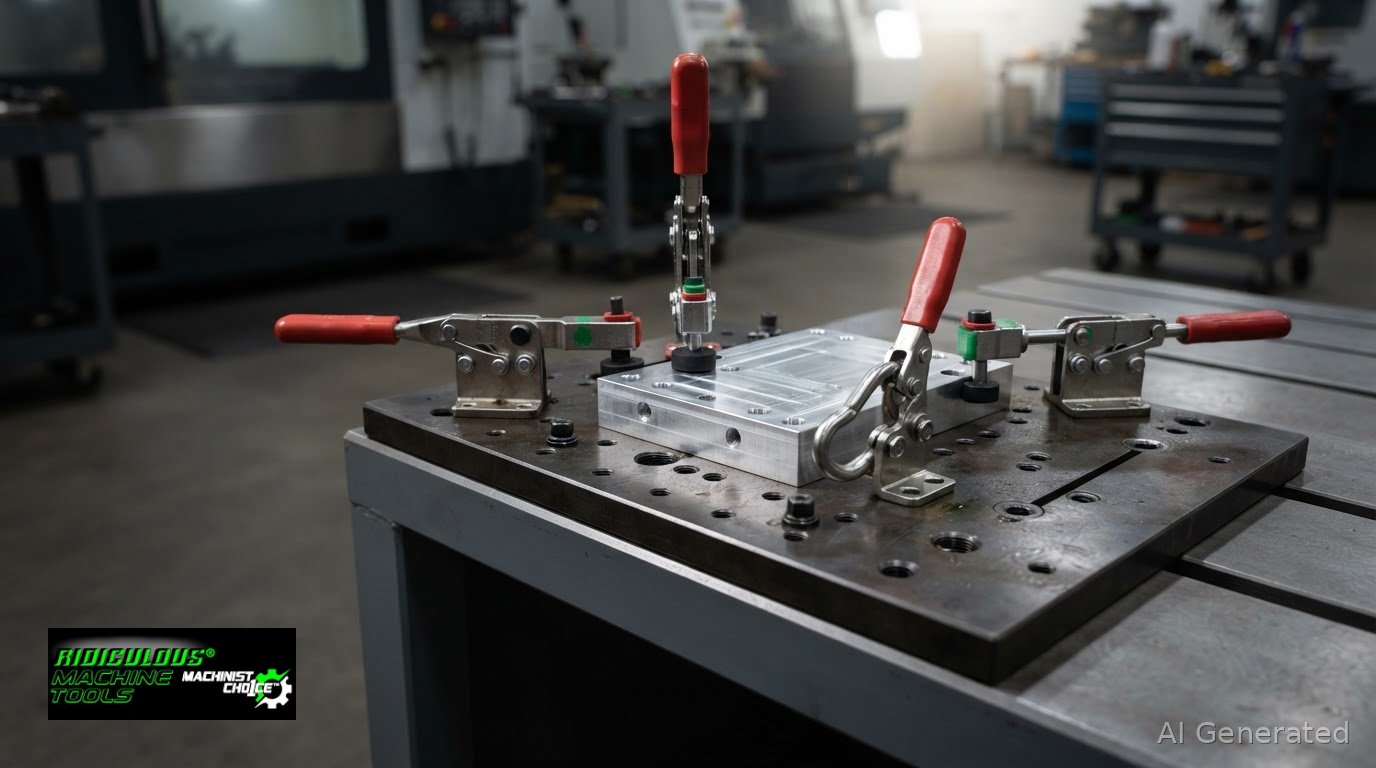
A clamp that matches the mounting holes can still change how a fixture loads, clears, or restrains a workpiece. Selecting te-co toggle clamp alternatives for industrial workholding takes more than comparing brand names. First identify the existing clamp’s motion, then check its mounting geometry, reach, operating clearance, and manufacturer-rated holding capacity.
Horizontal and vertical hold-down clamps, latches, and push-pull straight-line clamps each move differently. Even clamps that look similar can affect operator access, workpiece restraint, and fixture loading.
Use this comparison to identify the configuration your application calls for and the model-specific details to verify before ordering. Assess clamp types against your fixture and workpiece rather than assuming another brand’s product is a direct replacement.
Key Takeaways
- Choose an alternative by the job it must perform, not by brand name alone. The required clamp motion and workpiece contact narrow the options.
- For te-co toggle clamp alternatives for industrial workholding, compare handle position, force direction, and operator access before selecting a configuration.
- Check the original model, fixture footprint, hole pattern, contact reach, and handle clearance before treating another clamp as a fit.
- Verify each candidate’s manufacturer-rated holding capacity and model-specific mounting details. Similar-looking clamps may not meet the same requirements.
TE-CO Clamp Alternatives: Define the Task First
A suitable alternative meets the fixture’s verified requirements; it does not have to be a drop-in replacement. Start with the operation, such as machining, fabrication, welding, assembly, or inspection. Record where the workpiece sits, the direction it must be restrained, how it is loaded, and the clearance available for the handle or plunger. A clamp is a fastening device, but its motion and contact geometry determine how it functions in a particular fixture.
Keep the terminology precise. Holding capacity is the manufacturer’s stated maximum holding force or capacity. Clamping force is the force applied to the workpiece. These terms are not interchangeable, so compare candidates using the terminology and specifications published for each model.
Which details identify the existing TE-CO clamp?
Record the model marking and clamp type. Document the base arrangement, mounting pattern, and contact component, such as a spindle or hook. Measure the available space, reach, and operating clearances on the fixture. Do not estimate dimensions from a product photo or assume a similar-looking base has the same hole pattern.
What must an alternative preserve?
Define the required restraint direction, workpiece contact point, and operator access. A replacement that blocks loading or changes the contact location may disrupt the process, even if its base can be mounted. Separate must-match interfaces, such as hole spacing and reach, from features that can change without affecting the operation. Use these requirements to compare te-co toggle clamp alternatives for industrial workholding.
Use the requirements to screen manual toggle clamp configurations, then verify the chosen model’s specifications and mounting details before ordering. A category match is a starting point, not proof of direct TE-CO compatibility.
Compare Toggle Clamp Alternatives by Motion and Workpiece Contact
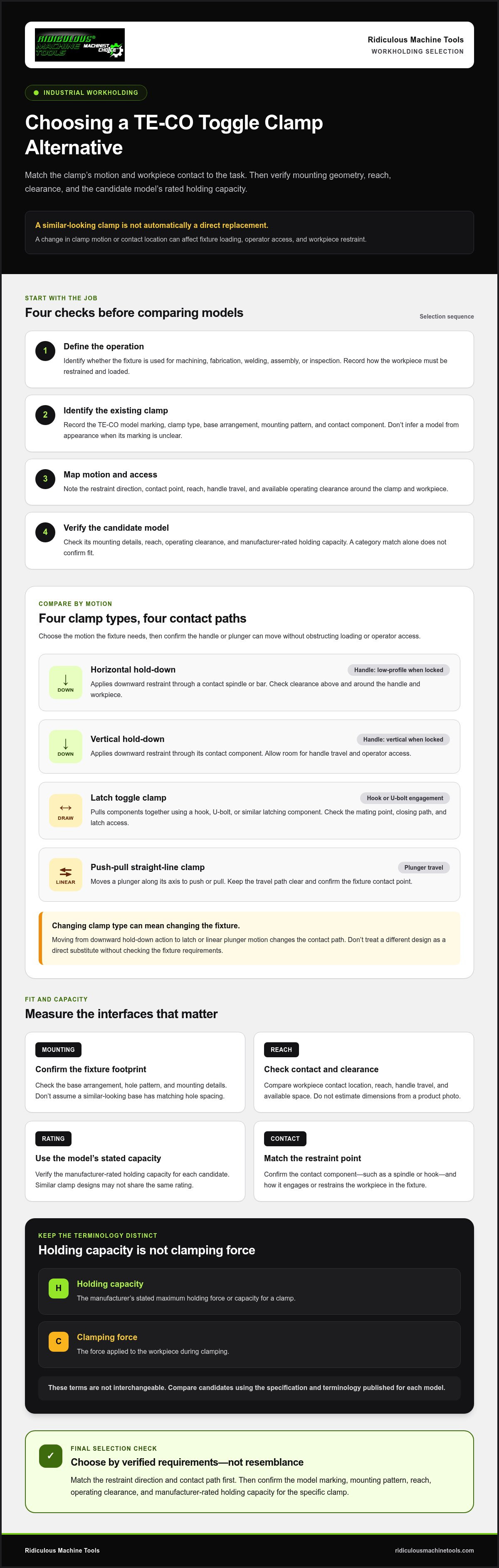
Match the clamp’s motion to the restraint the fixture needs, then check handle clearance and the contact point. These distinctions matter more than a similar outline. Changing from downward hold-down action to a latch or linear plunger may require a fixture change. The principles of workholding offer useful context for assessing how the clamp supports the workpiece during an operation.
| Clamp type | Handle position when locked | Motion and contact | Access to assess |
|---|---|---|---|
| Horizontal hold-down | Generally horizontal or low-profile | Applies downward restraint through a contact spindle or bar | Check clearance above and around the handle and workpiece |
| Vertical hold-down | Generally vertical | Applies downward restraint through its contact component | Allow room for handle travel and operator access |
| Latch | Varies by configuration | A hook or U-bolt engages a mating point to pull components together | Check hook engagement, closing path, and access to the latch |
| Push-pull straight-line | Varies by configuration | A plunger moves along its axis to push or pull | Keep the plunger path clear and confirm the fixture’s contact point |
Choose hold-down motion for access and restraint
Horizontal and vertical hold-downs both apply downward restraint, but their locked handle positions differ. A low-profile handle may work where overhead clearance is limited. A vertical handle needs room to move through its operating arc. For either type, confirm the specific model’s manufacturer-rated holding capacity, base, and mounting details.
Choose latch or plunger motion for the contact path
Consider latch motion when a hook or U-bolt must draw two components together, and check that it fits the mating point. Push-pull action may suit a fixture that calls for linear plunger travel. Over-center locking and mechanical advantage depend on linkage geometry and proper engagement, not clamp type alone. Review manual toggle clamp configurations against the required motion. Do not assume a different design is a direct substitute.
Verify Fit, Capacity, and Mounting for TE-CO Clamps
Use a consistent check when comparing te-co toggle clamp alternatives for industrial workholding. Matching the clamp type alone does not confirm that a candidate will mount correctly or restrain the workpiece as intended.
- Identify the clamp. Record its TE-CO model marking and configuration. If the marking is missing or unclear, do not infer the model from appearance.
- Record fixture requirements. Note the restraint direction, contact point, required reach, handle travel, and operating clearance. Include access limits during loading and unloading.
- Compare dimensions. Check the base style, footprint, hole pattern, fasteners, contact component, and reach against the fixture. Use measured dimensions and manufacturer drawings when available.
- Confirm specifications. Compare the manufacturer-rated holding capacity and relevant model details for the intended setup. Resolve missing or conflicting information before ordering.
Compare mounting geometry
Similar-looking clamps can differ in hole spacing, reach, mounting hardware, or accessory fit. Verify each interface rather than relying on a visual match. A mismatch may require fixture changes, and a different mounting position can affect handle clearance or the clamp’s contact location.
Assess capacity and operating conditions
Use the manufacturer’s stated holding-capacity terminology and note any conditions attached to the rating. Do not treat holding capacity as clamping force or assume a rating applies across models. Check the candidate’s material, spindle, base style, and mounting requirements in its product information. Changes to the contact position or linkage can alter workholding conditions, so review the assembled fixture before use.
Use this checklist to compare verified requirements with RMT manual toggle clamp options. Specifications vary by model, and a category match alone does not establish TE-CO compatibility.
Compare manual toggle clamp configurations
Evaluate RMT Toggle Clamp Alternatives Against Your Fixture Requirements
Once you have identified the required motion, mounting geometry, operating clearance, and manufacturer-rated holding capacity, use those criteria to narrow the clamp type. Ridiculous Machine Tools offers manual toggle clamp categories to assess against fixture requirements. These are options to compare, not confirmed TE-CO equivalents or guaranteed drop-in replacements.
Match the required motion to an available category
A horizontal hold-down clamp may suit a fixture that needs downward restraint and a generally low-profile handle position. Verify the specific model’s geometry and mounting details. Consider a vertical hold-down if its handle movement fits the available space, a latch clamp if a hook or U-bolt must engage a mating point, or a push-pull straight-line clamp if the task calls for plunger movement along its axis. Choose motion to suit the operation, not just the available mounting area.
Review the manual toggle clamp category to compare configurations. Select a type that matches the fixture’s task, then check the candidate model’s current product details against your recorded requirements.
When a direct fit cannot be confirmed
A category listing identifies a clamp style; it does not establish compatibility with a particular TE-CO model. Check the candidate’s base style, hole pattern, contact component, reach, handle clearance, and stated holding capacity. Confirm model-specific material and mounting details in the product information. If a required dimension or specification is not listed, seek confirmation rather than assuming the clamps interchange.
Before ordering, compare fixture measurements with the selected model’s current specifications. Consider whether a change to clamp position or motion affects workpiece restraint. This turns a general search for te-co toggle clamp alternatives for industrial workholding into an application-based selection.
Make the Next Clamp Choice on Verified Fit
A suitable substitute is defined by the job it performs, not by brand or appearance. For te-co toggle clamp alternatives for industrial workholding, confirm the required motion, mounting geometry, workpiece contact, operating clearance, and manufacturer-rated holding capacity before treating a candidate as compatible.
Ridiculous Machine Tools offers horizontal, vertical, latch, and push-pull manual toggle clamp categories to compare against fixture requirements. Specifications and mounting details vary by model, so check the current product information rather than assuming a category match means direct interchangeability.
Use your recorded fixture measurements to narrow the options and verify the selected model before ordering.
Compare RMT’s manual toggle clamp categories against your fixture requirements before selecting a model.
Frequently Asked Questions
Are TE-CO toggle clamps interchangeable with clamps from another manufacturer?
Not automatically. A substitute must suit the application and match required fixture interfaces, including mounting geometry, contact reach, operating motion, and clearance. Compare drawings and manufacturer specifications for the exact models before ordering. Similar appearance or the same clamp category does not establish interchangeability. If the contact position changes, reassess how the workpiece is restrained.
How do I choose an alternative for an existing TE-CO toggle clamp?
Identify the existing model and document its motion, mounting pattern, envelope, contact point, and required holding capacity. Then compare those requirements with candidate model specifications. For te-co toggle clamp alternatives for industrial workholding, do not estimate missing dimensions or ratings. Ask the supplier to confirm unavailable or conflicting information. Treat any fixture modification as a separate engineering decision, not as proof of compatibility.
Can I replace a horizontal hold-down clamp with a vertical toggle clamp?
Possibly, if the specific model fits the fixture and provides the required restraint. Handle position, operating clearance, mounting geometry, and workpiece contact can differ between models. Check the full operating path, not just the locked position. If the replacement changes the contact point or loading direction, reassess the fixture setup and confirm that the candidate’s specifications suit the application.
What does toggle clamp holding capacity mean?
Holding capacity is the manufacturer’s specified maximum holding force or capacity for a clamp. It is not automatically the same as clamping force, which describes force applied to the workpiece. Use the terminology and test conditions stated for the exact model. Do not assume a listed capacity applies to every clamp in a manufacturer’s product family or every fixture arrangement.
Which toggle clamp type should I use for a fixture?
Choose by required motion and contact direction. Horizontal and vertical hold-down clamps apply restraint in a hold-down arrangement; latch clamps draw components together; push-pull straight-line clamps move a plunger linearly. These categories help narrow the search, but they do not prove a model is suitable. Verify the candidate’s mounting, operating clearance, holding capacity, and application details before use.
Article by
Ridiculous Machine Tools Technical Team
The Ridiculous Machine Tools Technical Team provides practical information about precision machine tooling, CNC tooling, workholding, and related manufacturing applications. RMT focuses on helping machinists, manufacturers, fabricators, and other customers understand tooling specifications, compatibility, selection, and proper application. Our technical content draws on product specifications, industry knowledge, and RMT's quality-control experience to provide clear, useful information for selecting and using machine tooling and workholding products.
Ridiculous Machine Tools — Machinist's Choice™