
1/4 20 tap bit size Best Practices and Expert Advice
Posted by RMT on Oct 27th 2026
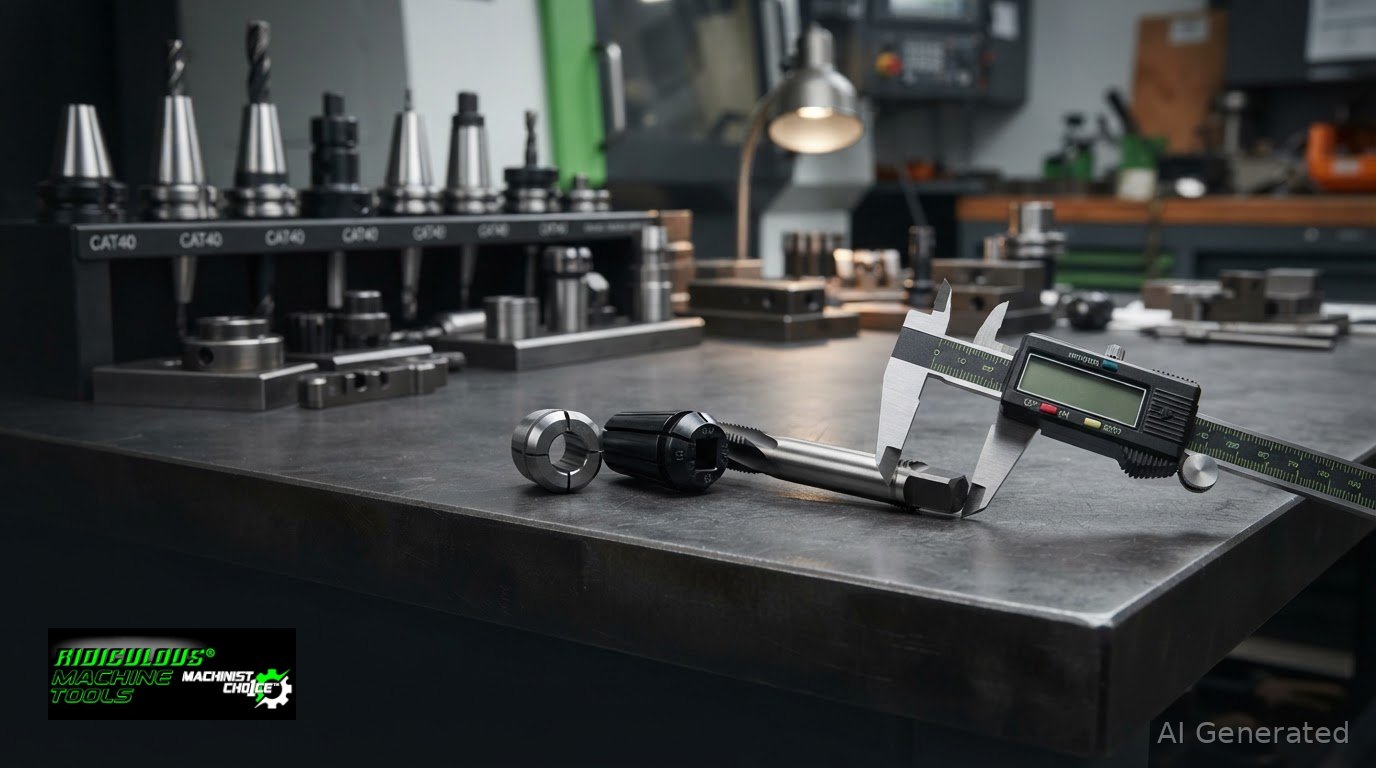
Select an ER tap collet by matching its clamping range to the tap’s shank diameter and its internal square drive to the tap’s square. Standard ER collets have a 1 mm clamping range, so the tap’s thread size alone doesn’t determine the collet size.
A close fit helps the collet grip the tool, while the square drive transfers torque to the tap. This guide explains how to compare metric and imperial tap dimensions with collet sizing, distinguish the tap shank from its square-drive end, and choose a compatible ER tap collet for your application.
Key Takeaways
- Match the collet’s clamping range to the tap’s shank diameter, rather than choosing by thread size alone.
- For tapping, account for both the round shank and the square drive that transfers torque.
- Choose metric or inch sizing to match the tap shank, then compare the actual diameter with the collet’s stated range.
- Read the ER series designation as a collet-system size, not as the tap diameter to be held.
Choosing a collet close to the tool diameter
Match the collet’s working range to the tap or cutter shank, then match its ER series to the chuck. An ER tap collet sizing guide starts with these two compatibility checks.
Matching the Collet to Tap Shank Diameter
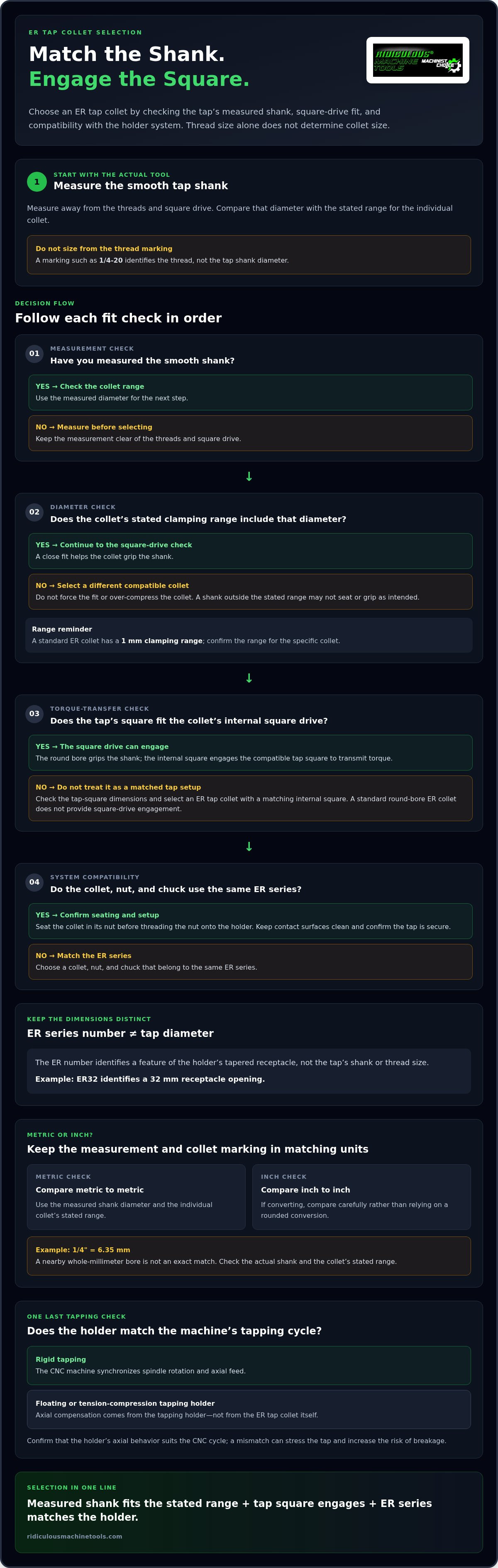
Measure the smooth tap shank with a caliper, away from the threads and square drive. Select an individual collet whose stated range includes that measured diameter. A standard ER collet’s clamping range is 1 mm, but confirm the range for the specific collet. The thread designation, such as 1/4-20, doesn’t establish the tap’s shank diameter. Accurate measurement helps prevent selecting a bore that cannot grip the shank as intended.
Selecting Collets for Tapping and Milling
For milling, match the collet bore to the cutter’s straight shank and the chuck’s ER series. For tapping, check both the round shank and the square-drive geometry. An ER tap collet with an internal square drive engages a compatible tap’s square; a standard round-bore collet does not. Seat the collet in its nut before threading the nut onto the holder. Tighten to the torque specified for that holder and nut, rather than assuming one value applies to every ER size.
An ER tap collet sizing guide also distinguishes collet selection from axial compensation. The collet grips and drives the tap, but does not itself compensate for axial movement. The tapping holder and machine cycle determine how feed and rotation stay synchronized.
Risks of Incorrect Collet Sizing
A tap smaller than the collet’s stated range may not be held securely, while a shank larger than that range can prevent proper seating. Either mismatch can cause slippage, poor concentricity, or added stress on the tap and workpiece. Don’t force the fit by over-compressing the collet. If the measured shank falls outside the stated range, choose a different compatible collet.
ER collet applications, including tapping
ER collet systems hold cutting tools by compressing a slotted collet inside a matching chuck. In milling, drilling, and tapping, the setup must suit the tool shank and operation, because clamping, runout, and concentricity affect how the tooling meets the workpiece.
An ER tap collet differs from a standard ER collet because it has an internal square drive. It grips a compatible tap’s round shank while engaging the square, helping transmit torque through the holder. A standard ER collet grips a round shank but does not provide that square-drive engagement.
That distinction matters during tapping. The square drive provides a positive path for torque, while the collet’s round bore centers and clamps the tap shank. Select the collet for the tap’s shank dimensions and square geometry, not just the thread’s nominal size. The tap and collet must also match the holder’s ER series.
An ER tap collet does not, by itself, compensate for axial movement. Axial compensation comes from a floating or tension-compression tapping holder, which allows controlled movement between spindle feed and tap advance. In a rigid tapping setup, the CNC machine synchronizes spindle rotation and axial feed. A mismatch can stress the tap and increase the risk of breakage.
For milling, a standard ER collet typically suits a compatible cylindrical tool shank, such as a straight-shank end mill. Cutting forces differ from tapping torque, so the operation, shank condition, and holder setup all matter. Clamping depends on correct seating and tightening; chips or damaged contact surfaces can affect runout.
Before running the machine, confirm that the ER collet, nut, and chuck belong to the same series. Seat the tool with sufficient shank engagement, then check that it is secure and the contact surfaces are clean. For tapping, confirm that the square drive engages fully and the holder’s axial behavior matches the CNC cycle. These checks help maintain concentricity and transmit torque as intended.
Metric and imperial collets
ER collets are marked in metric or inch dimensions. Choose based on the tool’s measured shank and the individual collet’s range. A practical ER tap collet sizing guide keeps the units consistent throughout selection.
Metric and Imperial Sizing
Metric and imperial sizing describe bore diameter in different units. Compare a metric tool measurement with a metric collet marking, or convert carefully before checking an inch-size collet. Avoid choosing based on a rounded conversion, since even a small mismatch can affect how evenly the collet contacts a drill, tap, or milling cutter.
For example, a 1/4" shank measures 6.35 mm, so a nearby whole-millimeter bore should not be treated as an exact match. Check the actual tool diameter and the collet’s stated clamping range. For tapping, also account for the tap’s square-drive dimensions.
Standard Sizes and Clamping Ranges
ER series offer different diameter capacities. ER collets are available in a range of metric clamping capacities, which vary by series.
Listed imperial capacities include ER11 at 0.019-0.275 inches, ER16 at 0.019-0.393 inches, ER20 at 0.039-0.511 inches, ER32 at 0.078-0.787 inches, and ER40 at 0.118-1.024 inches. These are series-level ranges; select the individual collet whose marked bore suits the tool rather than assuming every collet in that series covers the full capacity.
For a drill or milling cutter, consider shank engagement length when setting up. For a tap, verify both the shank fit and square engagement. This ER tap collet sizing guide approach keeps unit conversion separate from the physical fit checks.
What does ER tap collet size refer to?
The number in an ER designation refers to the opening diameter of the holder’s tapered receptacle, expressed in millimeters. For example, the numeral in ER32 identifies a 32 mm receptacle opening. It names a feature of the ER system, not a tap measurement.
The ER series commonly listed include ER8, ER11, ER16, ER20, ER25, ER32, ER40, and ER50. Read each suffix as a millimeter dimension associated with the tapered receptacle. ER20 therefore refers to a 20 mm opening, while ER25 refers to a 25 mm opening. These numerals identify different series rather than individual tap diameters.
That distinction matters because a tap has several dimensions. A 1/4-20 designation describes the thread, while the tap also has a shank and square drive. None of those tap dimensions is encoded in “ER20” or “ER32.” The ER number identifies the receptacle geometry shared by the corresponding holder and collet family.
Think of the ER label as a system identifier with a dimensional reference. ER16 and ER32 indicate different receptacle-opening sizes, not different thread pitches or tap capacities. The numeral is useful for identifying the ER format of a holder or collet, but it does not describe every dimension of that component.
Product labels can include both an ER series and a separate bore marking. These indicate different measurements: the series identifies the tapered receptacle opening, while the bore marking describes the collet’s internal opening. Distinguishing the two prevents a common labeling error and avoids mistaking the ER numeral for a tap’s nominal size.
For example, an ER32 marking points to the 32 mm receptacle dimension. It does not state that the tool, tap shank, or tap thread measures 32 mm. The ER designation describes the holder-system geometry; the tool’s own dimensions remain separate information.
That internal opening also helps explain the fit of a round tool or stock. ER collets can clamp round tools or stock that are 0.5-2 mm smaller than the collet’s internal diameter, depending on collet size. The series label and the bore marking therefore serve different purposes: one identifies the holder-system format, while the other helps establish the collet’s gripping range for the workpiece.
Ridiculous Machine Tools: Horizontal Toggle Clamps
Ridiculous Machine Tools supplies Horizontal Toggle Clamps for fixture setups that need a low-profile hold-down arrangement. These clamps address a different workholding need from ER tap collets: securing a workpiece during machining or related shop operations.
Choose a clamp style based on the fixture and the direction of restraint. Horizontal Toggle Clamps hold down a workpiece; Latch Toggle Clamps secure adjoining components; Vertical Toggle Clamps suit setups with a vertical handle position; and Push-Pull Straight Line Toggle Clamps apply force through linear plunger movement. Check the model’s mounting layout and specified holding capacity against the application.
For a tapping setup, select the ER tooling by tap shank and holder compatibility, then address workpiece restraint with suitable fixture hardware. Visit Ridiculous Machine Tools to review Horizontal Toggle Clamps.
Put the Right Tooling Into Your Next Setup
Use this ER tap collet sizing guide when planning tooling for a new job or reviewing an existing setup. Record the measured tap shank, square-drive fit, collet series, and holder interface in your setup notes. These details give operators a clear basis for selecting compatible tooling and repeating the setup.
Workholding is another part of setup planning. Ridiculous Machine Tools offers Horizontal Toggle Clamps, Latch Toggle Clamps, and Vertical Toggle Clamps for fixture applications. Match the clamp style to the required restraint and fixture layout, then compare relevant configurations using the product information.
To explore Ridiculous Machine Tools’ tooling and workholding products, visit the company’s website.
Build your next setup around clear measurements and compatible components, and move forward with confidence.
Frequently Asked Questions
How do you choose the correct ER tap collet size for a tap shank?
Use the tap’s measured shank diameter and the collet’s stated bore range to make the selection. For a 1/4-20 tap, don’t assume the 1/4" thread designation describes the shank. Check the tap drawing or measure the smooth shank directly, then verify the collet’s ER series matches the holder. For a square-drive tap, confirm that the square fits the collet’s drive feature.
Which ER collet size fits common tap shank diameters?
No single ER series corresponds to a particular tap thread size. ER11, ER16, ER20, ER25, ER32, and ER40 cover different shank capacities, while individual collets within each series have different bores. For example, choose the collet by comparing the actual shank diameter with its listed range, then confirm the ER series matches the chuck. Tap drawings help distinguish thread size from shank dimensions.
What are the recommended tightening torque and installation steps for ER tap collets?
There is no single torque value for all ER tap collets; use the value specified for the holder and nut. Fully engage the collet in the nut before threading it onto the holder, then seat the tap so its square drive engages fully and tighten as specified.
Article by
Ridiculous Machine Tools Technical Team
The Ridiculous Machine Tools Technical Team provides practical information about precision machine tooling, CNC tooling, workholding, and related manufacturing applications. RMT focuses on helping machinists, manufacturers, fabricators, and other customers understand tooling specifications, compatibility, selection, and proper application. Our technical content draws on product specifications, industry knowledge, and RMT's quality-control experience to provide clear, useful information for selecting and using machine tooling and workholding products.
Ridiculous Machine Tools — Machinist's Choice™